Vendor Document Checklist by Industry: Free Supplier Document Checklist
Different industries require different types of vendor documents.
A manufacturing supplier may need quality, safety, equipment, and statutory records, while a logistics provider may require transport-related documents, insurance, and operational records. Using the same document list for every vendor can create unnecessary work and may still leave important requirements unidentified.
A Vendor Document Checklist by Industry provides a structured starting point for identifying the documents and operational records that should be collected from vendors.
Our free Vendor Document Checklist by Industry helps you generate a practical checklist based on the industry you select.
Try the Free Vendor Document Checklist by Industry →
What Is a Vendor Document Checklist?
A vendor document checklist is a structured list of documents and records that an organization may request from a supplier, contractor, or service provider.
The checklist can help procurement and compliance teams organize requirements into areas such as:
- Core documents
- Operational records
- Recommended controls
- Compliance documentation
- Quality records
- Safety records
- Insurance documents
- Licences and certifications
The exact documents required depend on the vendor, industry, services provided, location, contract, site requirements, and applicable regulations.
Why Vendor Documents Matter
Vendor documentation helps organizations understand whether a supplier or contractor meets the requirements relevant to the business relationship.
A structured document process can help teams:
- Standardize vendor onboarding
- Identify missing documents
- Improve vendor visibility
- Support compliance reviews
- Prepare for audits
- Track operational requirements
- Reduce repeated email follow-ups
- Maintain better vendor records
Document collection should be treated as part of an ongoing vendor management process rather than only an onboarding activity.
Why the Checklist Should Be Industry-Specific
A vendor document checklist should reflect the nature of the supplier’s work.
For example, a manufacturing vendor may require documentation related to:
- Business registration
- Tax registration
- Quality management
- EHS requirements
- Equipment maintenance
- Calibration
- Insurance
- Vendor evaluation
A different industry may require a different set of documents.
Industry-specific checklists help procurement teams start with a more relevant set of requirements instead of building every checklist from scratch.
What Does the Free Vendor Document Checklist Tool Do?
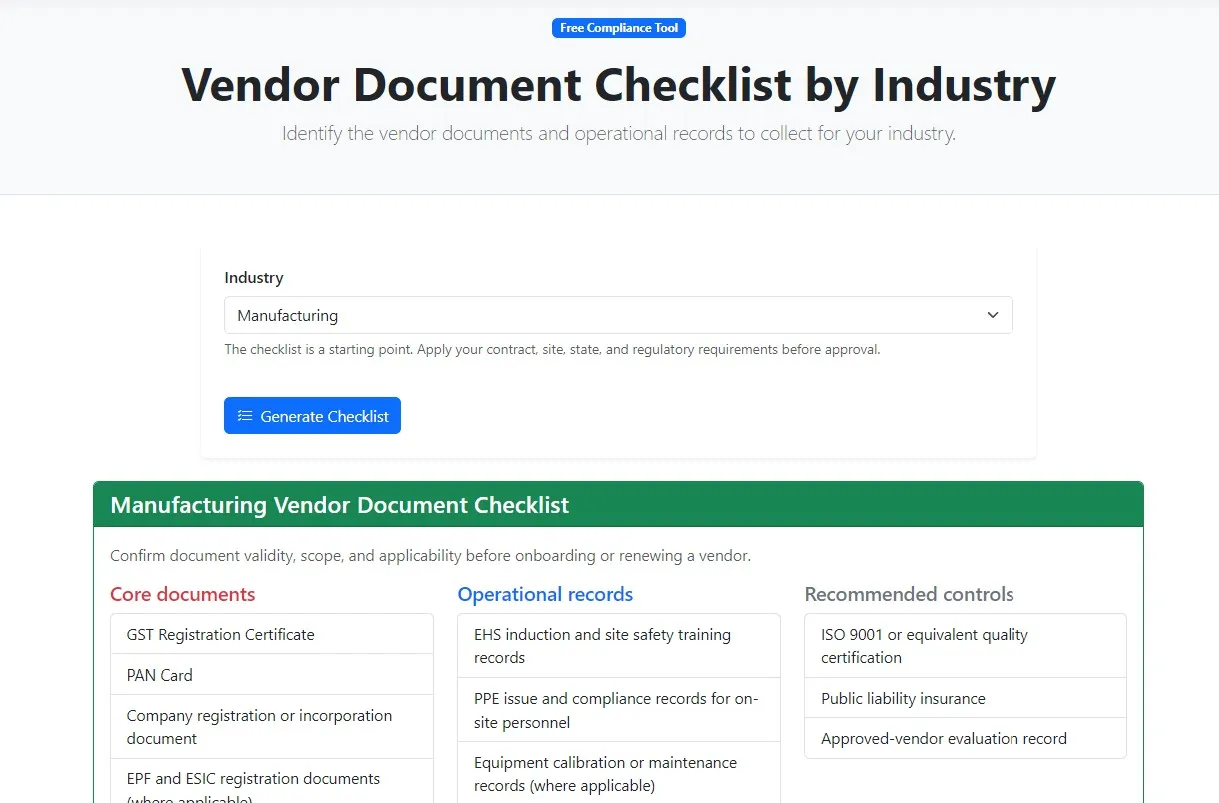
The Vendor Document Checklist by Industry is designed to provide a practical starting point for vendor documentation.
The tool allows you to:
- Select an industry.
- Generate an industry-specific checklist.
- Review core documents.
- Review operational records.
- Review recommended controls.
The generated checklist also includes a reminder to confirm document validity, scope, and applicability before onboarding or renewing a vendor.
Generate Your Vendor Document Checklist →
Example: Manufacturing Vendor Document Checklist
For a manufacturing vendor, the generated checklist can organize requirements into different categories.
Core Documents
Examples shown by the tool include:
- GST Registration Certificate
- PAN Card
- Company registration or incorporation document
- EPF and ESIC registration documents where applicable
These documents help establish the vendor’s basic business and statutory information.
Operational Records
The manufacturing checklist can include operational records such as:
- EHS induction and site safety training records
- PPE issue and compliance records for on-site personnel
- Equipment calibration or maintenance records where applicable
These records can be particularly useful when a vendor’s personnel or equipment operate at a manufacturing site.
Recommended Controls
The checklist can also identify recommended controls such as:
- ISO 9001 or equivalent quality certification
- Public liability insurance
- Approved-vendor evaluation record
These should be treated as recommendations to review rather than universal requirements for every vendor.
Core Documents vs Operational Records vs Recommended Controls
Separating vendor requirements into categories makes the checklist easier to use.
Core Documents
Core documents establish the vendor’s basic identity and registration.
Examples may include:
- Business registration
- Tax registration
- PAN
- Applicable statutory registrations
Operational Records
Operational records demonstrate how the vendor performs its activities.
Examples may include:
- Safety training records
- PPE records
- Equipment maintenance records
- Calibration records
Recommended Controls
Recommended controls can provide additional assurance depending on the vendor and risk.
Examples may include:
- Quality certifications
- Insurance
- Vendor evaluation records
- Other organization-specific controls
This structure helps teams distinguish between foundational information and additional controls.
Vendor Documents for Manufacturing Companies
Manufacturing companies often work with several types of suppliers and contractors.
Examples include:
- Raw material suppliers
- Component suppliers
- Packaging suppliers
- Maintenance contractors
- Engineering service providers
- Manpower contractors
- Equipment suppliers
- Industrial service providers
Depending on the vendor relationship, procurement teams may need to review:
- Company registration
- GST and PAN information
- Statutory registrations where applicable
- Quality documentation
- Safety records
- Insurance
- Equipment records
- Certifications
- Vendor evaluation records
The exact checklist should be adapted to the supplier’s scope of work and risk.
Vendor Documents for Different Industries
The right document requirements vary by industry.
Manufacturing
Potential focus areas include:
- Statutory registrations
- Quality management
- EHS records
- Equipment maintenance
- Calibration
- Insurance
Logistics
Potential focus areas may include:
- Business registration
- Insurance
- Vehicle or transport documentation
- Driver-related records where applicable
- Safety requirements
- Operational records
Construction
Potential focus areas may include:
- Contractor documentation
- Labour compliance
- Insurance
- Safety training
- Site-related records
- Applicable licences
Engineering
Potential focus areas may include:
- Technical qualifications
- Quality certifications
- Safety documentation
- Insurance
- Equipment records
- Applicable licences
Facility Management
Potential focus areas may include:
- Contractor documentation
- Employee records
- Safety requirements
- Insurance
- Labour-related compliance
- Training records
These are examples of areas to consider, not universal legal requirements.
Vendor Document Checklist for Onboarding
A structured checklist can make vendor onboarding easier.
A typical process can include:
Step 1: Identify the Vendor
Record the vendor’s company information and type of service.
Step 2: Identify the Industry
Choose the relevant industry or operational category.
Step 3: Generate the Checklist
Use an industry-specific checklist as a starting point.
Step 4: Confirm Applicability
Review the checklist against:
- Contract requirements
- Site requirements
- State or local requirements
- Regulatory requirements
- Internal procurement policies
- Vendor risk
Step 5: Collect Documents
Request the applicable documents from the vendor.
Step 6: Verify Documents
Check whether the submitted documents are complete, valid, and relevant.
Step 7: Approve the Vendor
Complete the organization’s internal approval process.
Step 8: Track Renewals
Monitor documents that have validity or renewal dates.
Why Document Validity Matters
Collecting a document is not enough.
Some documents may have expiry or renewal requirements. A vendor compliance process should therefore consider:
- Document issue date
- Expiry date
- Renewal date
- Applicable scope
- Document status
- Replacement document
The tool itself advises users to confirm document validity, scope, and applicability before onboarding or renewing a vendor.
This is important because the checklist is a starting point rather than a substitute for organization-specific compliance review.
Free Vendor Document Checklist by Industry
Creating a vendor document checklist manually for every industry can take considerable time.
The free Vendor Document Checklist by Industry gives you a quick starting point.
You select an industry and generate a checklist containing:
- Core documents
- Operational records
- Recommended controls
You can then adapt the generated list to your organization’s requirements.
Generate a Free Vendor Document Checklist →
Benefits of Using an Industry-Specific Checklist
Faster Vendor Onboarding
A predefined starting checklist reduces the time needed to decide what information to request.
More Consistent Processes
Procurement teams can use a common framework for similar vendors.
Better Document Visibility
Teams can identify which documents have been requested, received, or still need attention.
Easier Compliance Reviews
A structured checklist makes periodic vendor reviews easier to organize.
Better Audit Preparation
Organized vendor records make it easier to identify documentation gaps before an audit.
Reduced Manual Work
Starting with a generated checklist can reduce repetitive work when onboarding multiple vendors.
Common Vendor Document Management Mistakes
Using One Checklist for Every Vendor
Different industries and vendor types have different operational requirements.
Collecting Documents Without Checking Applicability
Not every document applies to every vendor.
Ignoring Document Scope
A document may exist but not cover the specific activity, site, or service being performed.
Not Tracking Validity
Documents may become outdated after onboarding.
Storing Everything in Email
Email-based document management can make records difficult to locate later.
Not Updating the Checklist
Vendor requirements can change as contracts, services, sites, and business processes change.
Best Practices for Vendor Document Checklists
Make the Checklist Industry-Specific
Start with requirements relevant to the vendor’s industry and activity.
Separate Required and Recommended Items
Clearly distinguish core requirements from additional controls.
Confirm Applicability
Review each item against the contract, site, state, regulatory, and organizational requirements.
Track Document Validity
Monitor documents that have expiry or renewal dates.
Keep an Audit Trail
Record submissions, reviews, approvals, and document changes.
Review the Checklist Periodically
Update requirements as your vendor program evolves.
Vendor Document Checklist and Audit Readiness
A structured checklist can support audit readiness by helping organizations identify:
- Missing vendor documents
- Incomplete records
- Expired documents
- Missing operational records
- Outstanding approvals
- Documentation gaps
Instead of waiting until an audit is announced, organizations can use the checklist as part of their ongoing vendor management process.
How VendorCompliancePro Helps
VendorCompliancePro helps organizations manage vendor compliance beyond the initial checklist.
Its capabilities include:
- Vendor self-service portal
- Centralized vendor document repository
- Compliance tracking
- Document expiry reminders
- Approval workflows
- AI-powered document validation
- Compliance dashboards
- Audit trails
- Reporting and analytics
The free Vendor Document Checklist by Industry can be used as a planning and onboarding utility, while VendorCompliancePro provides a broader workflow for ongoing vendor compliance management.
Frequently Asked Questions
What is a vendor document checklist?
A vendor document checklist is a structured list of documents and records that an organization may collect from suppliers or contractors.
Why should vendor document checklists be industry-specific?
Different industries and vendor activities have different operational, quality, safety, insurance, and compliance requirements.
What documents should I collect from a manufacturing vendor?
Common areas may include business registration, tax information, statutory registrations where applicable, quality documentation, safety records, insurance, equipment records, and certifications.
Is there one universal vendor document checklist?
No. Requirements depend on the vendor, industry, services, contract, site, location, risk level, and applicable requirements.
Should vendor documents be checked for expiry?
Where documents have validity periods, their expiry and renewal dates should be monitored.
Can this checklist be used for contractors?
Yes. Contractor requirements can include operational records, safety documentation, insurance, statutory documents, licences, and other requirements relevant to the contractor’s work.
Is the Vendor Document Checklist by Industry free?
Yes. The tool is available as a free online utility that provides an industry-specific starting checklist.
Conclusion
A Vendor Document Checklist by Industry provides a practical starting point for organizing supplier and contractor documentation.
Instead of using the same document list for every vendor, organizations can begin with an industry-specific checklist and then adapt it to their contract, site, state, regulatory, and internal requirements.
If you need a quick starting point, try the free Vendor Document Checklist by Industry to identify core documents, operational records, and recommended controls for your industry.
Try the Free Vendor Document Checklist by Industry →