Supplier Evaluation Scorecard Generator: Create a Weighted Supplier Scorecard
Choosing the right supplier is an important procurement decision. Price is only one part of supplier evaluation. Quality, delivery performance, compliance, service, and other factors can also affect the success of a supplier relationship.
A Supplier Evaluation Scorecard provides a structured way to evaluate suppliers using measurable criteria and weighted scores.
Instead of relying on subjective opinions or disconnected spreadsheets, procurement teams can use a consistent evaluation framework to compare suppliers and make more informed decisions.
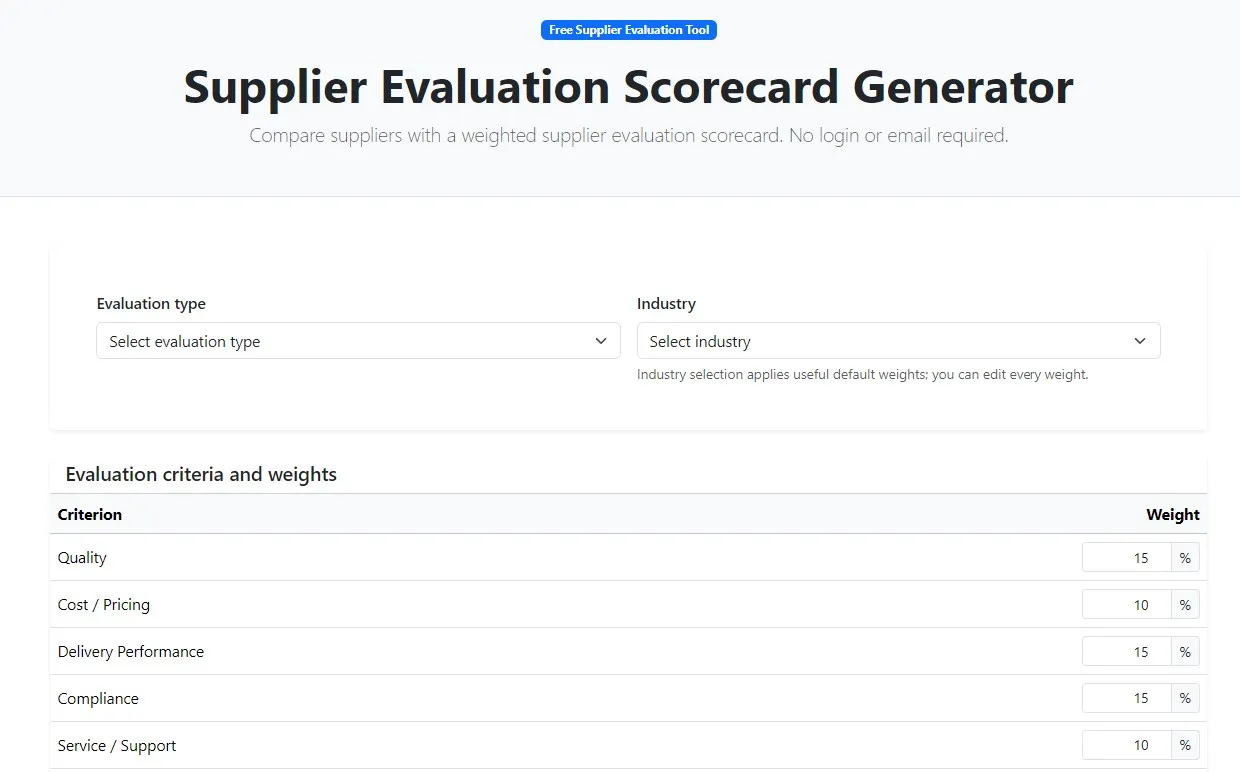
Our free Supplier Evaluation Scorecard Generator helps you create a weighted supplier evaluation framework based on the evaluation type and industry.
Try the Free Supplier Evaluation Scorecard Generator
What Is a Supplier Evaluation Scorecard?
A supplier evaluation scorecard is a structured method for measuring supplier performance against predefined criteria.
Common evaluation criteria include:
- Quality
- Cost or pricing
- Delivery performance
- Compliance
- Service and support
Each criterion can be assigned a percentage weight based on its importance.
For example, an organization may consider delivery and quality more important than cost for a critical manufacturing supplier. A weighted scorecard makes these priorities explicit.
Why Use a Supplier Evaluation Scorecard?
Without a standardized evaluation method, supplier selection can become inconsistent.
Different procurement team members may prioritize different factors, making supplier comparisons difficult.
A scorecard helps organizations:
- Standardize supplier evaluations
- Compare suppliers using consistent criteria
- Prioritize important performance areas
- Reduce subjective decision-making
- Document supplier evaluation results
- Identify supplier strengths and weaknesses
- Support supplier improvement discussions
A consistent evaluation framework is particularly useful when an organization works with multiple suppliers.
Key Supplier Evaluation Criteria
The right criteria depend on your organization, industry, supplier type, and business requirements.
Here are some commonly used supplier evaluation criteria.
1. Quality
Quality measures how consistently a supplier meets your product or service requirements.
Possible measures include:
- Defect rate
- Product conformity
- Rejection rate
- Quality complaints
- Corrective action performance
- Quality certification status
For manufacturing companies, supplier quality can directly affect production and customer satisfaction.
2. Cost and Pricing
Cost evaluation considers whether the supplier provides competitive pricing while meeting required quality and service standards.
Possible measures include:
- Unit price
- Total cost
- Price stability
- Cost transparency
- Payment terms
- Cost reduction opportunities
The lowest price should not automatically determine the best supplier. A low-cost supplier with poor quality or delivery performance may create higher overall costs.
3. Delivery Performance
Delivery performance measures whether suppliers deliver products or services when required.
Possible KPIs include:
- On-time delivery rate
- Lead time
- Delivery reliability
- Order fulfillment accuracy
- Late delivery frequency
Reliable delivery is particularly important when supplier delays can affect production schedules.
4. Compliance
Supplier compliance evaluates whether the supplier meets applicable contractual, statutory, regulatory, and organizational requirements.
Depending on the supplier and industry, organizations may evaluate:
- Required registrations
- Compliance documents
- Insurance coverage
- Contract requirements
- Safety requirements
- Document validity
Compliance can be especially important when suppliers or contractors work on company premises or provide regulated services.
5. Service and Support
Service and support measure how effectively a supplier responds to questions, issues, and service requests.
Possible measures include:
- Response time
- Issue resolution time
- Communication quality
- Technical support
- After-sales service
- Responsiveness
Strong supplier communication can make it easier to resolve problems before they affect operations.
What Is Weighted Supplier Evaluation?
Not every evaluation criterion has the same importance.
A weighted supplier evaluation assigns a percentage to each criterion according to its importance.
For example:
| Evaluation Criterion | Example Weight |
|---|---|
| Quality | 25% |
| Cost / Pricing | 15% |
| Delivery Performance | 25% |
| Compliance | 20% |
| Service / Support | 15% |
| Total | 100% |
The exact weights should be determined by your organization’s requirements.
A critical component supplier may receive a higher weight for quality and delivery, while a service provider may require greater emphasis on responsiveness and compliance.
How a Supplier Scorecard Works
A typical supplier evaluation process can follow these steps.
Step 1: Define the Evaluation Type
Determine what you want to evaluate.
Examples may include:
- New supplier evaluation
- Existing supplier review
- Supplier performance review
- Supplier selection
- Periodic supplier assessment
Step 2: Select the Industry
Industry context can influence which criteria are important.
For example, manufacturing organizations may place significant importance on quality and delivery, while service organizations may emphasize responsiveness and support.
Step 3: Define Evaluation Criteria
Select the criteria that should be included in the supplier evaluation.
Common criteria include:
- Quality
- Cost
- Delivery
- Compliance
- Service
Step 4: Assign Weights
Assign a percentage weight to each criterion.
The total weight should equal 100%.
Step 5: Evaluate Suppliers
Score each supplier against the selected criteria using a consistent scoring method.
Step 6: Compare Results
Use the resulting scores to compare supplier performance and identify areas that require improvement.
Free Supplier Evaluation Scorecard Generator
Creating supplier scorecards manually can take time, especially when procurement teams need different evaluation frameworks for different industries or supplier situations.
The Supplier Evaluation Scorecard Generator provides a simple starting point.
You can select:
- Evaluation type
- Industry
The tool provides evaluation criteria and weights that you can review and adjust.
No Login or Email Required
The tool is designed for quick use without requiring an account or email address.
Create Your Supplier Scorecard →
Example Supplier Evaluation Scorecard
A manufacturing organization could use a scorecard such as:
| Criterion | Weight |
|---|---|
| Quality | 30% |
| Delivery Performance | 25% |
| Compliance | 20% |
| Cost / Pricing | 15% |
| Service / Support | 10% |
| Total | 100% |
The organization can then score each supplier against these criteria using its own evaluation scale.
For example, a procurement team might use a scale from 1 to 5:
| Score | Meaning |
|---|---|
| 5 | Excellent |
| 4 | Good |
| 3 | Acceptable |
| 2 | Needs Improvement |
| 1 | Poor |
The scoring method should remain consistent across suppliers being compared.
Supplier Scorecard vs Supplier Performance Scorecard
These terms are often used interchangeably, but they can serve slightly different purposes.
A supplier evaluation scorecard is often used to assess or compare suppliers against defined criteria.
A supplier performance scorecard is commonly used for ongoing monitoring of an existing supplier.
For example:
Supplier evaluation:
Should we approve or select this supplier?
Supplier performance review:
How is this supplier performing over the last quarter?
Organizations may use both approaches as part of their supplier management process.
Benefits of Standardized Supplier Evaluation
More Consistent Decisions
A standardized framework helps procurement teams evaluate suppliers using the same basic methodology.
Better Supplier Comparisons
Weighted criteria make it easier to compare suppliers across important performance areas.
Clearer Procurement Discussions
Teams can discuss specific evaluation criteria instead of relying only on general opinions.
Easier Supplier Reviews
A defined scorecard can provide a repeatable structure for periodic reviews.
Improved Supplier Development
Scorecards can highlight areas where suppliers need improvement.
Better Documentation
Evaluation criteria and weights provide a documented basis for supplier decisions.
Common Supplier Evaluation Mistakes
Evaluating Suppliers Only on Price
Price is important, but it should not always be the only factor.
Quality, delivery, compliance, and service can have significant business impact.
Using Different Criteria for Similar Suppliers
Inconsistent criteria make supplier comparisons difficult.
Ignoring Weighting
If all criteria are treated equally when they should not be, the final evaluation may not reflect business priorities.
Changing Scoring Rules Between Suppliers
Suppliers should be evaluated using a consistent scoring approach when they are being directly compared.
Not Reviewing Supplier Performance
Supplier evaluation should not necessarily end after onboarding.
Periodic reviews can identify changes in quality, delivery, compliance, or service.
Best Practices for Supplier Scorecards
Keep Criteria Relevant
Only include criteria that matter to the supplier relationship.
Use Measurable KPIs
Where possible, use objective data such as delivery performance, defect rates, response times, and compliance status.
Keep Weights Meaningful
Give higher weights to factors that have greater business impact.
Make the Scoring Method Consistent
Use the same scoring scale when comparing suppliers.
Review the Scorecard Periodically
Business priorities can change, so evaluation criteria and weights may need to be updated.
Combine Performance and Compliance
A supplier may perform well operationally but still create risk if required compliance obligations are not maintained.
Supplier Evaluation for Manufacturing Companies
Manufacturing companies often depend on suppliers for raw materials, components, packaging, equipment, maintenance, and services.
Supplier evaluation may therefore include:
- Product quality
- Delivery performance
- Pricing
- Compliance
- Technical capability
- Service and support
- Capacity
- Responsiveness
A structured scorecard helps procurement teams evaluate suppliers using criteria that reflect manufacturing priorities.
Supplier Evaluation for Contractors and Service Providers
The same scorecard concept can also be applied to contractors and service providers.
Depending on the relationship, organizations may evaluate:
- Compliance
- Safety
- Service quality
- Responsiveness
- Delivery or completion performance
- Cost
- Documentation
For contractor relationships, compliance and safety may deserve higher weights than they would for some other supplier categories.
How VendorCompliancePro Fits Into Supplier Management
VendorCompliancePro focuses on vendor compliance and document management.
Its capabilities include:
- Vendor self-service portal
- Centralized vendor document repository
- Compliance tracking
- Document expiry reminders
- Approval workflows
- AI-powered document validation
- Compliance dashboards
- Audit trails
- Reporting
The Supplier Evaluation Scorecard Generator can be used as a free planning and evaluation tool alongside your broader supplier management process.
Frequently Asked Questions
What is a supplier evaluation scorecard?
A supplier evaluation scorecard is a structured framework for evaluating suppliers against predefined criteria such as quality, cost, delivery, compliance, and service.
What should be included in a supplier scorecard?
Common criteria include quality, cost or pricing, delivery performance, compliance, and service or support. The exact criteria should depend on the supplier relationship and business requirements.
What is a weighted supplier scorecard?
A weighted supplier scorecard assigns percentage weights to evaluation criteria based on their importance.
Should supplier scorecard weights total 100%?
Yes. When using percentage-based weighting, the weights should normally total 100%.
How often should suppliers be evaluated?
The appropriate frequency depends on the supplier, risk level, industry, and organization. Some companies may conduct monthly or quarterly reviews, while others may use annual evaluations.
Can a supplier scorecard be used for contractors?
Yes. The criteria can be adapted for contractors and service providers, including compliance, safety, service quality, responsiveness, and cost.
Is the Supplier Evaluation Scorecard Generator free?
Yes. The tool is available as a free online utility and does not require login or email according to the current tool experience.
Conclusion
A supplier evaluation scorecard provides a practical framework for comparing suppliers and monitoring supplier performance.
By defining relevant criteria, assigning meaningful weights, and applying a consistent scoring method, procurement teams can make supplier evaluations more structured and transparent.
If you need a quick starting point, try the free Supplier Evaluation Scorecard Generator to create a weighted evaluation framework based on your evaluation type and industry.
Try the Free Supplier Evaluation Scorecard Generator →