Supplier Prequalification Questionnaire Generator: Create a Supplier Qualification Questionnaire
Before approving a new supplier, procurement teams need to understand whether the supplier has the required capabilities, financial stability, quality processes, insurance, safety controls, and regulatory compliance.
A Supplier Prequalification Questionnaire provides a structured way to collect this information before a supplier moves further through the procurement process.
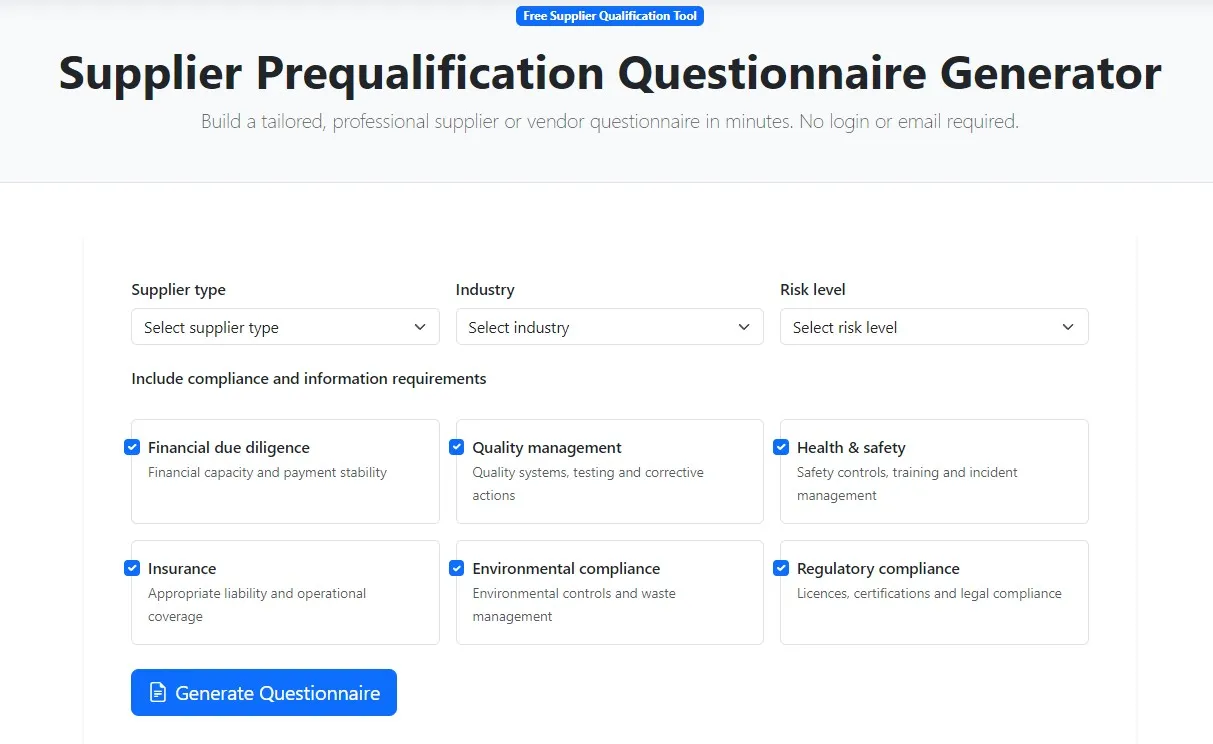
Instead of creating questionnaires manually for every supplier category, our free Supplier Prequalification Questionnaire Generator helps you create a tailored questionnaire based on the supplier type, industry, risk level, and information requirements.
Try the Free Supplier Prequalification Questionnaire Generator
What Is a Supplier Prequalification Questionnaire?
A supplier prequalification questionnaire is a set of questions used to collect important information about a supplier before qualification or approval.
The questionnaire helps procurement teams understand whether a supplier can meet the organization’s commercial, operational, quality, safety, and compliance requirements.
Depending on the supplier and industry, a prequalification questionnaire may cover:
- Financial capability
- Quality management
- Health and safety
- Insurance
- Environmental compliance
- Regulatory compliance
- Company information
- Operational capability
- Certifications and licences
The exact requirements should depend on the supplier relationship, industry, risk level, and organization’s procurement policy.
Why Supplier Prequalification Matters
Supplier selection can create significant operational and commercial consequences.
A structured prequalification process can help procurement teams:
- Collect supplier information consistently
- Identify potential risks before approval
- Compare suppliers using common requirements
- Verify relevant capabilities and documentation
- Improve supplier qualification decisions
- Create a documented qualification process
- Reduce avoidable procurement risks
Prequalification is particularly useful when suppliers provide critical products, services, equipment, or work that can affect business operations.
What Information Should a Supplier Questionnaire Cover?
A supplier questionnaire should be tailored to the supplier and the risk associated with the relationship.
Common areas include the following.
1. Financial Due Diligence
Financial due diligence helps procurement teams understand the supplier’s financial capacity and stability.
Possible questions may cover:
- Financial capacity
- Payment stability
- Business continuity
- Relevant financial information
- Banking or commercial references
The level of financial review should depend on the supplier’s importance and risk.
2. Quality Management
Quality management is important when supplier performance can affect products, production, or customer outcomes.
Possible areas include:
- Quality management systems
- Quality certifications
- Inspection and testing processes
- Corrective action procedures
- Non-conformance management
- Quality performance history
For manufacturing suppliers, quality requirements may be particularly important.
3. Health and Safety
Health and safety requirements are especially relevant when suppliers or contractors work at company sites or perform potentially hazardous activities.
Questions may cover:
- Safety controls
- Employee training
- Incident management
- Safety procedures
- Risk assessments
- Safety certifications
The requirements should reflect the work being performed and the applicable organizational policies.
4. Insurance
Insurance requirements help organizations assess whether suppliers maintain appropriate coverage for their activities.
Depending on the relationship, requirements may include:
- Liability insurance
- Workers’ compensation or employee-related coverage where applicable
- Other operational insurance
- Contract-specific insurance requirements
Insurance requirements should be determined based on the contract, risk profile, and applicable requirements.
5. Environmental Compliance
Environmental requirements may be important for suppliers involved in manufacturing, industrial activities, waste management, chemicals, or other environmentally regulated operations.
Possible areas include:
- Environmental controls
- Waste management
- Environmental permits
- Regulatory compliance
- Environmental certifications
Not every supplier requires the same level of environmental assessment.
6. Regulatory Compliance
Regulatory compliance questions help determine whether a supplier maintains the licences, certifications, registrations, and other requirements relevant to its business.
Possible areas include:
- Licences
- Certifications
- Registrations
- Legal compliance
- Regulatory history
- Required statutory documentation
Requirements should be tailored to the supplier’s location, industry, services, and applicable regulations.
Supplier Prequalification vs Supplier Evaluation
Supplier prequalification and supplier evaluation are related but serve different purposes.
Supplier Prequalification
The primary question is:
Is this supplier suitable to proceed with our qualification or procurement process?
Prequalification generally focuses on capability, risk, compliance, and minimum requirements.
Supplier Evaluation
The primary question is:
How well does this supplier perform against our evaluation criteria?
Supplier evaluation can include factors such as:
- Quality
- Cost
- Delivery
- Compliance
- Service
A business may use both processes as part of its overall supplier management lifecycle.
How Supplier Prequalification Works
A typical process can include:
Step 1: Identify the Supplier Type
Determine whether the supplier is a manufacturer, service provider, contractor, distributor, logistics provider, or another category.
Step 2: Identify the Industry
Industry context helps determine which requirements are relevant.
Step 3: Assess Risk Level
Higher-risk suppliers may require more detailed due diligence.
Step 4: Define Information Requirements
Select the areas that should be assessed, such as:
- Financial due diligence
- Quality management
- Health and safety
- Insurance
- Environmental compliance
- Regulatory compliance
Step 5: Generate the Questionnaire
Create a structured questionnaire based on the selected requirements.
Step 6: Send the Questionnaire to the Supplier
The supplier provides the requested information and supporting documentation.
Step 7: Review the Responses
Procurement, compliance, quality, EHS, finance, or other relevant teams review the information.
Step 8: Make a Qualification Decision
The organization determines whether the supplier should proceed based on its internal qualification criteria.
Free Supplier Prequalification Questionnaire Generator
Creating supplier questionnaires manually can be repetitive.
Different supplier types and industries may require different questions. A high-risk supplier may also require more detailed information than a low-risk supplier.
Our free Supplier Prequalification Questionnaire Generator provides a quick starting point.
You can select:
- Supplier type
- Industry
- Risk level
You can also choose information and compliance areas such as:
- Financial due diligence
- Quality management
- Health & safety
- Insurance
- Environmental compliance
- Regulatory compliance
The tool then generates a tailored supplier qualification questionnaire.
Generate a Supplier Prequalification Questionnaire →
Why Risk Level Matters in Supplier Prequalification
Not every supplier presents the same level of risk.
For example, a supplier providing office stationery may require a much simpler qualification process than a contractor performing high-risk work inside a manufacturing facility.
Risk-based qualification can help organizations focus their due diligence where it matters most.
Lower-Risk Supplier
Potential focus areas:
- Company information
- Basic financial information
- Commercial requirements
- Basic compliance documentation
Higher-Risk Supplier
Potential focus areas may include:
- Financial due diligence
- Quality management
- Health and safety
- Insurance
- Environmental compliance
- Regulatory compliance
The actual requirements should always be determined by the organization’s procurement and risk policies.
Example Supplier Prequalification Questionnaire Structure
A manufacturing company could structure a supplier questionnaire around:
| Section | Example Focus |
|---|---|
| Company Information | Business profile and capabilities |
| Financial Due Diligence | Financial capacity and stability |
| Quality Management | Quality systems and corrective actions |
| Health & Safety | Safety controls and incident management |
| Insurance | Relevant insurance coverage |
| Environmental Compliance | Environmental controls and waste management |
| Regulatory Compliance | Licences, certifications, and legal compliance |
The exact questions should be adapted to the supplier and business requirements.
Benefits of a Standardized Supplier Questionnaire
Consistent Supplier Qualification
Using a common framework makes it easier to collect comparable information.
Better Risk Visibility
Structured questions can reveal potential supplier risks earlier.
Faster Questionnaire Creation
Templates and generators reduce repetitive manual work.
Better Cross-Functional Collaboration
Procurement, quality, finance, EHS, and compliance teams can contribute relevant requirements.
Better Documentation
A structured questionnaire creates a clear record of the information requested during supplier qualification.
Easier Supplier Comparisons
When suppliers answer similar questions, procurement teams can compare relevant information more consistently.
Common Supplier Prequalification Mistakes
Using the Same Questionnaire for Every Supplier
A questionnaire designed for a high-risk contractor may be unnecessarily complicated for a low-risk supplier.
Ignoring Risk Level
Supplier due diligence should reflect the potential impact and risk of the supplier relationship.
Focusing Only on Price
Commercial pricing is important, but supplier capability, quality, compliance, and operational risks may also matter.
Asking for Too Much Information
Excessive requirements can make the qualification process unnecessarily slow.
Not Defining Ownership
Someone should be responsible for reviewing supplier responses and making the qualification decision.
Treating Prequalification as a One-Time Activity
Supplier risk can change over time. Depending on the relationship, organizations may need periodic reviews after onboarding.
Best Practices for Supplier Prequalification
Use a Risk-Based Approach
Adjust questionnaire depth according to supplier risk.
Define Minimum Requirements
Clearly identify the information and documentation required before a supplier can proceed.
Keep Questions Relevant
Ask questions that help your organization make a qualification decision.
Involve the Right Teams
Include procurement and, where relevant, quality, finance, EHS, legal, compliance, or operations teams.
Maintain Records
Keep supplier responses and supporting documentation available for future reviews.
Review Requirements Periodically
Update questionnaires as business requirements, supplier risks, and regulatory expectations change.
Supplier Prequalification for Manufacturing Companies
Manufacturing organizations may depend on suppliers for:
- Raw materials
- Components
- Packaging
- Equipment
- Maintenance
- Contract labour
- Engineering services
- Logistics
- Industrial services
Depending on the supplier, qualification may need to consider quality, delivery capability, financial stability, safety, insurance, environmental requirements, and regulatory compliance.
A structured questionnaire provides a repeatable starting point for gathering this information.
Supplier Prequalification for Contractors
Contractors may require additional qualification areas because they can work directly at company facilities or perform specialized activities.
Depending on the work, organizations may consider:
- Health and safety
- Insurance
- Workforce capability
- Relevant licences
- Regulatory compliance
- Environmental requirements
- Previous experience
- Incident history
The questionnaire should be aligned with the contractor’s actual scope of work.
How VendorCompliancePro Fits Into Supplier Management
VendorCompliancePro focuses on vendor compliance and document management.
Its capabilities include:
- Vendor self-service portal
- Centralized vendor document repository
- Compliance tracking
- Document expiry reminders
- Approval workflows
- AI-powered document validation
- Compliance dashboards
- Audit trails
- Reporting
The Supplier Prequalification Questionnaire Generator can be used as a free planning tool before or during the supplier qualification process.
Frequently Asked Questions
What is a supplier prequalification questionnaire?
A supplier prequalification questionnaire is a structured set of questions used to collect information about a supplier’s capability, financial position, quality systems, safety practices, insurance, environmental controls, and regulatory compliance.
Why is supplier prequalification important?
It helps organizations gather relevant supplier information and identify potential risks before proceeding with a supplier relationship.
What should a supplier prequalification questionnaire include?
Common areas include financial due diligence, quality management, health and safety, insurance, environmental compliance, and regulatory compliance. Requirements should be tailored to the supplier and risk level.
Should high-risk suppliers receive more questions?
Generally, a risk-based process can use more detailed due diligence for suppliers with greater potential operational, financial, safety, compliance, or other risks.
Can contractors use supplier prequalification questionnaires?
Yes. Contractor questionnaires can be adapted to include requirements relevant to safety, insurance, licences, workforce capability, and regulatory compliance.
How is supplier prequalification different from supplier evaluation?
Prequalification generally determines whether a supplier meets minimum requirements to proceed, while supplier evaluation measures supplier performance or compares suppliers using defined criteria.
Is the Supplier Prequalification Questionnaire Generator free?
Yes. The tool is provided as a free online utility and is designed to help users quickly create a supplier qualification questionnaire without login or email.
Conclusion
Supplier prequalification helps organizations make more informed decisions before entering into supplier or contractor relationships.
A structured questionnaire can bring together important areas such as financial due diligence, quality management, health and safety, insurance, environmental compliance, and regulatory compliance.
The most effective approach is usually risk-based: higher-risk suppliers may require more detailed due diligence, while lower-risk suppliers can follow a simpler process.
If you need a quick starting point, use the free Supplier Prequalification Questionnaire Generator to create a tailored questionnaire based on supplier type, industry, risk level, and selected information requirements.
Try the Free Supplier Prequalification Questionnaire Generator →