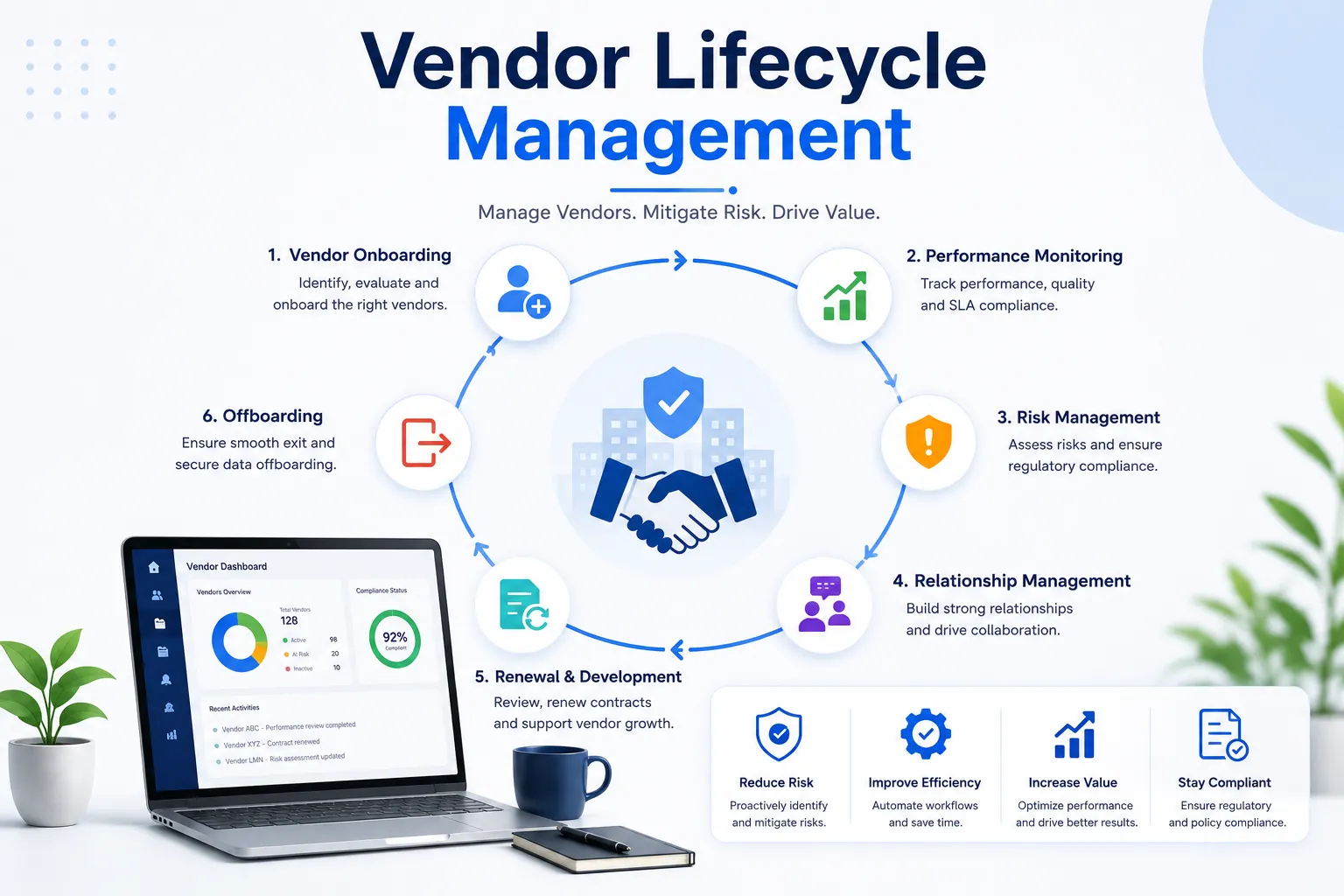
Vendor Lifecycle Management: Complete Guide to Managing Suppliers (2026)
Managing a supplier does not end when the vendor is approved.
After onboarding, organizations may need to collect updated compliance documents, monitor performance, review contracts, track renewals, reassess risk, and eventually offboard the supplier.
Vendor Lifecycle Management (VLM) is the structured process of managing a vendor throughout the complete relationship with an organization — from initial registration and onboarding to ongoing monitoring, renewal, reassessment, and offboarding.
For manufacturing companies, logistics providers, warehouses, engineering firms, construction companies, facility-management organizations, and other businesses that depend on external suppliers and contractors, a structured vendor lifecycle process can improve visibility, reduce administrative work, and support better vendor governance.
This guide explains the stages of vendor lifecycle management, common workflows, vendor lifecycle checklists, best practices, software features, and how automation can support the process.
What Is Vendor Lifecycle Management?
Vendor Lifecycle Management is the process of managing every major stage of a supplier or contractor relationship.
A typical vendor lifecycle can include:
- Vendor identification
- Registration
- Classification
- Due diligence
- Onboarding
- Compliance management
- Performance monitoring
- Risk monitoring
- Contract and renewal management
- Periodic reassessment
- Offboarding
The exact stages vary by organization and vendor category.
The objective is to maintain a consistent process from the moment a vendor is considered until the relationship ends.
Vendor Lifecycle Management vs Vendor Management
These terms are closely related.
Vendor management is the broader discipline of managing supplier relationships, performance, contracts, costs, compliance, and business interactions.
Vendor lifecycle management focuses specifically on how those activities change throughout the vendor’s relationship with the organization.
A simple way to think about it is:
Vendor Management = the overall discipline
Vendor Lifecycle Management = the supplier journey through that discipline
Why Vendor Lifecycle Management Matters
Organizations often manage vendor activities in separate systems:
- Procurement systems
- ERP platforms
- Excel spreadsheets
- Shared folders
- Paper records
When information is fragmented, teams may struggle with:
- Missing documents
- Duplicate vendor records
- Slow onboarding
- Expired certificates
- Missed contract renewals
- Poor performance visibility
- Incomplete audit history
- Unclear vendor ownership
- Difficult offboarding
A structured lifecycle process connects these activities and gives teams a clearer view of the vendor relationship.
The 8 Key Stages of Vendor Lifecycle Management
Different organizations may use different terminology, but a practical lifecycle can be divided into eight stages.
Stage 1: Vendor Identification and Selection
The lifecycle begins when the organization identifies a need for a supplier or service provider.
Activities may include:
- Defining the business requirement
- Identifying potential suppliers
- Comparing capabilities
- Evaluating commercial requirements
- Assessing initial risks
- Selecting a preferred vendor
For critical suppliers, organizations may perform additional due diligence before proceeding.
Stage 2: Vendor Registration
The organization collects basic vendor information.
Typical information includes:
- Legal company name
- Registered address
- Contact details
- Vendor category
- GST details, where applicable
- PAN details
- Bank information
- Business type
- Primary contacts
This information becomes part of the vendor master record.
See Vendor Onboarding Process.
Stage 3: Vendor Due Diligence and Onboarding
Before activation, the organization verifies the vendor and collects applicable documents.
Depending on the vendor category, requirements may include:
- GST registration
- PAN
- MSME certificate, where applicable
- PF registration
- ESIC registration
- Labour or contractor licences
- Insurance
- Safety documentation
- Contracts
- Other organization-specific requirements
Not every vendor needs every document. Requirements should be based on vendor category, activities, risk, and applicable rules.
Stage 4: Compliance and Document Management
After onboarding, vendor compliance becomes an ongoing activity.
Organizations may monitor:
- Required documents
- Document validity
- Expiry dates
- Renewal submissions
- Missing documents
- Approval status
- Compliance exceptions
Automated expiry reminders can help teams identify upcoming renewals before documents expire.
Stage 5: Vendor Performance Monitoring
Vendor relationships should be evaluated using appropriate performance indicators.
Depending on the vendor, organizations may monitor:
- On-time delivery
- Product or service quality
- Order accuracy
- Responsiveness
- Issue resolution
- SLA performance
- Cost performance
- Customer or internal complaints
A vendor performance scorecard can provide a structured way to review these KPIs.
See Vendor Performance Scorecard.
Stage 6: Vendor Risk Monitoring
Vendor risk can change after onboarding.
Organizations may monitor:
- Compliance risk
- Operational risk
- Quality risk
- Contract risk
- Business continuity concerns
- Supplier criticality
- Other relevant risk indicators
Risk-based monitoring allows organizations to focus greater attention on high-risk or business-critical vendors.
Stage 7: Contract, Renewal, and Reassessment
Vendor relationships often involve contracts with defined terms and renewal dates.
Teams may need to track:
- Contract start date
- Contract end date
- Renewal date
- Notice period
- Service-level obligations
- Contract changes
- Renewal decisions
Before renewal, organizations can reassess:
- Vendor performance
- Compliance status
- Risk level
- Commercial terms
- Business requirements
See Vendor Contract Expiry Reminder.
Stage 8: Vendor Offboarding
When a vendor relationship ends, the organization should complete a controlled offboarding process.
Activities may include:
- Stop new transactions
- Complete outstanding obligations
- Revoke system or portal access
- Recover company property where applicable
- Close contracts
- Preserve required records
- Archive vendor documents
- Record the offboarding reason
- Update the vendor status
Offboarding should preserve historical information needed for audits, legal requirements, reporting, or future reference.
Vendor Lifecycle Workflow
A practical lifecycle can be represented as:
Vendor Identification
↓
Registration
↓
Due Diligence
↓
Onboarding & Approval
↓
Activation
↓
Compliance Monitoring
↓
Performance Monitoring
↓
Risk Monitoring
↓
Contract Renewal / Reassessment
↓
Continue, Renew, or Offboard
This lifecycle repeats while the vendor relationship remains active.
Vendor Lifecycle Checklist
Use the following checklist when designing a vendor lifecycle process.
Vendor Setup
- Business requirement defined
- Vendor category assigned
- Vendor information collected
- Duplicate vendor check completed
- Business criticality recorded
Due Diligence and Onboarding
- Risk assessment completed where applicable
- Required documents defined
- Vendor documents collected
- Documents reviewed
- Required approvals completed
- Vendor activated
Ongoing Compliance
- Mandatory documents tracked
- Expiry dates recorded
- Renewal reminders configured
- Missing documents monitored
- Compliance exceptions tracked
Performance
- Performance KPIs defined
- Performance data collected
- Supplier reviews scheduled
- Corrective actions tracked
- Historical performance retained
Risk
- Risk category defined
- Risk indicators identified
- High-risk vendors identified
- Monitoring frequency established
- Periodic reassessment completed
Contract and Renewal
- Contract dates recorded
- Renewal dates tracked
- Notice periods recorded
- Renewal review completed
- Contract decisions documented
Offboarding
- Offboarding owner assigned
- Access removed
- Outstanding obligations reviewed
- Required records retained
- Vendor status updated
Manual Vendor Lifecycle Management vs Automated Management
| Manual Process | Automated Lifecycle Management |
|---|---|
| Excel vendor registers | Centralized vendor records |
| Email-based onboarding | Online vendor registration |
| Manual document follow-up | Automated notifications |
| Separate compliance files | Centralized document repository |
| Manual approvals | Workflow-based approvals |
| Spreadsheet scorecards | Performance dashboards |
| Manual expiry checks | Automated expiry reminders |
| Difficult historical reviews | Lifecycle history and audit trails |
Automation can reduce repetitive work and improve visibility, but organizations still need appropriate human review and governance.
Benefits of Vendor Lifecycle Management
Faster Vendor Onboarding
Standardized workflows can reduce unnecessary back-and-forth during registration and approval.
Better Compliance Visibility
Teams can monitor required documents, expiry dates, and compliance exceptions.
Improved Vendor Performance
Consistent performance reviews help organizations identify improvement opportunities.
Better Risk Management
Risk information can be monitored throughout the supplier relationship.
Fewer Administrative Tasks
Automation can reduce repetitive reminders, status updates, and manual reporting.
Better Audit Readiness
Centralized records and audit trails make it easier to retrieve vendor history.
Better Supplier Governance
A defined lifecycle gives procurement and business teams clearer ownership and processes.
Risk-Based Vendor Lifecycle Management
Not every vendor requires identical controls.
A practical approach is to classify vendors according to factors such as:
- Business criticality
- Product or service type
- Compliance exposure
- Operational dependency
- Safety exposure
- Data or system access
- Spend or strategic importance
For example:
| Vendor Category | Example Approach |
|---|---|
| Low Risk | Standard onboarding and periodic review |
| Medium Risk | Regular compliance and performance review |
| High Risk | Enhanced due diligence and more frequent monitoring |
| Critical Supplier | Enhanced monitoring, continuity planning, and management review |
These are examples. Organizations should define their own risk categories and controls.
Common Vendor Lifecycle Management Mistakes
Focusing Only on Onboarding
A vendor relationship continues after activation.
Treating Every Vendor the Same
Different vendors have different risks and compliance requirements.
Keeping Vendor Data in Multiple Places
Fragmented information makes lifecycle management harder.
Missing Document Renewals
Expired documents can create avoidable compliance gaps.
Ignoring Performance Trends
A supplier’s performance can deteriorate over time.
No Renewal Review
Contract renewal should consider performance, risk, compliance, and business requirements.
Weak Offboarding
Inactive vendors should be properly closed and access should be reviewed.
No Historical Record
Organizations should retain appropriate vendor history for audits and future reference.
Best Practices for Vendor Lifecycle Management
1. Standardize the Lifecycle
Define clear stages, owners, approval rules, and required outputs.
2. Use Category-Based Requirements
Apply different document and approval requirements according to vendor type.
3. Maintain One Vendor Record
Keep important vendor information and history connected.
4. Automate Routine Activities
Automate reminders, notifications, expiry tracking, and workflow tasks where practical.
5. Use Risk-Based Monitoring
Apply stronger controls to high-risk and critical vendors.
6. Monitor Performance
Use measurable KPIs and regular supplier reviews.
7. Review Before Renewal
Consider compliance, risk, performance, contract terms, and business needs before renewal.
8. Control Offboarding
Remove access, close obligations, and preserve required records.
9. Maintain Audit Trails
Record important submissions, approvals, changes, reviews, and decisions.
Vendor Lifecycle Management Software: Features to Look For
Depending on your organization’s needs, useful capabilities include:
- Vendor self-registration
- Vendor self-service portal
- Configurable vendor forms
- Category-based document requirements
- Document repository
- Document expiry tracking
- Automated notifications
- Approval workflows
- Compliance dashboards
- Performance scorecards
- Vendor risk indicators
- Contract and renewal tracking
- Corrective-action tracking
- Audit trails
- Role-based access
- Reports and analytics
- API integration
The right feature set depends on vendor complexity, organizational size, existing ERP/procurement systems, and risk requirements.
How AI Can Support Vendor Lifecycle Management
AI can assist with repetitive information and document-processing activities.
Depending on the system, AI may help:
- Extract information from vendor documents
- Identify document types
- Detect expiry dates
- Flag missing information
- Validate submitted documents
- Summarize vendor records
- Prioritize records for human review
AI should support human decision-making rather than replace appropriate legal, financial, safety, procurement, or compliance review.
How VendorCompliancePro Helps
VendorCompliancePro focuses on vendor onboarding, document management, compliance monitoring, and ongoing vendor visibility.
Relevant capabilities include:
- Vendor self-service portal
- Vendor registration
- Centralized vendor records
- Configurable document requirements
- Secure document uploads
- AI-powered document validation
- OCR processing
- Approval workflows
- Automated expiry reminders
- Compliance dashboards
- Vendor risk monitoring
- Audit trails
- Reports and analytics
Organizations can use these capabilities to manage important parts of the vendor lifecycle, from onboarding and document collection through ongoing compliance monitoring and vendor reviews.
For organizations with complex ERP, procurement, cybersecurity, or enterprise supplier-management requirements, VendorCompliancePro can complement those existing systems rather than replace every procurement function.
Frequently Asked Questions
What is Vendor Lifecycle Management?
Vendor Lifecycle Management is the structured process of managing a supplier or contractor from identification and onboarding through compliance monitoring, performance review, renewal, reassessment, and offboarding.
What are the stages of the vendor lifecycle?
Common stages include vendor selection, registration, due diligence, onboarding, compliance management, performance monitoring, risk monitoring, contract renewal, reassessment, and offboarding.
Why is Vendor Lifecycle Management important?
It helps organizations maintain consistent vendor processes, improve visibility, reduce administrative work, monitor compliance, and manage supplier risks throughout the relationship.
What is the difference between vendor onboarding and vendor lifecycle management?
Vendor onboarding is the process of bringing a new vendor into the organization. Vendor lifecycle management covers the entire relationship, including onboarding, ongoing monitoring, renewal, reassessment, and offboarding.
How often should vendors be reviewed?
Review frequency should depend on vendor risk and business criticality. High-risk or critical suppliers generally require more frequent reviews than low-risk vendors.
Can Vendor Lifecycle Management be automated?
Yes. Software can automate parts of the lifecycle, including registration, document collection, approval workflows, expiry reminders, reporting, and compliance monitoring.
Can Excel be used for Vendor Lifecycle Management?
Excel can work for small and simple vendor populations. As the number and complexity of vendors increase, centralized software can provide stronger workflows, automation, visibility, and audit history.
What happens when a vendor relationship ends?
The organization should complete a controlled offboarding process, including access removal, outstanding-obligation review, record retention, and vendor-status updates.
Conclusion
Vendor Lifecycle Management provides a structured way to manage supplier and contractor relationships from the first interaction through the end of the relationship.
A practical lifecycle connects:
Selection → Registration → Due Diligence → Onboarding → Compliance → Performance → Risk Monitoring → Renewal → Reassessment → Offboarding
The most effective programs are standardized but flexible enough to support different vendor categories and risk levels.
For manufacturing, logistics, engineering, construction, warehousing, and other supplier-dependent organizations, connecting vendor onboarding, compliance, performance, risk, and contract activities can create a more complete view of the supplier relationship.
The goal is not simply to maintain a list of vendors.
The goal is to maintain complete, current, and governed vendor relationships throughout their lifecycle.
Related Articles
- Vendor Onboarding Process
- Vendor Self-Service Portal
- Vendor Portal Software
- Vendor Compliance Checklist India
- Vendor Document Management
- Vendor Document Tracking
- Vendor Risk Monitoring
- Third-Party Risk Management
- Vendor Performance Scorecard
- Vendor Contract Expiry Reminder
- Vendor Compliance Software India