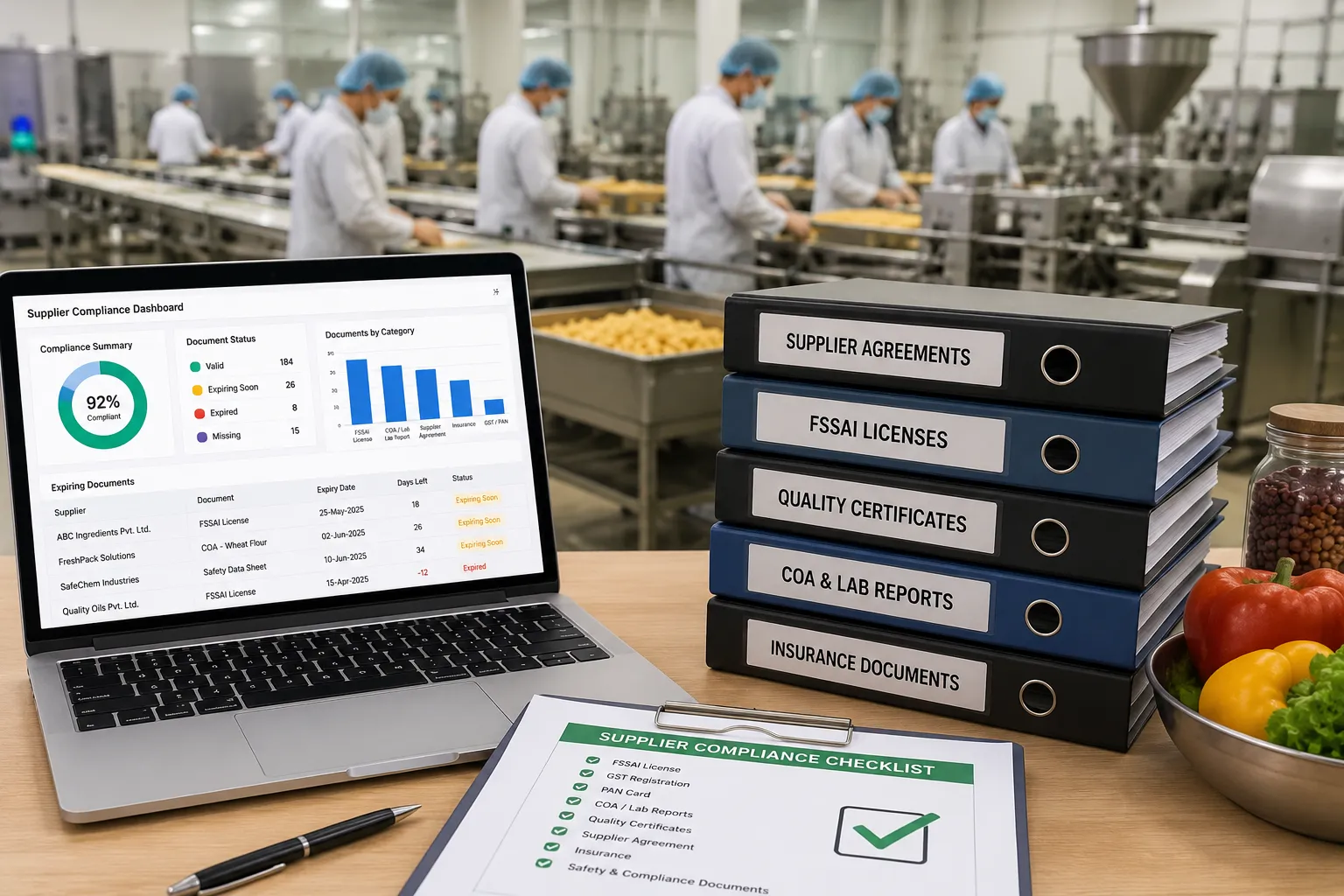
How Food Manufacturers Can Manage Supplier Compliance Documents
Food manufacturers depend on a large network of suppliers to keep production running.
A typical food manufacturing business may work with suppliers of:
- Raw materials
- Ingredients
- Dairy products
- Meat and poultry
- Seafood
- Spices
- Oils and fats
- Additives
- Packaging materials
- Cleaning chemicals
- Maintenance services
- Pest-control services
- Logistics providers
- Contract labour and facility services
Each supplier can have different documentation, quality and compliance requirements.
As the supplier network grows, managing these documents through email, spreadsheets and shared folders can become difficult.
Quality and procurement teams need to know:
- Which suppliers are approved
- Which documents are mandatory
- Which documents have been received
- Whether the submitted documents are the expected documents
- Which documents are valid
- Which documents are expiring
- Which documents have expired
- Which supplier records are incomplete
- Which suppliers require follow-up
- Which records are needed during an audit
This is why food manufacturers benefit from a structured supplier compliance document-management process.
Important: This is a practical supplier-management guide, not legal advice. Exact food-safety, quality, tax, labour, licensing and contractual requirements vary by business, product, supplier, location and applicable regulations. Food manufacturers should confirm their specific requirements with their legal, quality, food-safety, procurement and compliance teams.
Why Supplier Document Management Matters in Food Manufacturing
Supplier documentation is closely connected to quality and food-safety processes.
A supplier may be approved during onboarding, but its documentation can later:
- Expire
- Change
- Require renewal
- Become outdated
- Need additional review
- No longer match the approved specification
A food manufacturer therefore needs to manage supplier compliance continuously.
A useful process should answer:
Who is the supplier?
What materials or services do they provide?
Which documents are required?
Are the documents current?
Which documents need action?
Can the team quickly produce the relevant records when required?
1. Create a Central Supplier Master
The first step is to create one reliable supplier record.
Depending on the manufacturer’s onboarding process, this may include:
- Legal business name
- Supplier ID
- Registered address
- Operating address
- Contact person
- Email address
- Phone number
- PAN
- GSTIN where applicable
- Bank details
- Supplier category
- Product category
- Manufacturing location
- Contract details
- Internal supplier owner
- Approved plant or facility
A centralized supplier master helps prevent duplicate supplier records and gives procurement and quality teams a common source of supplier information.
2. Categorize Suppliers
Different suppliers require different documentation.
A food manufacturer may create categories such as:
- Raw Material Supplier
- Ingredient Supplier
- Dairy Supplier
- Meat Supplier
- Seafood Supplier
- Packaging Supplier
- Chemical Supplier
- Logistics Provider
- Pest-Control Vendor
- Maintenance Vendor
- Facility Management Vendor
Once a supplier category is defined, the system can assign the relevant document checklist.
3. Define Supplier-Specific Document Requirements
Avoid asking every supplier for the same documents.
For example:
Raw Material Supplier
Potential requirements:
- FSSAI documentation where applicable
- GST/PAN
- Product specifications
- Quality certificates
- Testing reports where required
- CoA where required
- Supplier declarations
Packaging Supplier
Potential requirements:
- GST/PAN
- Product specifications
- Quality documentation
- Food-contact documentation where relevant
- Supplier declarations
- Agreement
Maintenance Vendor
Potential requirements:
- GST/PAN
- Insurance
- Service agreement
- Technical certificates where applicable
- Safety documentation
- Service reports
The exact requirements should be configured according to the manufacturer’s own quality and compliance process.
4. Centralize Supplier Documents
Supplier documents can easily become scattered across:
- Shared drives
- Cloud storage
- Procurement folders
- Local computers
- Paper files
- Individual spreadsheets
A centralized repository can associate each document with:
- Supplier
- Document type
- Product or service
- Plant
- Status
- Issue date
- Expiry date
- Review status
This makes it easier to find the current record.
5. Separate Quality Documents From Commercial Documents
Food manufacturers often manage two broad categories of supplier information.
Quality and Food-Safety Documents
Examples include:
- FSSAI documentation where applicable
- Product specifications
- Quality certificates
- Laboratory reports
- Certificates of Analysis
- Supplier declarations
- Audit reports
- Corrective-action records
Commercial Documents
Examples include:
- Supplier agreement
- Purchase agreement
- Contract
- Insurance
- GST/PAN
- Banking information
- Commercial terms
Separating these categories makes the workflow easier for quality and procurement teams.
6. Track Product Specifications
Product specifications are important supplier records.
Depending on the material, a specification may contain:
- Product name
- Ingredient information
- Physical characteristics
- Chemical characteristics
- Microbiological parameters
- Storage requirements
- Shelf-life
- Packaging requirements
- Handling instructions
The manufacturer should maintain the current approved specification.
If a supplier changes the product or specification, the quality team may need to review the change before the material is accepted.
7. Manage Certificates of Analysis
For applicable materials, suppliers may provide a Certificate of Analysis (CoA) or equivalent quality documentation.
A CoA can contain information such as:
- Product name
- Batch or lot number
- Test parameters
- Test results
- Specification limits
- Testing date
- Supplier information
The manufacturer should define:
- Which materials require CoAs
- When CoAs must be submitted
- Who reviews them
- Which parameters must be checked
- How records are retained
Not every supplier or material requires the same process.
8. Track Laboratory and Testing Reports
Food manufacturers may receive testing documentation related to:
- Microbiological testing
- Chemical analysis
- Product quality
- Contaminants where applicable
- Other product-specific testing
These records may not behave like traditional expiry documents.
Instead, the manufacturer may need to track:
- Test date
- Batch or lot
- Report number
- Product
- Supplier
- Review date
- Follow-up action
This is why supplier document management should support both expiry-based documents and periodic records.
9. Manage FSSAI and Other Regulatory Documents
For applicable food businesses, FSSAI licensing or registration is an important area to monitor.
FSSAI states that applicable food business operators in India are required to obtain the relevant licence or registration, with requirements depending on the nature of the food business.
Food manufacturers should determine which supplier FSSAI documents are relevant to their supplier categories and processes.
Potential fields to track include:
- Document type
- Licence or registration number
- Supplier name
- Manufacturing location
- Issue date where applicable
- Validity or expiry information where applicable
- Uploaded document
- Review status
The exact requirements should be confirmed according to the supplier’s business activity and applicable framework.
10. Track Supplier Declarations
Supplier declarations can provide useful supporting information.
Depending on the product and company policy, these may include:
- Ingredient declarations
- Allergen-related information where applicable
- Product declarations
- Food-safety declarations
- Compliance declarations
- Other product-specific declarations
The required declarations should be defined by the quality and food-safety teams.
11. Manage Packaging Supplier Documents
Packaging can be a critical part of food manufacturing.
Manufacturers may purchase:
- Bottles
- Pouches
- Films
- Cartons
- Labels
- Containers
- Closures
- Other packaging materials
Potential supplier records include:
- Supplier profile
- GST/PAN
- Product specifications
- Material specifications
- Quality documentation
- Food-contact documentation where relevant
- Supplier declarations
- Agreement
The exact requirements depend on the packaging material, product and applicable requirements.
12. Track Cleaning Chemical Supplier Documents
Food manufacturers often depend on cleaning and sanitation chemicals.
Depending on internal controls, suppliers may provide:
- Product information
- Safety Data Sheets (SDS) where applicable
- Product specifications
- Usage instructions
- Supplier declarations
- Quality documentation
- Agreement
These records can help the facility maintain better control over products used in cleaning and sanitation processes.
13. Manage Pest-Control Vendor Documents
Pest control can be an important part of a food manufacturing facility’s supplier network.
Potential records include:
- Business documents
- GST/PAN
- Applicable licences or authorizations
- Insurance
- Service agreement
- Chemical/product information where relevant
- Service reports
- Safety documentation
- Training records
The manufacturer should also track service dates and follow-up actions.
14. Track Maintenance Vendor Documents
Manufacturing plants depend on external maintenance providers for equipment and facility systems.
Examples include:
- Processing equipment
- Refrigeration
- HVAC
- Electrical systems
- Boilers
- Compressors
- Generators
- Packaging machinery
- Water systems
Potential documents include:
- Vendor profile
- GST/PAN
- Service agreement
- Insurance
- Technician qualifications where relevant
- Technical certificates
- Safety documentation
- Inspection reports
- Service reports
Maintenance records are often periodic records rather than traditional expiry-based documents.
15. Manage Logistics and Cold-Chain Suppliers
Food manufacturers may use logistics providers for:
- Raw material transportation
- Finished goods transportation
- Cold-chain transportation
- Warehouse movement
- Distribution
Depending on the business and product, supplier documentation may include:
- Transport agreement
- Insurance
- Vehicle documentation where applicable
- Driver documentation where required
- Temperature records where applicable
- Delivery records
- Other transportation documentation
For temperature-sensitive products, the manufacturer may also track cold-chain records.
16. Manage Contractor and Labour Documents
Food manufacturing facilities may use contractors for:
- Housekeeping
- Security
- Maintenance
- Loading and unloading
- Facility management
- Production support
Depending on the arrangement and applicable requirements, the manufacturer may track:
- Contractor registration/licence where applicable
- PF registration
- PF payment records
- ESI registration where applicable
- ESI payment records where applicable
- Wage records
- Attendance records
- Worker information
- Insurance
- Labour-related documents
- Safety training records
The exact requirements depend on the establishment, contractor arrangement and applicable laws.
17. Track Insurance Documents
Depending on the supplier’s activities and contractual requirements, the manufacturer may track:
- Public liability insurance
- Product liability insurance where required
- Employee/workmen-related insurance
- Vehicle insurance
- Equipment insurance
- Other required coverage
Insurance requirements should be determined according to supplier risk and company policy.
18. Track Supplier Contracts
Supplier compliance also includes commercial agreements.
The manufacturer may track:
- Supplier agreement
- Purchase agreement
- Quality agreement
- Service-level agreement
- Scope of supply
- Contract start date
- Contract end date
- Renewal date
- Quality requirements
- Insurance requirements
A supplier can have valid quality documents but an expired contract.
Therefore:
Track contract dates separately from certificate expiry dates.
19. Automate Supplier Document Collection
Instead of requesting every document manually by email, a structured submission workflow can be used.
For example:
Supplier Onboarding
       ↓
Supplier Category
       ↓
Required Documents Assigned
       ↓
Supplier Uploads Documents
       ↓
Document Validation
       ↓
Quality / Compliance Review
       ↓
Approval
This makes missing documents easier to identify.
20. Use AI-Assisted Document Validation
One of the most useful automation opportunities is checking whether a submitted file appears to be the expected document.
For example:
Expected:
Certificate of Analysis
Uploaded:
Invoice
A basic file-storage system may mark the requirement as complete.
AI-assisted validation can instead help identify:
- Document type
- Supplier name
- Product name
- Batch or lot number
- Certificate number
- Issue date
- Expiry date where applicable
- Other relevant information
A simplified workflow is:
Document Uploaded
       ↓
OCR / Text Extraction
       ↓
Document Classification
       ↓
Information Extraction
       ↓
Validation Rules
       ↓
Validation Result
       ↓
Human Review
AI should assist the quality or compliance team rather than replace the final decision.
21. Track Expiry Dates Automatically
Many supplier documents have defined validity periods.
Examples include:
- Licences
- Certificates
- Insurance policies
- Contracts
- Permits
- Registrations
Instead of manually entering every date into a spreadsheet, a document-management system can extract relevant dates and create a tracking record.
For example:
Document Uploaded
       ↓
Relevant Date Extracted
       ↓
Date Stored
       ↓
Reminder Schedule
       ↓
Renewal
Extracted dates should be reviewed according to the manufacturer’s process.
22. Automate Renewal Reminders
Once expiry dates are stored, reminders can be automated.
For example:
60 Days Before Expiry
        ↓
Supplier Reminder

30 Days Before Expiry
        ↓
Follow-Up

15 Days Before Expiry
        ↓
Escalation

Expiry Date
        ↓
Status = Expired
The exact reminder schedule should be configurable.
Notifications may go to:
- Supplier
- Procurement
- Quality
- Food-safety team
- Compliance
- Supplier owner
23. Track Missing Documents
A supplier compliance dashboard should show incomplete supplier records.
For example:
| Supplier | Category | Missing Document | Status |
|---|---|---|---|
| ABC Ingredients | Raw Material | CoA | Action Required |
| Fresh Dairy | Dairy | Quality Certificate | Action Required |
| PackPro | Packaging | Declaration | Action Required |
| CleanTech | Chemical | SDS | Action Required |
This allows teams to work from an exception list rather than search through folders.
24. Maintain Supplier Compliance Status
A simple internal status model can be used.
Compliant
All mandatory requirements are satisfied according to the company’s defined process.
Attention Required
One or more documents are approaching expiry or require review.
Incomplete
Mandatory documents are missing.
Expired
One or more required documents have expired.
Under Review
Documents have been submitted but are awaiting review.
These are internal workflow statuses and should not be treated as a complete legal determination.
25. Create a Supplier Compliance Dashboard
A centralized dashboard can give procurement and quality teams a current view of supplier compliance.
Supplier Summary
- Total suppliers
- Active suppliers
- Pending suppliers
- Incomplete suppliers
Document Summary
- Missing documents
- Documents under review
- Expiring documents
- Expired documents
Supplier Category Summary
- Raw materials
- Ingredients
- Packaging
- Chemicals
- Logistics
- Maintenance
- Pest control
Plant Summary
- Supplier compliance by plant
- Missing documents by plant
- Expired documents by plant
- Upcoming renewals by plant
This helps management focus on exceptions.
26. Maintain an Audit Trail
A structured supplier document system should record important events.
For example:
- Supplier created
- Document requested
- Document uploaded
- Validation performed
- Document approved
- Document rejected
- Expiry date updated
- Reminder sent
- Renewal submitted
- Supplier status changed
This makes it easier to answer:
When did the supplier submit the document?
Who reviewed it?
When was the renewal reminder sent?
Which document was rejected?
27. Manage Suppliers Across Multiple Plants
Food manufacturers may operate multiple manufacturing plants.
A supplier may serve:
Central Supplier
       ↓
Plant 1
Plant 2
Plant 3
Plant 4
A centralized supplier master can maintain:
- One supplier profile
- Supplier documents
- Quality records
- Expiry dates
- Supplier status
- Plant relationships
This reduces duplicate supplier records and provides visibility into which plants may be affected by a supplier issue.
Excel vs Supplier Compliance Software
Excel can work for a small supplier network.
But food manufacturers with many suppliers, documents and plants may need a more structured workflow.
| Capability | Excel | Supplier Compliance Software |
|---|---|---|
| Supplier master | ✓ | ✓ |
| Document tracking | ✓ | ✓ |
| Expiry tracking | ✓ | ✓ |
| Central document repository | Limited | ✓ |
| Automated reminders | Manual / additional setup | ✓ |
| Supplier-specific requirements | Manual | ✓ |
| AI-assisted validation | No | ✓ |
| Approval workflow | Manual | ✓ |
| Multi-plant management | Possible but complex | ✓ |
| Compliance dashboard | Manual | ✓ |
| Audit trail | Limited | ✓ |
| Automated reporting | Manual | ✓ |
The main difference is that dedicated software manages the workflow around supplier compliance, not just a list of dates.
When Should a Food Manufacturer Automate?
There is no universal supplier count at which automation becomes necessary.
Look for operational signals.
Too Many Suppliers
If procurement teams are managing a large supplier network, manual tracking becomes increasingly time-consuming.
Too Many Documents
For example:
200 Suppliers
×
5 Documents
=
1,000 Documents
The actual number can be much higher when quality records and periodic documents are included.
Missed Expiry Dates
If expired documents are discovered after the fact, the existing reminder process may not be reliable.
Too Much Manual Follow-Up
If employees spend significant time emailing suppliers for renewals, automation can reduce repetitive work.
Multiple Plants
If supplier information is maintained separately by different plants, centralized management can improve visibility.
Audit Preparation Takes Too Long
If teams have to search multiple spreadsheets, folders and email threads to produce supplier records, a centralized system can help.
Food Manufacturer Supplier Compliance Checklist
Supplier Master
- Supplier ID
- Legal business name
- Contact details
- PAN
- GSTIN where applicable
- Supplier category
- Product category
- Approved plant/location
- Supplier owner
Regulatory & Food Safety
- FSSAI documentation where applicable
- Food-safety documentation
- Applicable certifications
- Supplier declarations
Quality
- Product specifications
- Quality certificates
- Laboratory reports where required
- CoAs where required
- Testing records
- Supplier audit records
- Corrective-action records
Commercial
- Supplier agreement
- Quality agreement
- Contract dates
- Insurance
- Commercial information
Operations
- Traceability records
- Delivery records
- Temperature records where applicable
- Service reports
- Inspection records
Monitoring
- Expiry dates
- Review dates
- Missing documents
- Expired documents
- Renewal reminders
- Approval history
- Audit trail
How VendorCompliancePro Helps Food Manufacturers
VendorCompliancePro is designed around the workflow:
Collect → Verify → Track → Remind → Report
Food manufacturers can use the platform to:
- Maintain centralized supplier records
- Categorize suppliers
- Define supplier-specific document requirements
- Associate suppliers with multiple plants
- Centralize supplier documents
- Validate uploaded documents using AI-assisted validation
- Extract relevant information from documents
- Track expiry and review dates
- Send automated reminders
- Monitor missing and expired documents
- Manage document review and approval
- Maintain an audit trail
- Generate supplier compliance reports
The objective is to reduce manual supplier follow-up while giving procurement, quality and compliance teams better visibility.
Explore VendorCompliancePro for Food Processing & Manufacturing
Best Practices for Food Manufacturer Supplier Document Management
1. Maintain One Supplier Master
Avoid unnecessary duplicate supplier records.
2. Categorize Suppliers
Use categories to drive document requirements.
3. Separate Quality and Commercial Documents
Make it clear which records are owned by quality, procurement, finance or compliance.
4. Track Both Expiry and Review Dates
Not every supplier record has a traditional expiry date.
5. Use AI as an Assistant
AI-assisted validation can reduce repetitive document checking.
6. Keep Human Review
Quality and compliance teams should make final decisions.
7. Automate Renewal Reminders
Reduce manual follow-up.
8. Map Suppliers to Plants
Know which manufacturing locations use each supplier.
9. Focus on Exceptions
Use dashboards to identify missing, expired and pending records.
10. Maintain an Audit Trail
Record submissions, reviews, approvals, rejections and renewals.
Frequently Asked Questions
How should food manufacturers manage supplier compliance documents?
Food manufacturers should maintain a centralized supplier master, define supplier-specific document requirements, centralize documents, validate submissions, track expiry and review dates, automate reminders and maintain an audit trail.
What documents should food manufacturers collect from suppliers?
Depending on the supplier category, companies may track FSSAI documentation where applicable, GST/PAN, product specifications, quality certificates, laboratory reports, CoAs, supplier declarations, contracts, insurance and other supplier-specific records.
Should food manufacturers track Certificates of Analysis?
Where CoAs are part of the company’s supplier-quality process, they can be tracked by supplier, product, batch or lot and review status.
Should all supplier documents have expiry dates?
No. Licences, certificates, insurance and contracts may have expiry dates, while laboratory reports, CoAs, audits and service records may use report or review dates.
Can AI validate supplier compliance documents?
AI-assisted OCR and document validation can help identify document types, extract supplier and product information and highlight potential mismatches. Final quality and compliance decisions should remain with the responsible team.
How can manufacturers manage suppliers across multiple plants?
A centralized supplier master can associate suppliers with multiple plants while maintaining common supplier documents and plant-specific requirements.
Can supplier document management be automated with Excel?
Excel can track supplier information and dates, but automation becomes more difficult as the number of suppliers, documents, users and plants increases. Dedicated software can provide automated reminders, workflows, validation and reporting.
When should a food manufacturer move from Excel to supplier compliance software?
The decision depends on supplier volume and process complexity. Missed expiries, excessive manual follow-up, multiple plants, scattered documents and lengthy audit preparation are common signals that a more structured system may be useful.
Conclusion
Supplier compliance document management is an important part of food manufacturing operations.
The objective is not simply to store supplier PDFs.
A strong process should make it easy to answer:
Who is the supplier?
What do they provide?
Which documents are required?
Are those documents current?
What needs review?
What expires next?
Which plant is affected?
A practical workflow is:
Collect
↓
Verify
↓
Review
↓
Track
↓
Remind
↓
Report
For food manufacturers with growing supplier networks and multiple plants, centralized supplier compliance software can reduce manual administration and provide better visibility into supplier documentation.
VendorCompliancePro is designed to help food processing and manufacturing businesses centralize supplier documents, use AI-assisted validation, track expiry dates, automate reminders and maintain audit-ready supplier records.
Explore VendorCompliancePro for Food Processing & Manufacturing
Related Articles
Food Processing & Manufacturing Vendor Compliance
- Food Processing Supplier Compliance Checklist
- Food Supplier Compliance: Documents Restaurants Should Track
- How Restaurant Chains Can Manage Supplier Documents Across Multiple Locations
- How QSRs Can Automate Vendor Document Management
Vendor Compliance
- What Is Vendor Compliance?
- Vendor Document Management
- Vendor Audit Readiness Checklist
- Vendor Compliance Software India