Vendor Risk Score Calculator: Free Tool to Assess Supplier and Contractor Risk
Not every supplier or contractor creates the same level of risk.
A local service provider with limited access to your operations may require a different level of monitoring than a critical supplier, high-value contractor, or vendor working directly at your facility.
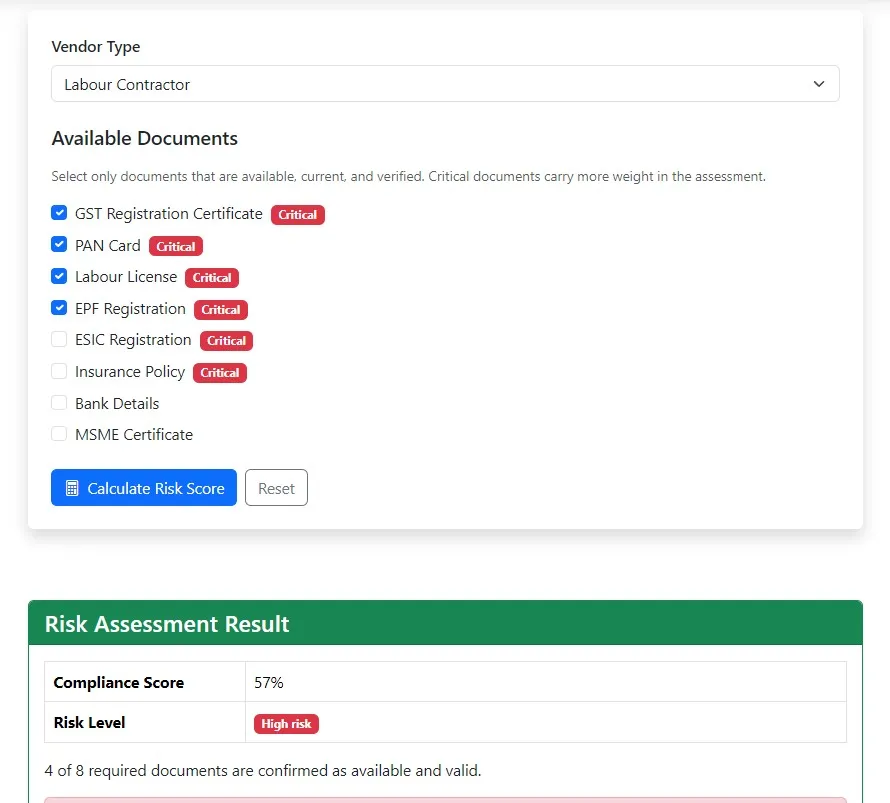
A Vendor Risk Score Calculator helps procurement, compliance, and supplier management teams assess vendor risk using a structured scoring approach.
Instead of relying only on subjective opinions, organizations can evaluate vendors against defined risk factors and use the resulting score to prioritize monitoring and review.
VendorCompliancePro provides a free online Vendor Risk Score Calculator to help businesses create a practical starting point for vendor risk assessment.
Use the Free Vendor Risk Score Calculator →
What Is a Vendor Risk Score?
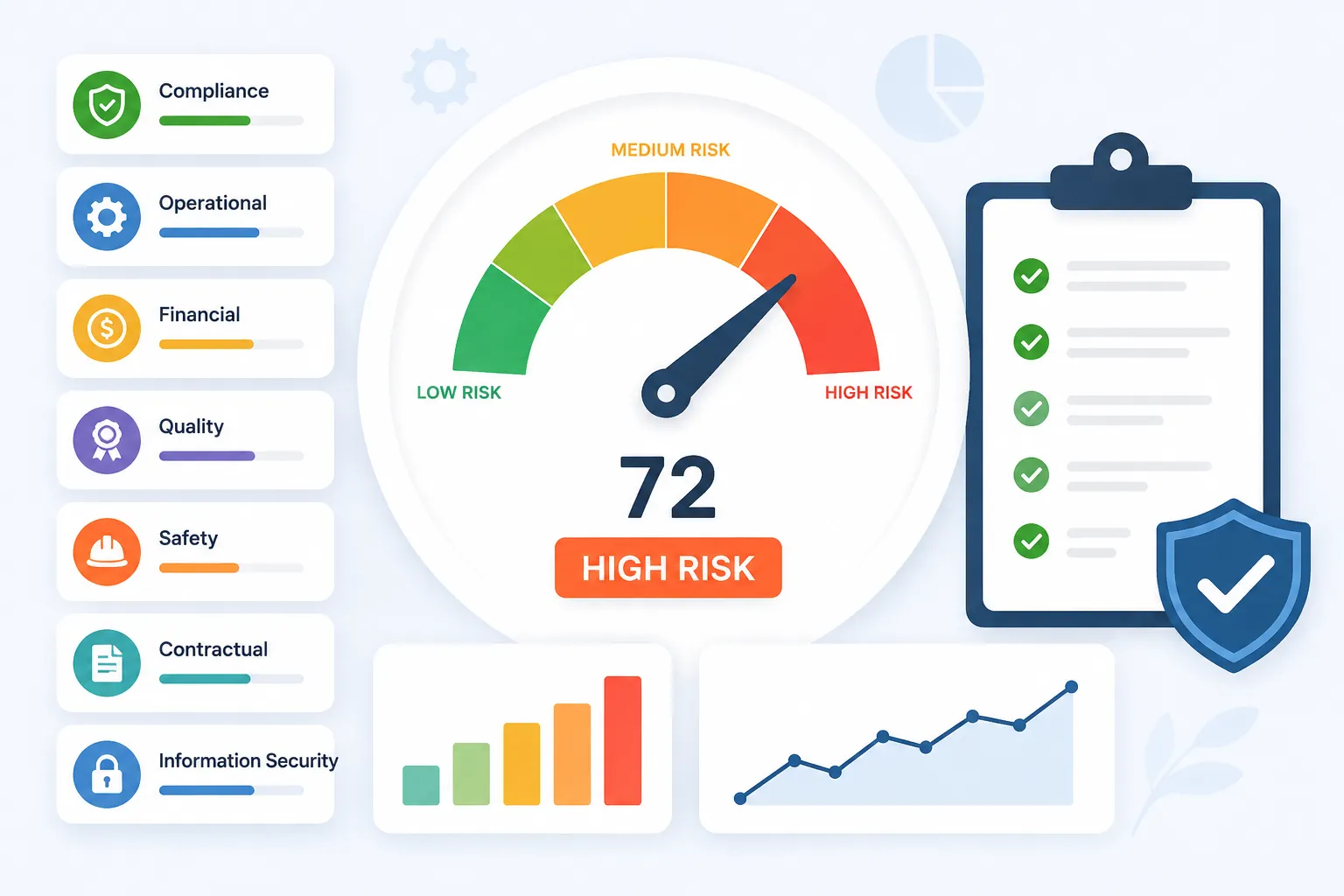
A vendor risk score is a numerical or categorized assessment that represents the level of risk associated with a supplier, contractor, or service provider.
The score can help organizations classify vendors into categories such as:
- Low risk
- Medium risk
- High risk
The exact scoring model should be customized to the organization’s industry, vendor type, risk appetite, contractual requirements, and applicable requirements.
A risk score is not a guarantee that a vendor is safe or compliant. It is a decision-support tool that helps teams prioritize attention.
Why Vendor Risk Scoring Matters
Organizations may work with dozens or hundreds of external vendors.
It can be difficult to give every vendor the same level of review and monitoring.
Risk scoring helps teams answer questions such as:
- Which vendors require closer monitoring?
- Which suppliers should be reviewed more frequently?
- Which vendors have significant compliance concerns?
- Which third parties are critical to operations?
- Where should procurement and compliance teams focus their time?
A structured score can make vendor reviews more consistent.
What Factors Should Be Considered in Vendor Risk?
Vendor risk can come from multiple areas.
Depending on your organization, relevant factors may include:
Compliance Risk
Consider:
- Missing documents
- Expired certificates
- Statutory requirements
- Regulatory history
- Compliance performance
Operational Risk
Consider:
- Impact of vendor failure
- Business continuity
- Criticality of supplied products or services
- Production dependency
- Service availability
Financial Risk
Consider:
- Financial stability
- Payment or credit concerns
- Supplier dependency
- Business continuity indicators
Quality Risk
Consider:
- Product quality
- Defect rates
- Quality certifications
- Corrective actions
- Customer complaints
Safety Risk
For vendors working at your site or performing higher-risk activities, consider:
- Safety performance
- Training
- Incident history
- PPE requirements
- Risk assessments
Contract Risk
Consider:
- Contract value
- Contract duration
- Renewal requirements
- Service-level obligations
- Critical contractual terms
Data or Security Risk
Where applicable, consider:
- Access to sensitive information
- System access
- Data handling
- Cybersecurity requirements
- Security controls
Not every risk category applies to every vendor.
What Is the Vendor Risk Score Calculator?
The Vendor Risk Score Calculator is a free online tool from VendorCompliancePro that helps users create a structured vendor risk assessment.
Instead of starting with a blank spreadsheet, procurement and compliance teams can use the calculator as a starting point for evaluating supplier and contractor risk.
Try the Free Vendor Risk Score Calculator →
The resulting score can then be used as an input into your organization’s vendor review and monitoring process.
How to Use a Vendor Risk Score Calculator
A practical vendor risk assessment can follow these steps.
Step 1: Identify the Vendor
Start with basic information such as:
- Vendor name
- Vendor category
- Products or services
- Business location
- Criticality to your organization
Step 2: Identify Relevant Risk Factors
Determine which risk areas apply to the vendor.
For example:
- Compliance
- Operational
- Financial
- Quality
- Safety
- Contract
- Security
Step 3: Assess Each Risk Area
Evaluate the vendor against your selected criteria.
Use consistent definitions for low, medium, and high risk where possible.
Step 4: Calculate the Overall Risk Score
Combine the individual assessments using your selected scoring method.
Step 5: Assign a Risk Category
Classify the vendor based on your organization’s thresholds.
For example:
- Low risk
- Medium risk
- High risk
Step 6: Define Monitoring Requirements
Higher-risk vendors may require more frequent reviews, additional documentation, or stronger controls.
Example Vendor Risk Assessment
Consider a manufacturing company that uses three different vendors.
| Vendor | Compliance | Operational | Quality | Overall Risk |
|---|---|---|---|---|
| Office Supplies Vendor | Low | Low | Low | Low |
| Maintenance Contractor | Medium | High | Medium | Medium/High |
| Critical Production Supplier | High | High | High | High |
The purpose of this type of assessment is not simply to produce a number.
The real value is using the assessment to determine how much oversight each vendor requires.
Low, Medium, and High Vendor Risk
Low-Risk Vendors
These vendors may have:
- Limited operational impact
- Low dependency
- Minimal site access
- Low compliance exposure
They may require standard onboarding and periodic review.
Medium-Risk Vendors
These vendors may have:
- Moderate operational impact
- Some site access
- Higher contract value
- Additional compliance requirements
They may require more frequent review.
High-Risk Vendors
These vendors may:
- Be critical to production
- Have significant site access
- Handle sensitive information
- Provide safety-critical services
- Create significant compliance exposure
- Have a high business impact if they fail
They may require enhanced due diligence and more frequent monitoring.
These classifications should be defined according to your organization’s risk framework.
Vendor Risk Score vs Vendor Compliance Score
These concepts are related but not identical.
| Vendor Risk Score | Vendor Compliance Score |
|---|---|
| Measures overall vendor risk | Focuses on compliance status |
| Can include operational and financial factors | Focuses mainly on required compliance |
| Helps prioritize vendor oversight | Helps identify compliance gaps |
| Can include business criticality | Can include document validity |
| Supports risk-based monitoring | Supports compliance management |
A vendor can have good document compliance but still represent significant operational or financial risk.
Why Risk-Based Vendor Monitoring Is Important
Treating every vendor exactly the same can consume unnecessary resources.
A risk-based approach allows organizations to prioritize.
For example:
Low Risk
- Standard onboarding
- Periodic review
- Basic documentation
Medium Risk
- More frequent compliance review
- Additional documentation
- Performance monitoring
High Risk
- Enhanced due diligence
- More frequent reviews
- Additional controls
- Senior management oversight where appropriate
The exact controls should be defined by the organization.
Common Vendor Risk Assessment Mistakes
Using Subjective Judgement Only
Different managers may assign different risk levels to similar vendors.
Using the Same Risk Criteria for Every Vendor
A manufacturing supplier and an office cleaning service may have very different risk profiles.
Ignoring Business Criticality
A vendor can be highly important even when its compliance documentation is complete.
Assessing Risk Only During Onboarding
Vendor risk can change over time.
Not Updating Risk Scores
Major changes in contracts, services, incidents, financial condition, or compliance status may require reassessment.
Focusing Only on Compliance
Compliance is important, but operational, financial, quality, safety, and security risks may also matter.
Best Practices for Vendor Risk Scoring
Define Clear Risk Categories
Document what low, medium, and high risk mean for your organization.
Use Consistent Criteria
Apply the same assessment methodology to comparable vendors.
Consider Vendor Criticality
Assess the impact of vendor failure on your operations.
Combine Multiple Risk Factors
Avoid relying on one metric.
Review High-Risk Vendors More Frequently
Higher-risk relationships generally require stronger oversight.
Update Scores Periodically
Reassess vendors when their risk profile changes.
Connect Risk With Action
A risk score should lead to appropriate monitoring, controls, or review.
Vendor Risk Scoring and Vendor Compliance
Vendor risk scoring can work together with vendor compliance management.
For example:
Vendor Onboarding
↓
Document Collection
↓
Compliance Verification
↓
Risk Assessment
↓
Vendor Approval
↓
Ongoing Monitoring
↓
Periodic Reassessment
This creates a more structured approach to vendor management.
How a Vendor Risk Score Calculator Helps Procurement Teams
A free risk calculator can provide a useful starting point when building a vendor risk assessment process.
It can help teams:
- Structure vendor risk discussions
- Compare vendors consistently
- Identify higher-risk vendors
- Prioritize reviews
- Create a repeatable assessment process
- Support procurement decisions
The calculator should complement, not replace, your organization’s formal risk management process.
Vendor Risk Scoring for Manufacturing Companies
Manufacturing organizations may manage suppliers across raw materials, machinery, maintenance, logistics, packaging, contractors, and other services.
Risk scoring can help identify vendors that could have a significant effect on:
- Production continuity
- Product quality
- Worker safety
- Regulatory compliance
- Supply chain continuity
- Customer commitments
For critical suppliers, risk assessment can be combined with performance monitoring and compliance tracking.
Vendor Risk Scoring for Contractors
Contractors can introduce additional operational and safety considerations.
Depending on the work, organizations may consider:
- Site access
- Number of workers
- Type of work
- Safety exposure
- Insurance
- Labour compliance
- Contract value
- Operational dependency
Higher-risk contractors may require additional documentation, safety controls, and periodic reviews.
How the Free Tool Can Help
The free Vendor Risk Score Calculator gives procurement and vendor management teams a simple starting point for assessing supplier and contractor risk.
You can use it to:
- Evaluate vendor risk
- Structure risk discussions
- Identify higher-risk vendors
- Prioritize monitoring
- Create a consistent assessment process
Use the Free Vendor Risk Score Calculator →
After generating a score, organizations should apply their own risk thresholds, approval policies, and monitoring requirements.
How VendorCompliancePro Helps With Ongoing Vendor Risk
VendorCompliancePro helps organizations manage vendor compliance and risk-related activities through:
- Vendor self-service portal
- Centralized vendor document repository
- Compliance tracking
- Automated expiry reminders
- Approval workflows
- AI-powered document validation
- Compliance dashboards
- Audit trails
- Reporting and analytics
These capabilities can help organizations move from one-time vendor assessment toward continuous vendor monitoring.
Frequently Asked Questions
What is a Vendor Risk Score Calculator?
A Vendor Risk Score Calculator is a tool that helps organizations assess supplier or contractor risk using defined risk factors and scoring criteria.
What factors should be included in vendor risk scoring?
Common factors may include compliance, operational impact, financial stability, quality, safety, contract exposure, security, and business criticality.
What does a high vendor risk score mean?
A high score generally indicates that a vendor requires greater attention or stronger controls under the organization’s risk framework.
How often should vendor risk be assessed?
The frequency should depend on vendor risk. Higher-risk vendors may require more frequent reassessment than low-risk vendors.
Can small businesses use vendor risk scoring?
Yes. Even small businesses can use a simple risk scoring framework to prioritize supplier reviews.
Is vendor risk the same as vendor compliance?
No. Compliance is one component of vendor risk. Overall vendor risk can also include operational, financial, quality, safety, security, and business continuity factors.
Can Excel be used for vendor risk scoring?
Yes. Excel can support basic scoring, but centralized systems can provide better visibility, workflow, history, and ongoing monitoring as the vendor base grows.
Is the Vendor Risk Score Calculator free?
Yes. VendorCompliancePro provides the Vendor Risk Score Calculator as a free online tool.
Conclusion
A Vendor Risk Score Calculator helps procurement and vendor management teams move toward a more structured, risk-based approach to supplier and contractor management.
Instead of treating every vendor identically, organizations can use risk scoring to identify higher-risk relationships, prioritize monitoring, and determine where additional controls may be appropriate.
Use the free calculator as a starting point, then customize your risk criteria and thresholds according to your organization’s industry, vendor types, contracts, risk appetite, and internal policies.
Try the Free Vendor Risk Score Calculator →