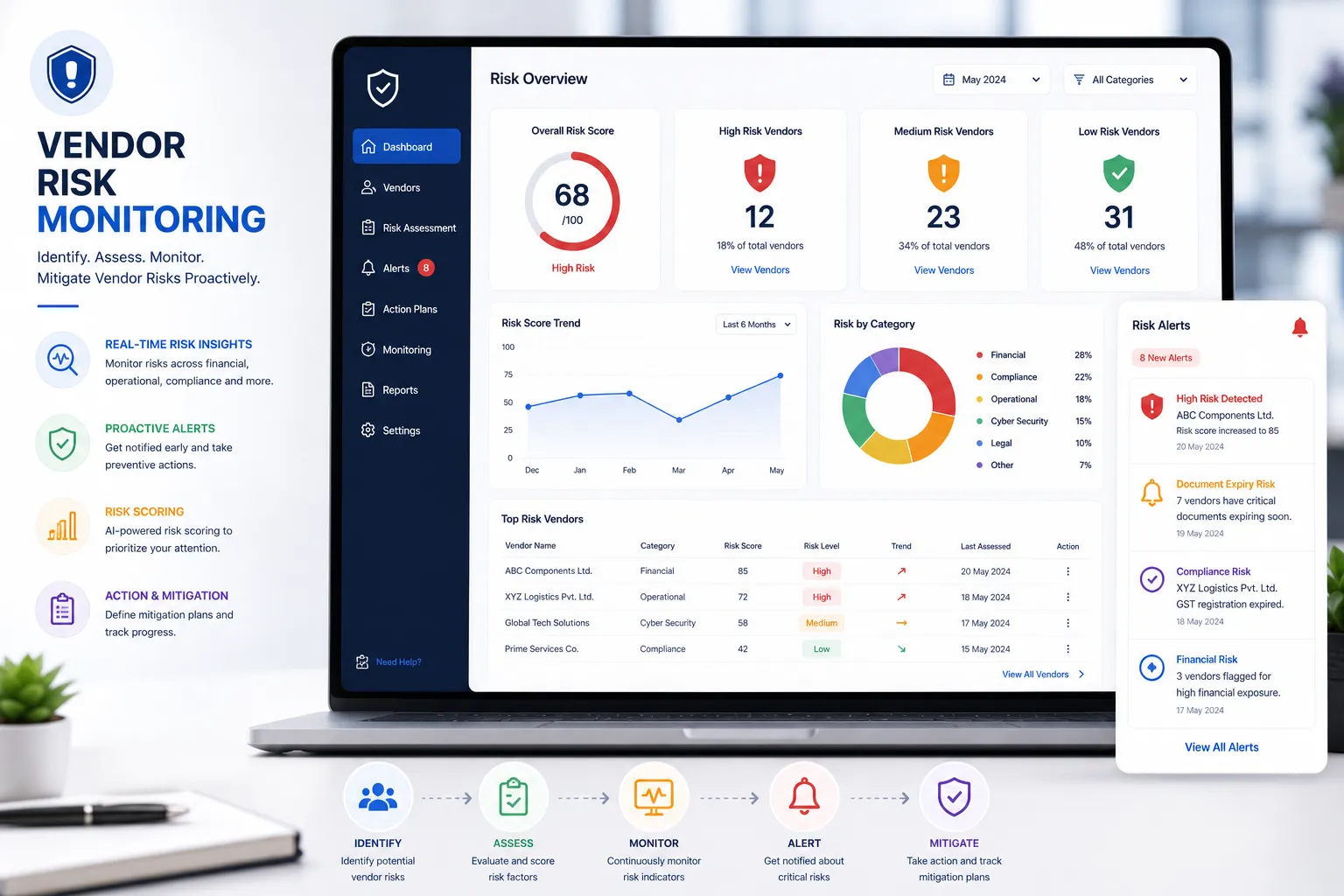
Vendor Risk Monitoring: Complete Guide to Supplier Risk Management (2026)
Vendor risk does not end when a supplier or contractor is approved.
Compliance documents can expire, contracts can approach renewal, delivery performance can decline, quality issues can appear, and operational risks can change over time.
Vendor Risk Monitoring is the ongoing process of identifying, assessing, tracking, and responding to risks associated with suppliers and other third parties throughout the vendor relationship.
For manufacturing companies, logistics providers, warehouses, engineering firms, construction companies, and facility-management organizations, continuous vendor risk monitoring can improve visibility and help teams respond to issues before they become larger operational or compliance problems.
This guide explains vendor risk monitoring, the main risk categories, vendor risk scoring, monitoring workflows, best practices, and software features to consider.
What Is Vendor Risk Monitoring?
Vendor risk monitoring is the continuous process of reviewing relevant risk indicators associated with a supplier, contractor, or service provider after onboarding.
Depending on the organization and vendor category, monitoring may include:
- Compliance status
- Document validity
- Contract status
- Delivery performance
- Quality performance
- Service-level performance
- Financial indicators
- Operational issues
- Safety-related information
- Corrective actions
- Vendor risk score
The objective is to maintain an up-to-date view of vendor risk instead of relying only on an initial assessment or an annual review.
Vendor Risk Assessment vs Vendor Risk Monitoring
These terms are related but not identical.
Vendor Risk Assessment
A vendor risk assessment evaluates a supplier’s risk before or during onboarding.
It may consider:
- Vendor category
- Services provided
- Location
- Access to facilities or data
- Compliance requirements
- Operational importance
- Business criticality
Vendor Risk Monitoring
Vendor risk monitoring continues after onboarding.
It looks for changes such as:
- Expiring documents
- New compliance issues
- Performance deterioration
- Contract renewals
- Repeated delays
- Quality problems
- Corrective actions
A useful vendor management process can therefore follow:
Assessment → Approval → Monitoring → Reassessment
Why Vendor Risk Monitoring Matters
A vendor can become higher risk after onboarding.
For example:
- An insurance certificate may expire.
- A required licence may approach expiry.
- Delivery performance may deteriorate.
- Quality complaints may increase.
- A contract may approach its renewal date.
- A critical supplier may experience operational disruption.
Without ongoing monitoring, these changes may remain unnoticed until they affect operations.
Continuous monitoring helps organizations:
- Identify issues earlier
- Prioritize follow-up
- Improve compliance visibility
- Support procurement decisions
- Reduce operational surprises
- Maintain better vendor records
- Prepare for audits and reviews
What Vendor Risks Should Be Monitored?
Not every vendor requires the same risk model.
Organizations should define risk indicators based on the vendor’s role, criticality, industry, and applicable requirements.
1. Compliance Risk
Monitor applicable:
- Registrations
- Licences
- Certificates
- Insurance documents
- PF and ESIC records where applicable
- Labour-related records
- Other required compliance documents
The objective is to identify missing, expired, or overdue records.
2. Operational Risk
Operational risk may include:
- Service interruptions
- Capacity problems
- Delivery delays
- Dependence on a single supplier
- Site-related issues
- Business continuity concerns
Critical suppliers may require more frequent monitoring.
3. Quality Risk
Depending on the supplier relationship, organizations may track:
- Rejected deliveries
- Quality complaints
- Defect rates
- Corrective actions
- Repeat quality issues
- Inspection results
Quality indicators should be based on measurable data rather than assumptions.
4. Contract Risk
Track:
- Contract start date
- Contract end date
- Renewal date
- Notice period
- Service-level requirements
- Pending contract actions
Contract monitoring helps teams avoid last-minute renewal decisions.
See Vendor Contract Expiry Reminder.
5. Financial Risk
Financial risk may be relevant for critical suppliers.
Organizations may consider indicators such as:
- Payment or credit concerns
- Supplier dependency
- Business continuity signals
- Financial information available through appropriate sources
Financial-risk monitoring should be based on reliable information and appropriate review processes.
6. Performance Risk
Track measurable supplier performance indicators such as:
- On-time delivery
- Quality performance
- Response time
- Service-level compliance
- Issue resolution time
- Complaint frequency
A vendor performance scorecard can help structure these measurements.
See Vendor Performance Scorecard.
7. Safety and Environmental Risk
For applicable vendors, organizations may monitor:
- Safety records
- Training records
- Incident information
- Required safety documents
- Environmental permits or certificates
- Corrective actions
Requirements should be based on the vendor’s activities and applicable regulations.
Vendor Risk Scoring
A vendor risk score helps organizations prioritize attention across a large vendor population.
A simple model could use:
| Risk Area | Example Weight |
|---|---|
| Compliance | 30% |
| Operational | 25% |
| Quality | 20% |
| Performance | 15% |
| Contract | 10% |
These weights are only an example. Each organization should define its own scoring model based on business priorities.
A score can then be mapped to categories such as:
| Score Range | Example Risk Level |
|---|---|
| 0–30 | Low |
| 31–60 | Medium |
| 61–80 | High |
| 81–100 | Critical |
The exact thresholds should be configured according to the organization’s risk framework.
How a Vendor Risk Score Can Change
A risk score should not be treated as permanent.
For example:
Initial assessment
Low risk
↓
Compliance document expires
Risk increases
↓
Repeated delivery delays
Risk increases further
↓
Corrective action completed
Risk may decrease
↓
Periodic reassessment
Risk score updated
This makes vendor risk monitoring a continuous process rather than a one-time exercise.
Vendor Risk Monitoring Workflow
A practical workflow can be:
Step 1: Classify the Vendor
Record vendor category, business criticality, location, and relevant risk factors.
Step 2: Perform Initial Risk Assessment
Evaluate the vendor against the organization’s risk criteria.
Step 3: Assign Risk Level
Classify the vendor as low, medium, high, or another defined category.
Step 4: Define Monitoring Requirements
High-risk or critical vendors may require more frequent monitoring.
Step 5: Collect Risk Indicators
Track applicable compliance, performance, quality, contract, and operational information.
Step 6: Update Risk Score
Recalculate the score when significant information changes.
Step 7: Identify Exceptions
Flag:
- Expired documents
- Missing records
- Performance problems
- Contract renewals
- Quality issues
- Open corrective actions
Step 8: Assign Corrective Actions
Define an owner and due date for each issue.
Step 9: Escalate Important Risks
Escalate high or critical risks according to the organization’s policy.
Step 10: Reassess Periodically
Review the vendor based on risk level and business criticality.
Continuous Vendor Monitoring vs Periodic Review
| Periodic Review | Continuous Monitoring |
|---|---|
| Review at fixed intervals | Monitor relevant changes |
| Issues may remain hidden between reviews | Issues can be identified earlier |
| Manual follow-up | Automated notifications where supported |
| Limited real-time visibility | Current risk status |
| Reactive action | Proactive action |
Continuous monitoring does not mean every vendor must be monitored every day.
The monitoring frequency should be risk-based.
Benefits of Vendor Risk Monitoring
Early Risk Identification
Organizations can identify changes before they become major problems.
Better Compliance Visibility
Teams can see which vendors have missing, expired, or pending records.
Better Procurement Decisions
Risk information can support supplier selection, renewal, and review decisions.
Reduced Operational Risk
Critical supplier issues can be identified earlier.
Better Audit Readiness
Risk records, compliance documents, reviews, and corrective actions can be maintained together.
Prioritized Follow-Up
Teams can focus their effort on high-risk and critical vendors.
Improved Supplier Relationships
Clear monitoring criteria and corrective-action processes can create more structured supplier reviews.
Manual Vendor Risk Monitoring vs Automated Monitoring
| Manual Monitoring | Automated Monitoring |
|---|---|
| Excel risk registers | Centralized risk dashboard |
| Manual expiry checks | Automated alerts |
| Periodic spreadsheet reviews | Configurable monitoring |
| Manual score calculations | Automated scoring where configured |
| Scattered evidence | Centralized records |
| Manual follow-up | Workflow notifications |
| Difficult reporting | Risk reports and dashboards |
Automation improves visibility and reduces repetitive administrative work, but organizations still need human judgment for important risk decisions.
Features to Look for in Vendor Risk Monitoring Software
A vendor risk management platform may provide:
- Vendor risk profiles
- Configurable risk categories
- Risk scoring
- Risk-level classification
- Compliance tracking
- Document expiry monitoring
- Performance scorecards
- Contract tracking
- Corrective-action management
- Automated notifications
- Approval workflows
- Dashboards
- Reports
- Audit trails
- Role-based access
- API integration
Choose features based on the actual risk-management process rather than selecting software solely because it has a long feature list.
Vendor Risk Monitoring Checklist
Use this checklist as a starting point.
Vendor Profile
- Vendor category recorded
- Business criticality defined
- Location recorded
- Contract owner assigned
- Risk owner assigned
Compliance
- Required documents identified
- Missing documents tracked
- Expiry dates monitored
- Renewals tracked
- Applicable PF/ESIC records monitored
Performance
- Delivery performance reviewed
- Quality performance reviewed
- Service-level performance reviewed
- Complaints tracked
- Corrective actions tracked
Risk
- Initial risk assessment completed
- Risk score assigned
- Risk level defined
- Monitoring frequency established
- High-risk vendors identified
- Periodic reassessment completed
Audit
- Review history maintained
- Supporting evidence accessible
- Risk changes recorded
- Corrective actions documented
- Audit reports available
Best Practices for Vendor Risk Monitoring
1. Use a Risk-Based Approach
Do not treat every supplier exactly the same.
Critical suppliers may require more frequent or detailed reviews.
2. Define Clear Risk Criteria
Document how compliance, operational, quality, performance, and other risk indicators affect the risk score.
3. Use Measurable Indicators
Where possible, use actual performance and compliance data rather than subjective assumptions.
4. Monitor Changes
Focus on events that can change the vendor’s risk profile.
5. Assign Ownership
Every significant risk should have an accountable owner.
6. Track Corrective Actions
Identifying a risk is not enough. Track actions until the issue is resolved or accepted.
7. Maintain an Audit Trail
Keep a history of assessments, risk changes, reviews, and corrective actions.
8. Reassess Critical Vendors
Review high-risk and business-critical vendors more frequently according to your risk policy.
Common Vendor Risk Monitoring Mistakes
Monitoring Vendors Only During Onboarding
Initial approval does not guarantee that vendor risk will remain unchanged.
Using the Same Risk Level Forever
Risk levels should be updated when significant conditions change.
Treating Every Vendor the Same
A critical production supplier may require more monitoring than a low-impact service provider.
Tracking Risk Without Corrective Actions
A dashboard is not enough if issues have no owner or due date.
Using Unreliable Data
Risk decisions should be based on appropriate and trustworthy information.
Relying Entirely on Automation
Automated scores and alerts should support, not replace, informed human decisions.
How AI Can Support Vendor Risk Monitoring
AI can assist with parts of the monitoring process.
Depending on the system, AI may help:
- Extract information from vendor documents
- Identify document types
- Detect expiry dates
- Flag missing information
- Summarize vendor records
- Identify patterns in vendor performance data
- Prioritize records for human review
AI-generated risk insights should be reviewed before being used for significant procurement, legal, financial, safety, or compliance decisions.
How VendorCompliancePro Helps
VendorCompliancePro helps organizations connect vendor compliance monitoring with broader vendor risk management.
Relevant capabilities include:
- Vendor self-service portal
- Centralized vendor records
- Configurable document requirements
- Compliance document tracking
- Automated expiry reminders
- AI-powered document validation
- OCR processing
- Compliance dashboards
- Vendor risk information
- Approval workflows
- Audit trails
- Reports and analytics
Organizations can use the platform to maintain vendor information, monitor compliance-related risks, identify missing or expiring documents, and maintain evidence for reviews and audits.
VendorCompliancePro can complement an ERP or procurement system by focusing on vendor onboarding, document collection, compliance monitoring, expiry tracking, and vendor risk visibility.
Frequently Asked Questions
What is vendor risk monitoring?
Vendor risk monitoring is the ongoing process of tracking relevant supplier risks after onboarding, including compliance, operational, contract, quality, financial, and performance indicators.
What is the difference between vendor risk assessment and monitoring?
Risk assessment evaluates a vendor at a particular point in the relationship. Monitoring continues after onboarding and identifies changes that may affect the vendor’s risk level.
What should be monitored for vendors?
The appropriate indicators depend on the vendor. Common areas include compliance documents, contracts, delivery, quality, service levels, operational risks, and corrective actions.
What is a vendor risk score?
A vendor risk score is a structured measure used to summarize selected risk indicators and help prioritize vendor reviews.
How often should vendors be monitored?
There is no single frequency for every vendor. A risk-based approach can use more frequent reviews for critical or high-risk vendors and less frequent reviews for lower-risk vendors.
Can vendor risk monitoring be automated?
Parts of the process can be automated, including document-expiry alerts, risk calculations, dashboards, notifications, reporting, and workflow management.
Human review remains important for significant risk decisions.
Can Excel be used for vendor risk monitoring?
Yes. Excel can work for small and simple vendor populations.
As vendor numbers and risk indicators increase, specialized software can provide centralized records, automated alerts, scoring, workflows, dashboards, and audit trails.
Conclusion
Vendor risk monitoring is an ongoing process rather than a one-time vendor assessment.
Organizations can strengthen supplier oversight by connecting:
Risk Assessment → Risk Classification → Compliance Monitoring → Performance Monitoring → Issue Detection → Corrective Action → Reassessment
A risk-based approach helps teams focus their attention where it matters most.
For manufacturing, logistics, warehousing, engineering, construction, and facility-management organizations, structured vendor risk monitoring can improve visibility, support better procurement decisions, and reduce avoidable compliance and operational surprises.
The goal is not to create a complicated risk score for every vendor.
The goal is to know:
Which vendors present the greatest risk, why they are considered high risk, what has changed, and what action is required?