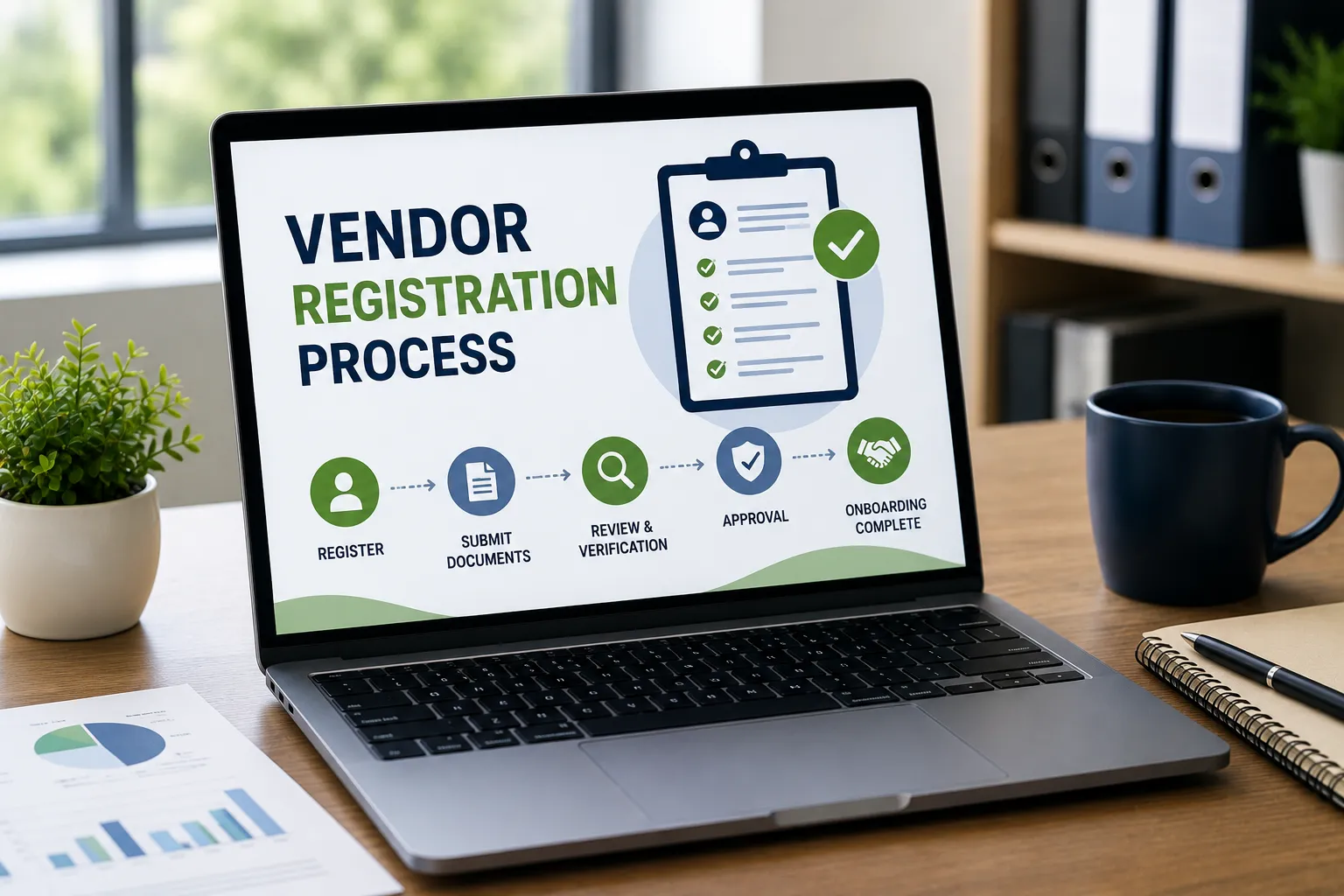
Vendor Registration Process: Requirements, Documents & Step-by-Step Guide
Selecting the right suppliers is only the first step in procurement.
Before a vendor can receive purchase orders, provide services, or receive payments, the organization typically needs to complete a vendor registration process.
Many organizations still manage vendor registration through emails, spreadsheets, paper forms, and shared folders. This can result in incomplete information, duplicate vendor records, delayed approvals, missing documents, and compliance problems.
A well-defined vendor registration process helps procurement teams collect the right information, verify supplier documents, assess risk, obtain approvals, and create a controlled vendor record.
In this guide, we will explain:
- What vendor registration means
- Why vendor registration is important
- The complete vendor registration process
- Vendor registration requirements
- Common vendor registration documents
- Vendor verification and risk assessment
- Vendor approval workflows
- Vendor master data creation
- Ongoing compliance monitoring
- Common registration challenges
- Best practices for faster vendor registration
- A practical vendor registration checklist
What Is Vendor Registration?
Vendor registration is the process of collecting, verifying, reviewing, and approving a supplier’s business, financial, tax, banking, and compliance information before the supplier is authorized to do business with an organization.
The objective is to make sure the vendor meets the organization’s procurement, legal, financial, operational, and compliance requirements.
Vendor registration is often the first stage of vendor onboarding.
A typical process looks like:
Vendor Registration Request → Information Collection → Document Verification → Risk Assessment → Approval → Vendor Master Creation → Vendor Activation
The exact process can vary by organization, industry, supplier type, and risk level.
Vendor Registration vs Vendor Onboarding
Vendor registration and vendor onboarding are related but not exactly the same.
Vendor Registration
Vendor registration focuses primarily on:
- Collecting vendor information
- Collecting required documents
- Verifying information
- Checking duplicates
- Reviewing compliance requirements
- Creating the vendor record
Vendor Onboarding
Vendor onboarding is broader and may include:
- Vendor registration
- Risk assessment
- Compliance review
- Contracting
- Approval
- Vendor activation
- System access
- Purchase order setup
- Ongoing supplier management
In simple terms:
Vendor registration is a key part of the broader vendor onboarding process.
Why Is Vendor Registration Important?
A structured vendor registration process helps organizations:
- Verify supplier identity
- Collect complete supplier information
- Reduce procurement risks
- Meet regulatory and internal requirements
- Prevent duplicate vendor records
- Improve payment accuracy
- Establish consistent vendor data
- Speed up purchase order processing
- Support vendor risk assessment
- Maintain audit readiness
Without proper registration, organizations may unknowingly work with vendors whose information is incomplete, inconsistent, or outdated.
Vendor registration also provides the foundation for the vendor master record used by procurement and finance systems.
Vendor Registration Process at a Glance
A practical vendor registration process can be organized into these stages:
| Stage | Activity | Main Outcome |
|---|---|---|
| 1 | Vendor registration request | Vendor enters the process |
| 2 | Company information collection | Initial vendor profile |
| 3 | Document collection | Required evidence gathered |
| 4 | Information and document verification | Vendor information validated |
| 5 | Duplicate check | Duplicate vendors identified |
| 6 | Risk assessment | Vendor risk understood |
| 7 | Internal approval | Vendor approved or rejected |
| 8 | Vendor master creation | Controlled vendor record |
| 9 | Vendor activation | Vendor becomes eligible for business |
| 10 | Ongoing monitoring | Vendor remains compliant and current |
Not every vendor requires the same level of review. The process should be risk-based.
Step-by-Step Vendor Registration Process
Step 1: Vendor Registration Request
The process begins when a supplier expresses interest in doing business with the organization or is nominated by a business unit.
Procurement can provide:
- A vendor registration form
- A secure online registration portal
- A supplier questionnaire
- A list of required documents
The registration request should capture enough information to determine what type of review the vendor requires.
For example, a critical production supplier may require more detailed review than a low-risk office supplies vendor.
Step 2: Collect Company Information
The vendor provides basic business information.
Typical information includes:
- Legal company name
- Trade name
- Registered address
- Business address
- Contact details
- Business type
- Industry
- Products or services
- Year of establishment
- Website
- Authorized contact person
- Ownership or registration information where required
This information is used to create the initial vendor profile.
The organization should define mandatory fields so incomplete registrations can be identified early.
Step 3: Collect Required Vendor Documents
The supplier uploads the documents required for its vendor category and business relationship.
Common vendor registration documents may include:
- GST Registration Certificate
- PAN Card
- Certificate of Incorporation or business registration
- MSME/Udyam Certificate where applicable
- Bank details
- Cancelled cheque where required
- PF Registration
- ESIC Registration
- Labour License
- Insurance Certificates
- ISO Certifications where applicable
- Other statutory or contractual documents
The exact requirements vary by:
- Country
- Industry
- Vendor type
- Organization policy
- Contract requirements
- Regulatory requirements
A document should not be considered mandatory for every vendor simply because it is required for another vendor category.
Step 4: Verify Vendor Information and Documents
Procurement and compliance teams review the submitted information.
Verification may include:
- Company name
- Registration information
- Tax information
- Registration numbers
- Document validity
- Document expiry dates
- Required compliance documents
- Business ownership information
- Banking information
- Address information
Any discrepancies or missing information should be returned to the vendor for correction.
Where appropriate, organizations can use document validation or OCR-assisted workflows to reduce manual review.
Step 5: Check for Duplicate Vendors
Before creating a new vendor record, organizations should check whether the supplier already exists.
Potential duplicate checks can use:
- Legal company name
- GST number
- PAN
- Tax identification number
- Email domain
- Bank account information
- Registered address
- Other organization-specific identifiers
For example:
ABC Engineering Pvt Ltd
and
ABC Engineering Private Limited
may represent the same vendor.
Creating duplicate vendor records can affect:
- Procurement reporting
- Spend analysis
- Payments
- Vendor risk assessment
- Vendor performance reporting
- Vendor counts
Duplicate checking should therefore happen before vendor activation.
Step 6: Assess Vendor Risk
Organizations should assess vendor risk according to the supplier relationship.
Typical risk areas include:
- Financial stability
- Operational capability
- Delivery risk
- Quality risk
- Regulatory compliance
- Cybersecurity
- Geographic risk
- Business continuity
- Previous supplier performance
- Supplier criticality
High-risk or strategically important vendors may require additional documentation, management review, audits, or contractual controls.
The assessment should be proportional to the vendor’s potential business impact.
For a detailed risk framework, see Supplier Risk Assessment Process.
Step 7: Complete Internal Approval
After information and documents have been reviewed, the vendor profile is submitted for internal approval.
A typical workflow may include:
- Procurement review
- Compliance review
- Finance verification
- Legal review where required
- Final procurement or management approval
The exact approval chain should depend on:
- Vendor category
- Vendor risk
- Contract value
- Business criticality
- Organization policy
Automated approval workflows can make it easier to track pending reviews and reduce delays.
Step 8: Create the Vendor Master Record
Once the vendor is approved, the organization creates or activates the vendor’s master record.
The vendor master may contain:
- Vendor ID
- Legal name
- Tax information
- Address
- Contact information
- Bank information
- Payment terms
- Vendor category
- Business unit
- Risk classification
- Compliance status
- Approval history
This creates a controlled source of vendor information for procurement and finance processes.
For more information, see Vendor Master Data Management.
Step 9: Activate the Vendor
After all required registration, verification, risk, compliance, and approval steps are complete, the vendor can be activated.
A vendor status model may include:
- Pending
- Under Review
- Approved
- Active
- Suspended
- Blocked
- Inactive
Only vendors that meet the organization’s requirements should be made eligible for relevant transactions.
Step 10: Monitor the Vendor After Registration
Vendor registration should not be treated as the end of the process.
Vendor information and compliance status can change after approval.
Organizations should monitor:
- Document expiry
- License renewals
- Insurance validity
- Compliance status
- Vendor performance
- Contract dates
- Risk level
- Contact information
- Vendor status
Continuous monitoring helps organizations keep vendor records current and reduces the risk of relying on outdated information.
Vendor Registration Documents Checklist
The following table provides a general example:
| Document | Typical Requirement | Renewal / Review |
|---|---|---|
| GST Registration | Common requirement in India | Usually reviewed when information changes |
| PAN Card | Common requirement in India | Usually no periodic renewal |
| Business Registration | Often required | Review when information changes |
| Bank Details | Common requirement | Review when changed |
| Cancelled Cheque | Organization dependent | Review when bank details change |
| MSME/Udyam Certificate | Applicable vendors | Review when information changes |
| PF Registration | Industry/relationship specific | Review as applicable |
| ESIC Registration | Industry/relationship specific | Review as applicable |
| Labour License | Industry/state specific | Periodic renewal where applicable |
| Insurance Certificate | Risk/contract dependent | Periodic renewal |
| ISO Certificate | Optional/requirement dependent | Periodic renewal |
These are examples, not universal requirements. Organizations should define their own vendor registration document matrix based on applicable laws, contracts, industry requirements, and internal policies.
Vendor Registration Requirements
A vendor registration policy should clearly define what information and documents are required before a vendor can be approved.
Requirements may be based on:
Vendor Type
Different vendor categories may require different documents.
Industry
Manufacturing, construction, logistics, food processing, and other industries may have different requirements.
Vendor Risk
Higher-risk vendors may require additional verification.
Contract Requirements
Customer or internal contractual requirements may introduce additional documentation.
Regulatory Requirements
Applicable laws and regulations may require specific registrations, licenses, or certificates.
A document requirement matrix can help procurement teams apply these rules consistently.
Common Challenges in Vendor Registration
Incomplete Applications
Vendors may forget mandatory fields or documents, resulting in repeated follow-ups.
A standardized online form can identify missing information before submission.
Email-Based Registration
Documents sent through email can become difficult to organize, search, and retrieve during audits.
A centralized registration process can provide a structured record of the vendor’s submission.
Duplicate Vendor Records
Without centralized registration and duplicate checks, the same vendor may be registered multiple times.
This can create payment, reporting, and compliance problems.
Slow Approval Processes
Manual approvals involving procurement, finance, compliance, and legal teams can delay vendor activation.
Workflow automation can help track who needs to review the vendor and what is still pending.
Expired Compliance Documents
A vendor may be approved with valid documents but later become non-compliant when certificates or licenses expire.
Registration should therefore connect with ongoing compliance monitoring.
Inconsistent Vendor Data
If different departments collect vendor information in different formats, the resulting records may be inconsistent.
Standardized fields and validation rules help improve data quality.
Best Practices for Vendor Registration
1. Use a Standard Registration Form
Every vendor should follow a consistent registration process appropriate to its vendor category.
Define:
- Mandatory fields
- Optional fields
- Required documents
- Validation rules
- Approval requirements
2. Use a Digital Vendor Portal
Allow vendors to submit information and documents through a secure online portal instead of relying on email attachments.
A portal can also allow vendors to update information when required.
3. Define Vendor-Specific Document Requirements
Not every vendor needs the same documents.
Create document requirements based on:
- Vendor type
- Industry
- Location
- Risk
- Contract
- Compliance requirements
This reduces unnecessary document collection while improving compliance coverage.
4. Verify Documents Before Approval
Ensure required documents are:
- Submitted
- Legible
- Valid
- Applicable
- Consistent with vendor information
- Within their required validity period
Where appropriate, use automated document validation to support the review process.
5. Check for Duplicate Vendors
Always check the existing vendor master before creating a new record.
Use identifiers such as GST, PAN, legal name, address, and other appropriate fields.
6. Automate Approval Workflows
Replace manual email approvals with controlled workflows that:
- Notify reviewers
- Track pending approvals
- Record decisions
- Maintain approval history
- Escalate overdue reviews where appropriate
7. Track Document Expiry
Configure reminders for documents that require periodic renewal.
This is particularly important for:
- Insurance
- Licenses
- Registrations
- Certifications
- Other time-limited documents
8. Maintain a Central Vendor Repository
Store vendor information and supporting documents in a controlled location.
A central repository makes it easier to:
- Search vendor information
- Find documents
- Review status
- Support audits
- Track changes
9. Maintain an Audit Trail
Record:
- Who submitted the vendor
- Who reviewed the information
- Who approved the vendor
- What changed
- When it changed
- Previous and current values where appropriate
This improves accountability and traceability.
10. Connect Registration With Ongoing Vendor Management
Vendor registration should not be an isolated workflow.
It should connect with:
Vendor Registration → Vendor Master → Vendor Risk → Vendor Compliance → Vendor Performance → Ongoing Monitoring
This provides a more complete view of the vendor lifecycle.
Manual vs Digital Vendor Registration
| Manual Registration | Digital Registration |
|---|---|
| Paper forms and emails | Online registration portal |
| Manual document collection | Structured document uploads |
| Spreadsheet tracking | Centralized vendor database |
| Email approvals | Workflow-based approvals |
| Difficult document search | Centralized search |
| Manual reminders | Automated notifications |
| Limited visibility | Dashboards and status tracking |
| Difficult audit trail | Recorded activity history |
Digital registration can reduce administrative effort and improve process visibility, but the exact benefits depend on implementation and organizational processes.
Vendor Registration Workflow Example
A manufacturing organization could use the following workflow:
Vendor Registration Request
↓
Vendor Information Submission
↓
Document Collection
↓
Information Validation
↓
Duplicate Check
↓
Risk Assessment
↓
Compliance Review
↓
Procurement / Finance Approval
↓
Vendor Master Creation
↓
Vendor Activation
↓
Ongoing Compliance Monitoring
This workflow creates a controlled path from initial vendor request to ongoing supplier management.
Vendor Registration Checklist
Before activating a vendor, procurement teams can check:
- Vendor legal name collected
- Registered address collected
- Contact information collected
- Vendor category selected
- Required tax information collected
- Required banking information collected
- Required documents identified
- Required documents submitted
- Documents reviewed
- Document validity checked
- Vendor information validated
- Duplicate vendor check completed
- Vendor risk assessed where required
- Compliance review completed
- Required internal approvals completed
- Vendor master record created
- Vendor ID assigned
- Vendor status activated
- Next review or monitoring requirements defined
This checklist should be adapted to the organization’s industry, vendor categories, and internal policies.
How VendorCompliancePro Helps With Vendor Registration
VendorCompliancePro provides a centralized workflow for vendor registration and compliance management.
Organizations can use the platform to:
- Create online vendor registration forms
- Collect vendor information
- Collect documents securely
- Configure document requirements
- Validate mandatory documents
- Support document validation with AI/OCR
- Check and manage compliance information
- Automate approval workflows
- Track document expiry dates
- Send renewal reminders
- Maintain vendor records
- Maintain audit trails
- Monitor vendor compliance through dashboards
VendorCompliancePro is designed to complement existing procurement or ERP systems by focusing on vendor information, documents, approvals, compliance monitoring, and audit readiness.
The goal is to help procurement and compliance teams keep vendor information organized, current, and ready when needed.
Frequently Asked Questions
What is the vendor registration process?
The vendor registration process is the structured process of collecting, verifying, reviewing, and approving supplier information before the supplier is authorized to do business with an organization.
What documents are required for vendor registration?
Common documents may include:
- GST Registration Certificate
- PAN Card
- Business registration documents
- Bank information
- MSME/Udyam Certificate where applicable
- Insurance certificates
- PF and ESIC registrations where applicable
- Labour licenses where applicable
- Other industry-specific or contractual documents
The exact requirements depend on the vendor and organization.
What is the difference between vendor registration and vendor onboarding?
Vendor registration focuses on collecting and verifying vendor information and documents.
Vendor onboarding is broader and may include registration, risk assessment, compliance, contracting, approvals, activation, and system setup.
How long does vendor registration take?
The timeline depends on:
- Completeness of the vendor application
- Number of documents required
- Verification requirements
- Vendor risk
- Number of approval steps
- Organization processes
Digital workflows can reduce administrative delays, but the actual registration time varies by organization.
Can vendor registration be automated?
Yes.
Organizations can automate parts of vendor registration, including:
- Registration forms
- Document collection
- Validation
- Duplicate checks
- Approval workflows
- Notifications
- Document expiry tracking
- Compliance monitoring
Human review may still be required for certain risk, legal, financial, or compliance decisions.
Why is vendor registration important for procurement?
Vendor registration creates a controlled process for establishing supplier identity, collecting required information, verifying documents, and obtaining approval before business transactions begin.
It also provides the foundation for the vendor master record.
How can organizations prevent duplicate vendor registrations?
Organizations can use standardized vendor information and duplicate checks based on identifiers such as:
- Legal name
- GST
- PAN
- Tax identification number
- Bank details
- Address
- Email domain
Potential duplicates should be reviewed before creating a new vendor record.
Should vendor compliance be checked during registration?
Yes, where compliance requirements apply.
Required registrations, licenses, certificates, insurance, and other documents can be reviewed during registration. Their validity should then continue to be monitored after the vendor is approved.
Conclusion
An effective vendor registration process is the foundation of a strong procurement and vendor management program.
A structured process helps organizations:
- Collect complete vendor information
- Verify supplier documents
- Prevent duplicate vendors
- Assess vendor risk
- Obtain appropriate approvals
- Create reliable vendor master records
- Improve compliance visibility
- Support audit readiness
A practical process can be summarized as:
Registration → Information Collection → Document Verification → Duplicate Check → Risk Assessment → Approval → Vendor Master Creation → Activation → Ongoing Monitoring
Vendor registration should not end when the vendor is approved.
Vendor information, documents, compliance status, and risk can change over time. Connecting registration with vendor master data, risk management, compliance, and ongoing monitoring creates a stronger vendor lifecycle process.
The goal is simple:
Register the right vendors, collect the right information, verify it properly, and keep it current throughout the vendor relationship.
Related Articles
- Vendor Master Data Management
- Supplier Master Data Management: Best Practices
- Supplier Risk Assessment Process
- Vendor Onboarding Process: Complete Checklist
- Vendor Onboarding Checklist
- Supplier Compliance Checklist
- Approved Vendor List (AVL): Complete Guide
- Approved Vendor vs Preferred Vendor
- Vendor Compliance Checklist India
- Vendor Audit Readiness Checklist
- What Is Vendor Compliance?
- How AI Can Reduce Vendor Onboarding Time