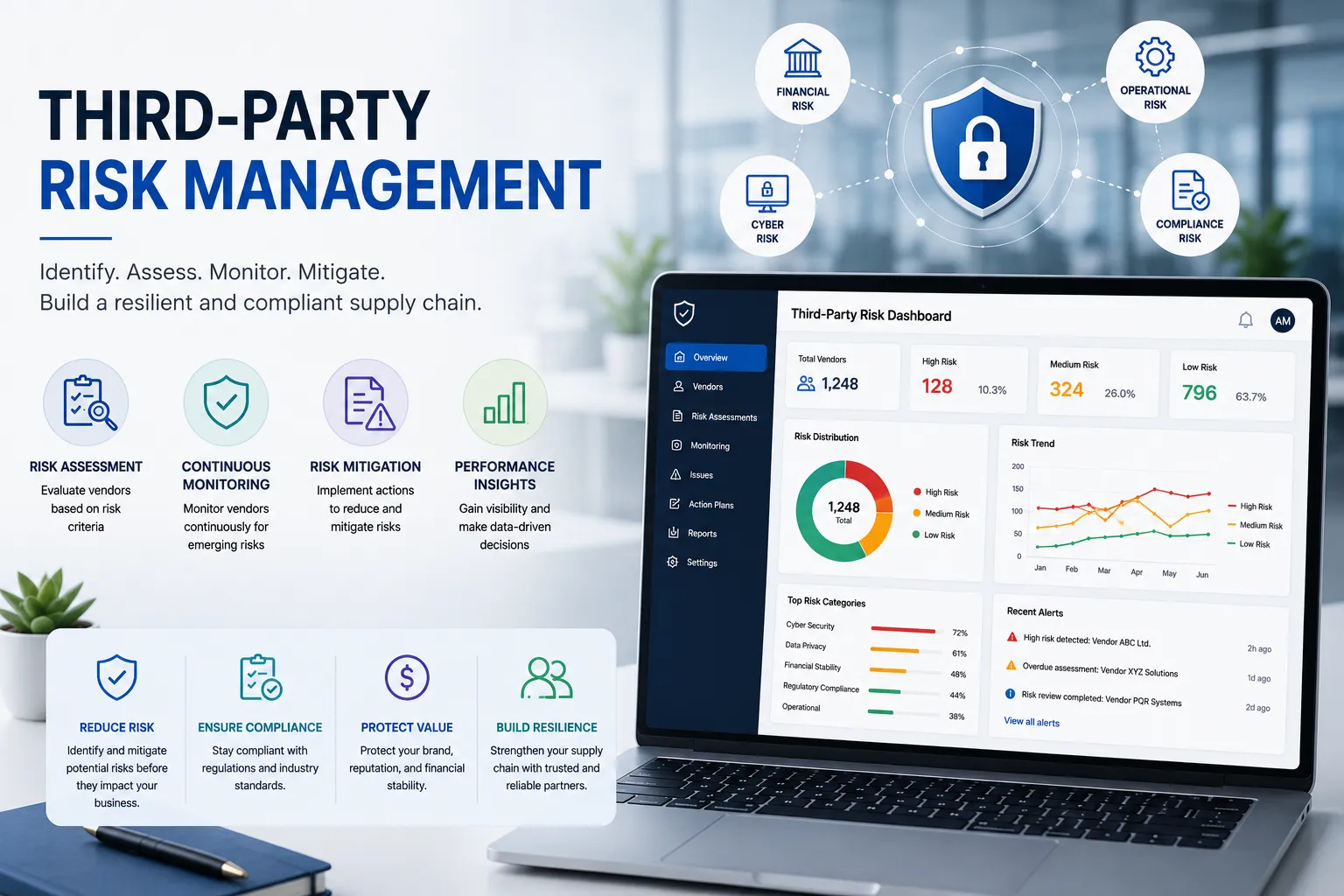
Third-Party Risk Management (TPRM): Complete Guide to Vendor Risk (2026)
Most organizations depend on third parties such as suppliers, contractors, transport providers, consultants, maintenance companies, technology providers, and service agencies.
These relationships create business value, but they can also introduce compliance, operational, financial, cybersecurity, quality, safety, and reputational risks.
Third-Party Risk Management (TPRM) is the structured process of identifying, assessing, managing, monitoring, and reducing risks associated with external organizations throughout the relationship.
For manufacturing, logistics, warehousing, engineering, construction, and other supplier-dependent businesses, a practical TPRM program can improve vendor visibility, support compliance, and help organizations identify important risks earlier.
This guide explains third-party risk management, third-party risk assessment, vendor due diligence, risk scoring, continuous monitoring, corrective actions, and TPRM software.
What Is Third-Party Risk Management?
Third-party risk management is a structured approach for managing risks created by external suppliers, contractors, service providers, and other business partners.
A TPRM program can include:
- Third-party identification
- Vendor classification
- Risk assessment
- Due diligence
- Compliance verification
- Contract review
- Approval workflows
- Ongoing risk monitoring
- Performance monitoring
- Corrective actions
- Periodic reassessment
- Offboarding
The exact process should depend on the type of third party, business criticality, services provided, applicable requirements, and the organization’s risk framework.
What Is a Third-Party Risk Assessment?
A third-party risk assessment evaluates the potential risks associated with a supplier or service provider.
Assessment criteria may include:
- Business criticality
- Compliance requirements
- Operational dependency
- Data or system access
- Safety exposure
- Geographic considerations
- Service type
- Supplier concentration
- Contractual requirements
The assessment helps determine how much due diligence and ongoing monitoring a particular third party may require.
A useful lifecycle is:
Assessment → Approval → Monitoring → Reassessment
Third-Party Risk Management vs Vendor Risk Management
These terms are often used interchangeably, but they can have different scopes.
Vendor risk management generally focuses on risks associated with suppliers and vendors.
Third-party risk management can be broader and include:
- Suppliers
- Contractors
- Consultants
- Service providers
- Technology providers
- Outsourced partners
- Other external organizations
The appropriate terminology depends on how an organization defines its third-party ecosystem.
Why Is TPRM Important?
A third party may become higher risk after onboarding.
For example:
- A required document can expire.
- Supplier performance can deteriorate.
- A contract can approach renewal.
- A critical supplier can experience an operational disruption.
- A quality problem can become recurring.
- A compliance issue can remain unresolved.
Without an ongoing process, these changes may not be identified quickly.
A structured TPRM program can help organizations:
- Improve third-party visibility
- Identify important risks earlier
- Prioritize reviews
- Improve compliance monitoring
- Support procurement decisions
- Track corrective actions
- Maintain audit evidence
- Improve supplier governance
Types of Third-Party Risk
Third-party risk is not limited to compliance.
1. Compliance Risk
Examples include:
- Missing required documents
- Expired licences or certificates
- Incomplete statutory records
- Unresolved compliance issues
- Failure to meet contractual requirements
See Vendor Compliance Checklist India.
2. Operational Risk
Operational risk can arise when a third party cannot reliably provide a product or service.
Examples include:
- Production disruption
- Delivery delays
- Capacity constraints
- Service interruptions
- Business continuity concerns
- Dependence on a single supplier
3. Financial Risk
Financial risk may become relevant when a supplier’s financial condition could affect continuity of supply or service.
Organizations may consider appropriate indicators such as:
- Supplier dependency
- Credit concerns
- Business continuity signals
- Financial information available through reliable sources
Financial risk assessments should use appropriate evidence rather than assumptions.
4. Cybersecurity and Data Risk
Some third parties may access:
- Business systems
- Sensitive information
- Customer information
- Production systems
- Networks
Where applicable, organizations should assess security and data-protection requirements according to their risk framework.
5. Quality Risk
Quality risks may include:
- Defective products
- Repeated non-conformances
- Customer complaints
- Failed inspections
- Poor corrective-action performance
6. Safety and Environmental Risk
For industrial suppliers and contractors, relevant risks may include:
- Safety incidents
- Missing safety documentation
- Inadequate training
- Environmental compliance issues
- Incomplete corrective actions
7. Reputational Risk
Third-party misconduct or serious failures can affect an organization’s reputation.
Organizations should define appropriate escalation criteria for significant third-party incidents.
Who Should Implement TPRM?
Third-party risk management is relevant to organizations that depend on external suppliers or service providers.
Common examples include:
| Industry | Example TPRM Focus |
|---|---|
| Manufacturing | Supplier continuity and compliance |
| Logistics | Transport and service-provider risk |
| Warehousing | Contractor and facility risk |
| Automotive | Quality and supplier continuity |
| Engineering | Contractor and project risk |
| Construction | Contractor, safety, and compliance risk |
| Food Processing | Supplier quality and compliance |
| Healthcare | Supplier and service-provider risk |
| Pharmaceuticals | Supplier and regulatory risk |
The depth of the TPRM process should be proportional to the organization’s size, third-party exposure, and risk profile.
Third-Party Risk Management Process
A practical TPRM workflow can include the following stages.
Step 1: Identify Third Parties
Create a complete inventory of relevant suppliers, contractors, and service providers.
Step 2: Classify Third Parties
Classify third parties based on factors such as:
- Business criticality
- Service category
- Risk exposure
- Data access
- Operational dependency
Step 3: Perform Risk Assessment
Evaluate the third party against defined risk criteria.
Step 4: Conduct Due Diligence
Collect and review appropriate business, compliance, security, financial, and operational information.
Step 5: Define Risk Level
Assign a risk category such as:
- Low
- Medium
- High
- Critical
The organization should define its own scoring thresholds and criteria.
Step 6: Review and Approve
Route the third party through the appropriate procurement, compliance, legal, finance, EHS, security, or business approvals.
Step 7: Contract and Activate
Complete the required agreement and activate the third party according to internal procedures.
Step 8: Monitor Continuously
Monitor relevant risk indicators, compliance status, performance, contracts, and corrective actions.
Step 9: Reassess
Reassess the third party when material changes occur or according to the organization’s review schedule.
Step 10: Offboard
When the relationship ends, complete the required offboarding steps, including access removal, record retention, and contract closure where applicable.
Third-Party Due Diligence Checklist
A due diligence process may include:
Business Information
- Legal entity information
- Registered address
- Contact details
- Ownership information where relevant
- Vendor category
- Business criticality
Compliance
- Applicable registrations
- Required licences
- Insurance
- Relevant statutory records
- Compliance declarations
Operational
- Capacity information
- Service capability
- Business continuity information
- Key operational dependencies
Security
Where applicable:
- Security requirements
- Data-access requirements
- Security assessments
- Relevant certifications
Contract
- Contract status
- Service levels
- Renewal date
- Required obligations
- Termination provisions
The actual checklist should be tailored to the third party and the organization’s risk framework.
Third-Party Risk Scoring
Risk scoring can help organizations prioritize third-party reviews.
For example:
| Risk Area | Example Weight |
|---|---|
| Compliance | 25% |
| Operational Risk | 25% |
| Quality / Performance | 20% |
| Contract Risk | 10% |
| Financial Risk | 10% |
| Security / Data Risk | 10% |
| Total | 100% |
These weights are illustrative. Organizations should define their own model based on their industry, risk appetite, and third-party activities.
A score can then be mapped to internal categories such as:
| Score | Example Risk Level |
|---|---|
| 0–30 | Low |
| 31–60 | Medium |
| 61–80 | High |
| 81–100 | Critical |
The thresholds should be documented and applied consistently.
Risk-Based Third-Party Monitoring
Not every third party needs the same level of monitoring.
For example:
| Risk Level | Possible Monitoring Approach |
|---|---|
| Low | Periodic review |
| Medium | Regular compliance and performance review |
| High | More frequent monitoring and escalation |
| Critical | Enhanced monitoring and management review |
These are examples, not universal requirements.
A risk-based approach allows teams to focus resources on third parties that are most important or present the greatest exposure.
Continuous Third-Party Risk Monitoring
Third-party monitoring may include:
- Compliance document expiry
- Contract renewal dates
- Performance indicators
- Quality issues
- Corrective actions
- Operational incidents
- Safety information
- Risk-score changes
- Review status
Continuous monitoring does not necessarily mean checking every vendor every day.
The monitoring frequency should reflect the third party’s risk and business criticality.
Third-Party Risk Management Checklist
Use this as a practical starting point:
Governance
- TPRM policy defined
- Roles and responsibilities assigned
- Risk criteria documented
- Escalation rules defined
Onboarding
- Third-party inventory created
- Vendor category assigned
- Risk assessment completed
- Due diligence completed
- Required approvals completed
Compliance
- Required documents identified
- Document validity monitored
- Expiry dates tracked
- Compliance issues recorded
- Corrective actions tracked
Risk Monitoring
- Risk level assigned
- Monitoring frequency defined
- Performance indicators tracked
- Material changes reviewed
- Periodic reassessment completed
Audit and Offboarding
- Assessment history retained
- Approval history retained
- Risk changes recorded
- Evidence accessible
- Offboarding process defined
Manual TPRM vs Automated TPRM
| Manual TPRM | Automated TPRM |
|---|---|
| Excel risk registers | Centralized risk records |
| Email follow-ups | Automated notifications |
| Manual document checks | Document validation support |
| Periodic spreadsheet reviews | Configurable monitoring |
| Manual scoring | Automated scoring where configured |
| Scattered evidence | Centralized records |
| Manual reporting | Dashboards and reports |
Automation can improve consistency and reduce repetitive work, but human review remains important for significant risk decisions.
Common Third-Party Risk Management Mistakes
Assessing Risk Only During Onboarding
Third-party risk can change after approval.
Treating Every Third Party the Same
Critical suppliers may require stronger controls than low-impact service providers.
Using Too Many Risk Indicators
An overly complicated framework can be difficult to maintain.
No Clear Risk Ownership
Each significant risk should have an accountable owner.
No Corrective-Action Process
Identifying a risk is not enough. Teams need to track what happens next.
Ignoring Historical Trends
A single risk score may not show whether a third party is improving or deteriorating.
Relying Only on Automation
Automated alerts and scores should support informed human decisions.
Best Practices for Third-Party Risk Management
1. Maintain a Complete Third-Party Inventory
Know which suppliers, contractors, and service providers are active and what services they provide.
2. Use Risk-Based Classification
Apply stronger controls to higher-risk and business-critical third parties.
3. Standardize Due Diligence
Create consistent assessment criteria while allowing category-specific requirements.
4. Monitor Material Changes
Focus on events that can materially change third-party risk.
5. Track Corrective Actions
Assign owners and due dates to significant issues.
6. Maintain Evidence
Keep assessments, approvals, documents, reviews, and actions accessible.
7. Review the Program Periodically
Risk criteria and business requirements can change over time.
Features to Look for in TPRM Software
Depending on the organization’s requirements, useful features may include:
- Third-party inventory
- Vendor self-service portal
- Risk assessment questionnaires
- Configurable risk scoring
- Risk classification
- Due diligence workflows
- Document management
- Compliance monitoring
- Expiry reminders
- Contract tracking
- Performance indicators
- Corrective-action workflows
- Dashboards
- Reports
- Audit trails
- Role-based access
- API integration
A manufacturing organization may prioritize supplier compliance and continuity, while a technology organization may place greater emphasis on cybersecurity and data risk.
How AI Can Support TPRM
AI can assist with repetitive analysis and document-processing activities.
Depending on the system, AI may help:
- Extract information from third-party documents
- Identify document types
- Detect expiry dates
- Flag missing information
- Summarize assessment responses
- Identify unusual patterns
- Prioritize records for human review
AI-generated risk insights should be reviewed before important legal, financial, security, safety, or compliance decisions are made.
How VendorCompliancePro Helps
VendorCompliancePro focuses on vendor onboarding, compliance, document management, and ongoing vendor monitoring.
Relevant capabilities include:
- Vendor self-service portal
- Vendor registration
- Centralized vendor records
- Configurable document requirements
- Secure document uploads
- AI-powered document validation
- OCR processing
- Automated expiry reminders
- Compliance dashboards
- Vendor risk monitoring
- Approval workflows
- Audit trails
- Reports and analytics
Organizations can use these capabilities as part of a broader TPRM process, particularly for vendor onboarding, compliance evidence, document monitoring, and vendor risk visibility.
For organizations with advanced cybersecurity, financial-risk, or enterprise TPRM requirements, VendorCompliancePro can complement dedicated ERP, procurement, security, or risk-management systems.
Frequently Asked Questions
What is Third-Party Risk Management?
Third-party risk management is the process of identifying, assessing, monitoring, and reducing risks associated with suppliers, contractors, service providers, and other external organizations.
What is TPRM?
TPRM stands for Third-Party Risk Management.
What is a third-party risk assessment?
A third-party risk assessment evaluates the potential risks associated with an external organization before or during the business relationship.
What risks should be included in TPRM?
Depending on the organization, common areas include compliance, operational, financial, cybersecurity, quality, safety, contractual, and reputational risk.
How often should third-party risks be reviewed?
Review frequency should depend on risk level and business criticality. Higher-risk third parties generally require more frequent monitoring.
Can TPRM be automated?
Yes. Software can automate parts of the process, including questionnaires, document collection, notifications, scoring, monitoring, workflows, and reporting.
Is TPRM only for large enterprises?
No. SMEs can also benefit from a structured approach, especially when they depend on critical suppliers, contractors, or service providers.
What is the difference between TPRM and vendor risk management?
Vendor risk management focuses primarily on suppliers and vendors. TPRM can have a broader scope covering many types of external organizations.
Conclusion
Third-Party Risk Management (TPRM) provides a structured way to understand and manage the risks created by external suppliers, contractors, service providers, and other business partners.
A practical TPRM lifecycle connects:
Inventory → Risk Assessment → Due Diligence → Approval → Monitoring → Corrective Action → Reassessment → Offboarding
The most effective programs are risk-based. They do not treat every third party identically; instead, they focus more attention on vendors that are critical to operations or present greater exposure.
For manufacturing, logistics, engineering, construction, warehousing, and other supplier-dependent organizations, combining third-party risk management with vendor compliance, document monitoring, and performance management can provide stronger supplier visibility and governance.
The goal is not simply to create a risk score.
The goal is to know:
Which third parties create the greatest exposure, why they are considered risky, what has changed, and what action is required?