Compliance Cost Calculator: Free Tool to Estimate Vendor Compliance Costs
Vendor compliance has a cost, even when organizations do not track it as a separate budget.
Procurement and compliance teams may spend significant time collecting documents, following up with suppliers, checking expiry dates, reviewing records, preparing reports, and getting ready for audits.
When these activities are handled manually, the real cost can be difficult to see.
A Compliance Cost Calculator helps organizations estimate the cost associated with managing compliance activities and understand where administrative effort is being spent.
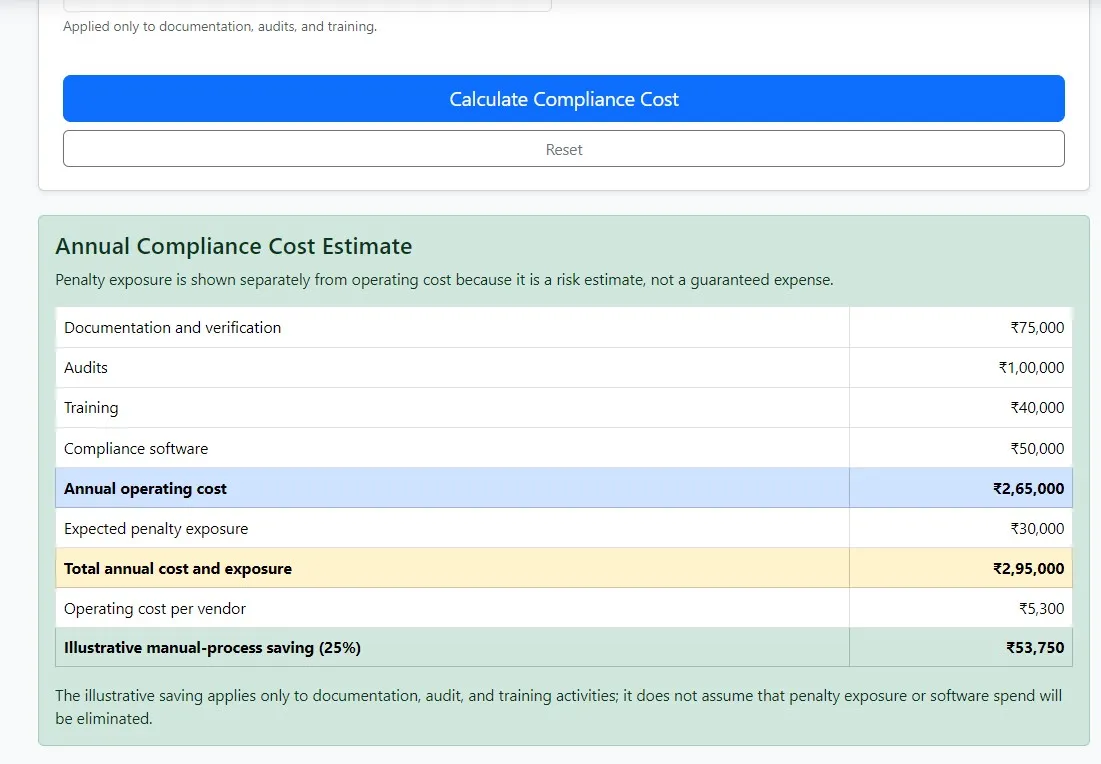
VendorCompliancePro provides a free online Compliance Cost Calculator to help businesses create a simple starting estimate of their compliance management costs.
Use the Free Compliance Cost Calculator →
What Is a Compliance Cost Calculator?
A Compliance Cost Calculator is a planning tool that helps organizations estimate the resources and costs associated with compliance activities.
Depending on the organization’s process, compliance-related costs may include:
- Employee time
- Vendor follow-up
- Document collection
- Document verification
- Expiry tracking
- Audit preparation
- Reporting
- Administrative work
- External services
- Compliance software
The calculator does not determine statutory fees, penalties, or legal obligations. It is intended to help organizations estimate internal compliance-management costs.
Why Calculate Compliance Costs?
Many organizations know how much they spend on software or external services, but may not know how much internal time is spent managing compliance.
For example, employees may spend hours each month:
- Sending reminder emails
- Calling vendors
- Searching for documents
- Updating spreadsheets
- Checking document expiry dates
- Preparing compliance reports
- Collecting evidence for audits
Individually, these tasks may appear small. Across hundreds of vendors, the accumulated effort can become significant.
Estimating the cost helps organizations understand the potential value of improving their compliance process.
What Costs Should Be Considered?
A useful compliance cost estimate should consider more than direct software expenses.
1. Employee Time
Calculate how much staff time is spent on compliance-related activities.
Examples include:
- Vendor follow-ups
- Document review
- Data entry
- Reporting
- Audit preparation
Employee time can represent a significant portion of the total compliance-management cost.
2. Vendor Follow-Up
Procurement and compliance teams may spend considerable time requesting missing or expired documents.
Activities may include:
- Sending emails
- Calling vendors
- Sending reminders
- Escalating overdue submissions
- Tracking responses
Repeated follow-up creates an ongoing administrative cost.
3. Document Management
Organizations may spend time managing documents across:
- Excel
- Shared drives
- Paper records
- ERP systems
The more fragmented the process, the more time employees may spend locating and maintaining records.
4. Compliance Verification
Someone may need to review submitted documents for:
- Correct document type
- Completeness
- Vendor information
- Validity
- Expiry date
- Applicable requirements
The effort required depends on the number and complexity of vendor documents.
5. Audit Preparation
Audit preparation can create a temporary increase in compliance workload.
Teams may need to:
- Locate vendor records
- Prepare reports
- Identify missing documents
- Verify expired records
- Respond to audit requests
- Organize supporting evidence
A structured process can reduce the amount of last-minute manual work.
6. External Compliance Costs
Some organizations may also use external services for:
- Compliance consulting
- Audits
- Legal reviews
- Certifications
- Specialist assessments
These costs are separate from internal administrative effort and should be considered independently.
What Is the Free Compliance Cost Calculator?
The Compliance Cost Calculator is a free online tool from VendorCompliancePro designed to help organizations estimate the cost of managing compliance activities.
It provides a simple way to think about the relationship between:
- Number of vendors
- Compliance workload
- Employee effort
- Administrative activities
- Overall compliance-management cost
Try the Free Compliance Cost Calculator →
The result should be treated as an estimate for planning and comparison rather than an accounting or legal calculation.
How to Estimate Vendor Compliance Costs
A practical approach can follow these steps.
Step 1: Estimate the Number of Vendors
Start with the number of active suppliers, contractors, and service providers that require compliance management.
Step 2: Estimate Compliance Activities
Consider how frequently your team performs activities such as:
- Document collection
- Document verification
- Vendor follow-up
- Expiry monitoring
- Compliance reporting
- Audit preparation
Step 3: Estimate Employee Time
Estimate the number of hours spent on these activities over a month or year.
Step 4: Estimate Internal Cost
Use an appropriate internal cost estimate for the employees performing the work.
Step 5: Add External Costs
Where relevant, include:
- Consulting
- Audits
- Certifications
- Legal services
- Other external compliance services
Step 6: Review the Total
The resulting estimate provides a starting point for understanding the overall cost of the current compliance process.
Example of Manual Compliance Cost
Consider a company managing 200 vendors.
Suppose the compliance team spends time every month on:
- Vendor follow-ups
- Document checking
- Spreadsheet updates
- Expiry monitoring
- Reporting
Even if each activity takes only a small amount of time, the total workload can become substantial.
For example:
| Activity | Estimated Monthly Hours |
|---|---|
| Vendor follow-up | 20 |
| Document verification | 25 |
| Spreadsheet updates | 15 |
| Expiry monitoring | 10 |
| Reporting | 10 |
| Total | 80 hours |
If the organization’s estimated internal compliance-management cost is ₹500 per hour, the illustrative monthly internal cost would be:
80 × ₹500 = ₹40,000
This is only an example. Actual costs depend on employee costs, workload, vendor volume, process complexity, and other factors.
Direct Cost vs Hidden Compliance Cost
Compliance costs are not always visible in the budget.
Direct Costs
These may include:
- Compliance software
- External consultants
- Audit fees
- Certification fees
- Specialist services
Internal Costs
These may include:
- Employee salaries allocated to compliance work
- Administrative time
- Procurement effort
- Reporting effort
Hidden Operational Costs
These may include:
- Repeated vendor follow-ups
- Searching for documents
- Manual spreadsheet maintenance
- Last-minute audit preparation
- Delayed vendor onboarding
Understanding all three categories provides a more complete picture.
Why Manual Compliance Can Become Expensive
Manual compliance management often involves repeated activities.
For example:
Vendor submits document
↓
Employee downloads document
↓
Employee checks document
↓
Expiry date entered into spreadsheet
↓
Reminder date calculated
↓
Follow-up email sent
↓
Vendor submits updated document
↓
Employee updates spreadsheet again
When this process is repeated across hundreds of vendors and thousands of documents, the administrative workload can increase significantly.
Compliance Cost and Vendor Volume
Compliance workload often increases as the number of vendors and documents increases.
| Vendor Base | Potential Administrative Complexity |
|---|---|
| 10 vendors | Low |
| 50 vendors | Moderate |
| 100 vendors | Higher |
| 250 vendors | Significant |
| 500+ vendors | Potentially complex |
These are illustrative categories, not universal thresholds.
The actual workload depends on vendor risk, document requirements, submission frequency, and internal processes.
Compliance Cost and Automation
Automation can reduce some repetitive compliance activities.
For example, software may help with:
- Automated expiry reminders
- Centralized document storage
- Vendor self-service
- Approval workflows
- Compliance dashboards
- Document validation
- Reporting
The purpose of calculating compliance cost is not to assume that automation will eliminate every cost.
Instead, it helps organizations identify where automation may reduce repetitive administrative work.
How to Compare Manual and Automated Compliance Costs
A useful comparison can include:
| Manual Process | Automated Process |
|---|---|
| Manual vendor follow-ups | Automated notifications |
| Spreadsheet tracking | Centralized repository |
| Manual expiry monitoring | Automated expiry tracking |
| Email document collection | Vendor self-service |
| Manual reports | Automated reporting |
| Manual document checks | AI/OCR-assisted validation |
When evaluating automation, consider both the current internal cost and the expected benefits of the proposed solution.
Benefits of Calculating Compliance Costs
Better Budget Planning
Understand the resources required to manage vendor compliance.
Identify High-Cost Activities
Find repetitive activities that consume significant employee time.
Support Automation Decisions
Use estimated costs as one input when evaluating compliance software.
Improve Process Visibility
Understand how much work is actually involved in vendor compliance.
Support Management Discussions
Provide a clearer business case for process improvements.
Common Compliance Cost Calculation Mistakes
Looking Only at Software Cost
The cost of manual work should also be considered.
Ignoring Employee Time
Internal labor can represent a significant portion of total compliance-management costs.
Counting Only Audit Costs
Routine vendor compliance activities also consume resources.
Assuming Every Vendor Requires the Same Effort
Vendor complexity and risk can vary significantly.
Treating Estimates as Exact Accounting Figures
Calculator results are estimates and should be validated against actual business data.
Ignoring Process Changes
Compliance costs may change as the vendor base, requirements, or processes change.
Best Practices for Managing Compliance Costs
Track Vendor Workload
Understand how much time teams spend on vendor compliance.
Identify Repetitive Tasks
Look for manual activities that occur repeatedly.
Prioritize High-Impact Automation
Focus first on processes that consume significant time or create recurring problems.
Use Risk-Based Monitoring
Not every vendor needs the same level of review.
Review Costs Periodically
Recalculate compliance workload as vendor numbers and requirements change.
Measure Before and After Automation
Compare estimated workload before and after process improvements.
Compliance Cost Calculator for Manufacturing Companies
Manufacturing companies may manage suppliers, contractors, logistics providers, maintenance vendors, engineering firms, and other third parties.
Their compliance workload may include:
- Vendor onboarding
- Statutory documentation
- Insurance
- Safety records
- Quality documentation
- Expiry monitoring
- Contractor compliance
- Audit preparation
A compliance cost estimate can help management understand how much internal effort is required to maintain these processes.
Compliance Cost Calculator for Contractors
Contractor management can involve recurring documentation and follow-up.
Depending on the contractor and scope of work, organizations may need to monitor:
- Labour-related records
- PF and ESIC records where applicable
- Insurance
- Safety documentation
- Licences
- Employee records
- Periodic submissions
Calculating the administrative workload can help organizations identify opportunities to streamline contractor compliance.
How the Free Tool Can Help
The free Compliance Cost Calculator provides a simple starting point for estimating the cost of your current compliance-management activities.
You can use it to:
- Estimate internal compliance workload
- Understand potential administrative costs
- Identify expensive manual activities
- Support automation discussions
- Compare different process scenarios
Use the Free Compliance Cost Calculator →
The result is an estimate and should be customized using your organization’s actual employee costs, vendor volume, workload, and external expenses.
How VendorCompliancePro Helps Reduce Manual Compliance Work
VendorCompliancePro provides capabilities designed to reduce repetitive vendor compliance activities, including:
- Vendor self-service portal
- Centralized document repository
- Automated expiry reminders
- Approval workflows
- AI-powered document validation
- Compliance dashboards
- Audit trails
- Reporting and analytics
The objective is to help organizations spend less time on repetitive administration and more time managing supplier relationships and compliance risks.
Frequently Asked Questions
What is a Compliance Cost Calculator?
A Compliance Cost Calculator is a planning tool that helps estimate the internal and external costs associated with managing compliance activities.
What costs should be included?
Depending on the organization, costs may include employee time, vendor follow-ups, document management, verification, reporting, audit preparation, consulting, and other external services.
Can I calculate vendor compliance costs?
Yes. Vendor-related compliance activities can be included when estimating the total cost of managing supplier and contractor compliance.
Does compliance cost include penalties?
A compliance cost estimate should generally be used to understand management and operational costs. Penalties and legal liabilities are separate considerations and should not be treated as predictable operating costs.
Can Excel be used to calculate compliance costs?
Yes. Excel can support a basic calculation, while a dedicated calculator can make the process faster and easier to repeat.
Is the Compliance Cost Calculator free?
Yes. VendorCompliancePro provides the Compliance Cost Calculator as a free online tool.
Is the calculator result an exact financial figure?
No. It is an estimate for planning and comparison. Actual costs depend on your organization’s workload, employee costs, vendor volume, process complexity, and external expenses.
Conclusion
Compliance management requires resources, and much of the cost can be hidden in repetitive administrative work.
A Compliance Cost Calculator helps organizations estimate the effort and cost associated with vendor compliance activities, identify major cost areas, and better understand where process improvements or automation may provide value.
Use the free calculator as a starting point, then compare the estimate with your organization’s actual workload and expenses.
Try the Free Compliance Cost Calculator →