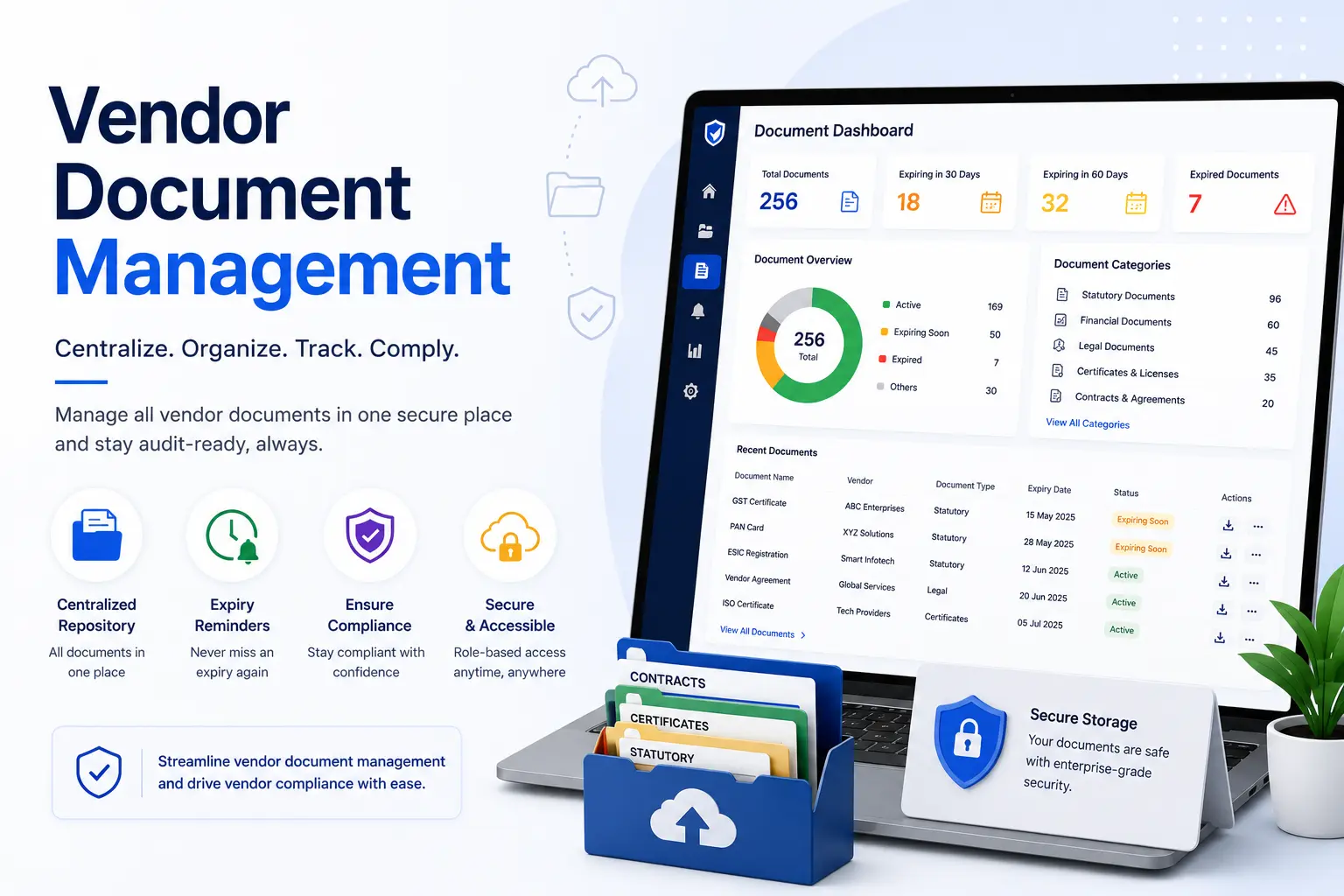
Vendor Document Management: Complete Guide to Organizing Supplier and Contractor Documents
How quickly can your procurement team find a vendor’s required compliance document when an auditor or manager asks for it?
As organizations grow, vendor and contractor documents are often scattered across emails, Excel spreadsheets, shared drives, local folders, and paper files.
This can make it difficult to determine:
- Which documents have been submitted
- Which documents are missing
- Which documents have expired
- Which documents are awaiting approval
- Which vendors are non-compliant
- Who approved a document
- When a document needs renewal
Vendor document management is the process of collecting, organizing, validating, storing, tracking, and maintaining documents associated with vendors and contractors throughout the vendor lifecycle.
A vendor document management system can help centralize records, automate expiry tracking, support approval workflows, and improve audit readiness.
This guide explains:
- What vendor document management means
- Why vendor document management is important
- Which vendor documents organizations commonly manage
- How the vendor document management process works
- How to track document expiry
- Common problems with manual document management
- Best practices
- Features to look for in vendor document management software
- How AI can support document processing
- How VendorCompliancePro fits into the process
What Is Vendor Document Management?
Vendor document management is the process of collecting, storing, organizing, validating, approving, tracking, and maintaining documents related to suppliers, vendors, contractors, and service providers.
It can cover activities such as:
- Vendor onboarding
- Document collection
- Document verification
- Document approval
- Document version management
- Expiry tracking
- Renewal reminders
- Compliance monitoring
- Audit reporting
- Document history
The objective is not simply to store files.
A good vendor document management process should help teams answer:
What document is required, where is it, is it valid, who approved it, and when does it need attention?
Vendor Document Management vs Vendor Compliance
These terms are closely related but are not identical.
Vendor Document Management
Focuses on:
- Collecting documents
- Storing documents
- Organizing documents
- Searching documents
- Tracking versions
- Tracking expiry dates
- Managing approvals
Vendor Compliance Management
Focuses on:
- Determining which documents are required
- Checking whether documents meet requirements
- Monitoring validity
- Identifying compliance gaps
- Following up on missing or expired documents
- Maintaining compliance status
In practice, vendor document management provides the document infrastructure that supports vendor compliance.
For example:
A vendor document management system may store an insurance certificate and track its expiry date, while the vendor compliance process determines whether that insurance certificate is actually required and whether the vendor remains compliant.
Why Is Vendor Document Management Important?
Organizations depend on suppliers, contractors, transporters, service providers, and other vendors.
Without a structured document management process, organizations may experience:
- Missing documents
- Expired licenses
- Duplicate files
- Inconsistent vendor information
- Slow document retrieval
- Delayed approvals
- Repeated email follow-ups
- Audit preparation problems
- Limited compliance visibility
A structured vendor document management process helps organizations:
- Centralize vendor records
- Improve document visibility
- Reduce manual follow-up
- Track document expiry
- Support compliance reviews
- Improve audit readiness
- Establish clearer accountability
Vendor Document Management Process at a Glance
A practical process can be organized into these stages:
| Stage | Activity | Main Outcome |
|---|---|---|
| 1 | Define requirements | Required documents identified |
| 2 | Vendor registration | Vendor information collected |
| 3 | Document collection | Required files submitted |
| 4 | Document verification | Documents reviewed |
| 5 | Approval | Documents accepted or rejected |
| 6 | Centralized storage | Documents organized |
| 7 | Expiry tracking | Validity monitored |
| 8 | Renewal | Expired or expiring documents replaced |
| 9 | Compliance monitoring | Gaps identified |
| 10 | Audit reporting | Evidence available when required |
The exact process should be adapted to the organization’s vendor categories and compliance requirements.
Common Vendor Documents Organizations Manage
The documents required depend on the vendor, industry, country, contractual requirements, and organization policy.
Registration and Business Documents
Examples include:
- Business registration documents
- GST Registration Certificate
- PAN Card
- MSME/Udyam Certificate
- Shop and Establishment registration where applicable
- Other applicable registrations
Statutory and Labour Documents
Depending on the vendor relationship:
- PF Registration Certificate
- ESIC Registration Certificate
- Labour License
- Contractor License
- Other applicable statutory documents
Insurance Documents
Where required:
- Workmen’s compensation insurance
- Public liability insurance
- Group medical insurance
- Other contractually required policies
Financial and Banking Documents
Organizations may maintain:
- Bank details
- Cancelled cheque where required
- Payment information
- Tax-related information
- Other finance documents
Sensitive financial information should be protected using appropriate access controls.
Employee and Contractor Records
For relevant contractor or manpower relationships:
- Employee list
- Attendance records
- Wage records
- Salary records
- Training records
- Other required labour compliance evidence
Safety Documents
Depending on the industry:
- Safety training records
- PPE compliance records
- Risk assessment reports
- Safety certifications
- Inspection records
Environmental and Operational Documents
Depending on the vendor and industry:
- Pollution-control consents
- Factory licenses
- Environmental clearances
- Operational certifications
- Other applicable permits
The objective should be to collect the documents actually required for each vendor, rather than asking every vendor for the same document set.
Vendor-Specific Document Requirements
One of the most important practices in vendor document management is defining document requirements by vendor type.
For example:
| Vendor Type | Example Documents |
|---|---|
| Raw-material supplier | Business, tax, quality, and contractual documents |
| Labour contractor | Labour, PF, ESIC, insurance, and employee-related records |
| Transporter | Business, insurance, vehicle, and applicable compliance documents |
| Facility-management vendor | Business, labour, insurance, and safety documents |
| Engineering contractor | Business, licenses, insurance, safety, and project documents |
The exact requirements should be determined by the organization’s policies and applicable obligations.
A document requirement matrix prevents both:
- Missing required documents
- Collecting unnecessary documents
Problems With Manual Vendor Document Management
Many organizations still rely on:
- Excel spreadsheets
- Email attachments
- Shared drives
- Paper files
- Individual desktop folders
These methods can work for small processes but become difficult to govern as vendor volumes and document requirements increase.
Scattered Documents
A vendor’s documents may be stored in multiple locations.
This makes retrieval slower and increases the chance that an outdated file is used.
Manual Tracking
Teams may use spreadsheets to record document expiry dates and compliance status.
Manual updates can become inconsistent.
Missed Expiry Dates
A document can expire without the responsible team noticing.
Repeated Follow-Ups
Procurement teams may repeatedly email vendors for missing or renewed documents.
Difficult Audits
Finding the correct document and proving its approval history can take significant time.
Limited Visibility
Management may not have a current view of:
- Compliant vendors
- Non-compliant vendors
- Missing documents
- Expiring documents
- Pending approvals
Vendor Document Management Workflow
Step 1: Define Document Requirements
Determine which documents are required for each vendor category.
Requirements may depend on:
- Vendor type
- Industry
- Risk
- Location
- Contract
- Applicable requirements
Step 2: Register the Vendor
Collect the vendor’s core business information.
This typically includes:
- Legal name
- Address
- Contact details
- Tax information
- Vendor category
- Other required registration information
See Vendor Registration Process for a detailed registration workflow.
Step 3: Collect Documents
Request required documents from the vendor.
A digital vendor portal can make this easier by showing the vendor exactly which documents are required.
Step 4: Verify Documents
Review submitted documents for:
- Correct document type
- Correct vendor
- Required information
- Readability
- Validity
- Expiry date
- Consistency with vendor information
Where appropriate, automated OCR or document validation can support human reviewers.
Step 5: Approve or Reject Documents
Documents can be:
- Approved
- Rejected
- Returned for correction
- Pending review
Rejected documents should include an appropriate reason so the vendor knows what needs to be corrected.
Step 6: Store Documents Centrally
Approved documents should be stored in an organized repository.
A useful structure may include:
Vendor → Document Category → Document → Version / Status
The exact structure should reflect the organization’s requirements.
Step 7: Track Expiry Dates
For time-limited documents, record:
- Issue date
- Expiry date
- Current status
- Renewal status
- Responsible owner
This makes it possible to identify documents that need attention before they expire.
Step 8: Send Renewal Reminders
Where a document requires renewal, reminders can be sent before expiry.
For example:
90 days before expiry
→ Reminder
60 days before expiry
→ Follow-up
30 days before expiry
→ Escalation
The actual reminder schedule should be configurable according to the organization’s policy.
Step 9: Monitor Compliance Status
Use the document information to identify:
- Missing documents
- Expired documents
- Documents awaiting approval
- Documents nearing expiry
- Vendors with unresolved compliance gaps
Step 10: Maintain Audit Evidence
Keep evidence of:
- Document submissions
- Approvals
- Rejections
- Replacements
- Expiry history
- User activity
- Vendor communication where required
This can make audit preparation easier.
Vendor Document Expiry Tracking
Expiry tracking is one of the most important capabilities in vendor document management.
For each time-limited document, track:
| Field | Example |
|---|---|
| Vendor | ABC Engineering |
| Document | Insurance Certificate |
| Issue Date | Defined by document |
| Expiry Date | Defined by document |
| Status | Active |
| Renewal Status | Pending / Renewed |
| Responsible Owner | Procurement |
| Last Reviewed | Review date |
The system should make it easy to identify documents that are:
- Active
- Expiring soon
- Expired
- Pending renewal
- Under review
Expiry tracking should be connected to the vendor compliance process.
Vendor Document Statuses
A consistent status model can make document management easier.
Possible statuses include:
- Required
- Pending Upload
- Submitted
- Under Review
- Approved
- Rejected
- Expiring Soon
- Expired
- Renewal Pending
- Archived
Organizations can adapt these statuses to their workflow.
Manual Process vs Vendor Document Management Software
| Manual Process | Vendor Document Management Software |
|---|---|
| Excel tracking | Centralized document repository |
| Email follow-ups | Automated notifications |
| Scattered files | Organized vendor records |
| Manual expiry checks | Automated expiry tracking |
| Manual approvals | Workflow-based approvals |
| Difficult retrieval | Searchable documents |
| Limited visibility | Compliance dashboards |
| Limited history | Audit trails and document history |
Software can reduce administrative effort, but it should support the organization’s existing procurement and compliance processes rather than simply adding another disconnected system.
Benefits of Vendor Document Management
Centralized Repository
Keep vendor documents organized in one controlled location.
Better Visibility
See document and compliance status across vendors.
Faster Document Retrieval
Find required evidence more quickly during audits and reviews.
Improved Compliance Monitoring
Identify missing and expired documents earlier.
Reduced Manual Work
Reduce repetitive email follow-ups and spreadsheet updates.
Better Approval Control
Make document review and approval status visible.
Improved Audit Readiness
Maintain records and evidence throughout the vendor lifecycle.
Better Vendor Collaboration
Give vendors a structured way to submit and update documents.
Features to Look for in Vendor Document Management Software
When evaluating a vendor document management system, consider capabilities such as:
- Centralized vendor document repository
- Vendor self-service portal
- Configurable document requirements
- Secure document uploads
- Document validation
- Duplicate document handling
- Approval workflows
- Document expiry tracking
- Automated renewal reminders
- Compliance dashboards
- Search and filtering
- Role-based access
- Audit trails
- Document history
- Reporting
- API integration
- ERP or procurement integration
- OCR or AI-assisted document processing
The right feature set depends on the organization’s vendor volume, compliance requirements, and existing systems.
Vendor Document Management Best Practices
1. Maintain a Single Source of Truth
Avoid keeping independent copies of important vendor documents across multiple locations.
2. Define Vendor-Specific Requirements
Different vendor categories should have appropriate document requirements.
3. Standardize Document Naming and Categories
Use consistent document types and categories so documents can be found easily.
4. Validate Documents Before Approval
Check that documents are relevant, readable, current, and associated with the correct vendor.
5. Automate Expiry Tracking
Do not rely only on spreadsheets or personal reminders.
6. Start Renewal Before Expiry
Allow sufficient time for vendors to submit replacement documents and for internal review.
7. Maintain an Audit Trail
Track submissions, approvals, rejections, replacements, and important changes.
8. Review Vendor Compliance Periodically
Periodic reviews help identify missing, expired, or incomplete records.
9. Protect Sensitive Information
Use role-based access and appropriate security controls for financial, personal, and other sensitive vendor information.
10. Connect Documents With Vendor Master Data
Documents should be associated with the correct vendor master record.
This improves visibility across:
Vendor Registration → Vendor Master → Vendor Documents → Vendor Compliance → Vendor Audit
Why Excel Is Not Always Enough
Excel can be useful for a small vendor document tracking process.
However, as the number of vendors and documents grows, teams may encounter:
- Manual data entry
- Duplicate records
- Incorrect expiry dates
- Missed reminders
- Limited access control
- Difficult approval tracking
- Scattered files
- Difficult audit preparation
The issue is not that Excel is inherently bad.
The issue is that spreadsheets are not designed to provide a complete workflow for vendor document collection, validation, approval, expiry monitoring, and audit history.
For larger or more complex vendor programs, a dedicated system may provide stronger control.
How AI Can Improve Vendor Document Management
AI and OCR technologies can support document-processing tasks.
Depending on the implementation, they can help:
- Extract information from uploaded documents
- Identify document types
- Extract registration numbers
- Extract dates
- Identify potential missing information
- Support document validation
- Reduce manual data entry
- Flag documents that need human review
For compliance-critical workflows, AI should support human review rather than automatically assuming every extracted value is correct.
Industries That Benefit From Vendor Document Management
Vendor document management can be useful across many industries.
Manufacturing
Manage supplier, contractor, quality, safety, and statutory documents.
Logistics
Manage transporter, fleet, insurance, and service-provider documentation.
Warehousing
Manage facility, maintenance, labour, and service vendor documents.
Construction
Manage contractor, subcontractor, labour, safety, and insurance records.
Engineering
Manage supplier, project, safety, and compliance documentation.
Facility Management
Manage multiple service providers, contractors, labour records, and compliance documents.
The exact document requirements vary by industry and vendor relationship.
How VendorCompliancePro Helps With Vendor Document Management
VendorCompliancePro provides a centralized workflow for vendor documents and compliance.
Organizations can use the platform for:
- Vendor self-service portal
- Vendor registration
- Centralized vendor document repository
- Configurable document requirements
- Secure document collection
- AI-powered document validation
- OCR processing
- Approval workflows
- Automated expiry reminders
- Compliance dashboards
- Audit trails
- Reports and analytics
The platform can help procurement and compliance teams move away from scattered email and spreadsheet processes toward a more structured vendor document workflow.
VendorCompliancePro can complement an existing ERP or procurement system by focusing on vendor document collection, validation, expiry monitoring, compliance workflows, and audit readiness.
Vendor Document Management Checklist
Before implementing or reviewing your process, check whether you have:
- A defined vendor document requirement matrix
- Standard vendor document categories
- A centralized document repository
- Vendor self-service or structured document collection
- Document validation process
- Approval workflow
- Document expiry tracking
- Renewal reminders
- Missing-document tracking
- Expired-document tracking
- Vendor compliance dashboard
- Audit trail
- Role-based access
- Document history
- Reporting
- Periodic compliance review
Frequently Asked Questions
What is vendor document management?
Vendor document management is the process of collecting, organizing, storing, validating, approving, tracking, and maintaining documents related to vendors and contractors.
Why is vendor document management important?
It helps organizations centralize vendor documents, track expiry dates, reduce manual follow-up, improve compliance visibility, and prepare for audits.
What documents should organizations maintain for vendors?
The required documents depend on the vendor, industry, contract, location, and applicable requirements. Common examples include GST, PAN, business registration, insurance, labour, PF, ESIC, and other statutory or contractual documents.
What is a vendor document management system?
A vendor document management system is software designed to help organizations collect, store, organize, validate, track, and manage vendor documents throughout the vendor lifecycle.
Can Excel be used for vendor document management?
Yes. Excel can be useful for smaller processes.
However, larger vendor programs may require centralized document storage, automated expiry tracking, workflows, access controls, and audit trails that are difficult to manage effectively with spreadsheets alone.
How do you track vendor document expiry?
Record the document issue date, expiry date, status, renewal status, and responsible owner. Automated reminders can then notify teams before documents expire.
What is the difference between vendor document management and vendor compliance?
Vendor document management focuses on handling and tracking documents.
Vendor compliance focuses on whether vendors meet the organization’s required legal, contractual, statutory, and operational requirements.
Document management is therefore an important part of vendor compliance.
Can vendor document management be automated?
Yes. Organizations can automate document collection, notifications, approval workflows, expiry tracking, reporting, and some document-validation tasks.
Human review may still be required for important compliance decisions.
Conclusion
Vendor document management is more than a document storage problem.
It is an important part of vendor compliance, procurement governance, and audit readiness.
A strong process should connect:
Vendor Registration → Document Collection → Verification → Approval → Centralized Storage → Expiry Tracking → Renewal → Compliance Monitoring → Audit Evidence
Organizations that rely entirely on spreadsheets, emails, and scattered folders can struggle as vendor volumes and document requirements grow.
A structured vendor document management process helps organizations maintain better visibility, reduce manual effort, identify compliance gaps earlier, and retrieve audit evidence more efficiently.
The goal is simple:
Keep every required vendor document organized, valid, traceable, and accessible when it is needed.
Related Articles
- Vendor Registration Process
- Vendor Master Data Management
- Supplier Master Data Management: Best Practices
- Supplier Risk Assessment Process
- Vendor Audit Readiness Checklist
- Vendor Document Tracking
- Vendor Document Expiry Reminder
- Vendor Compliance Checklist India
- Vendor Compliance Software India
- What Is Vendor Compliance?