Vendor Compliance Calendar: Free Tool to Plan Supplier and Contractor Compliance
Managing vendor compliance is not only about collecting documents. Procurement and compliance teams also need to know when documents expire, when recurring records are due, when vendors need to submit updates, and when compliance reviews should be completed.
When these dates are tracked through spreadsheets, emails, and personal reminders, important deadlines can easily be missed.
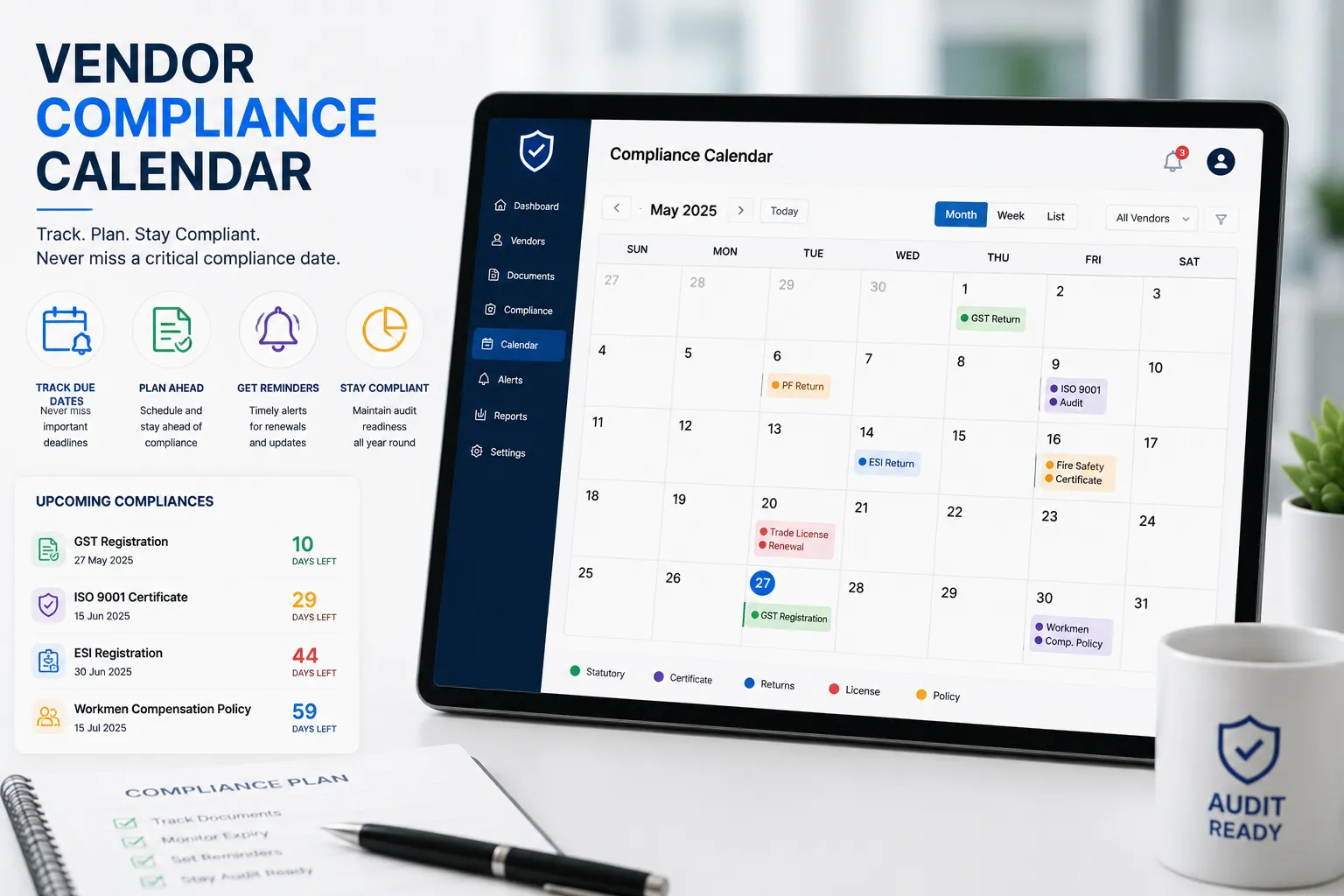
A Vendor Compliance Calendar provides a structured way to organize vendor compliance activities and upcoming deadlines in one place.
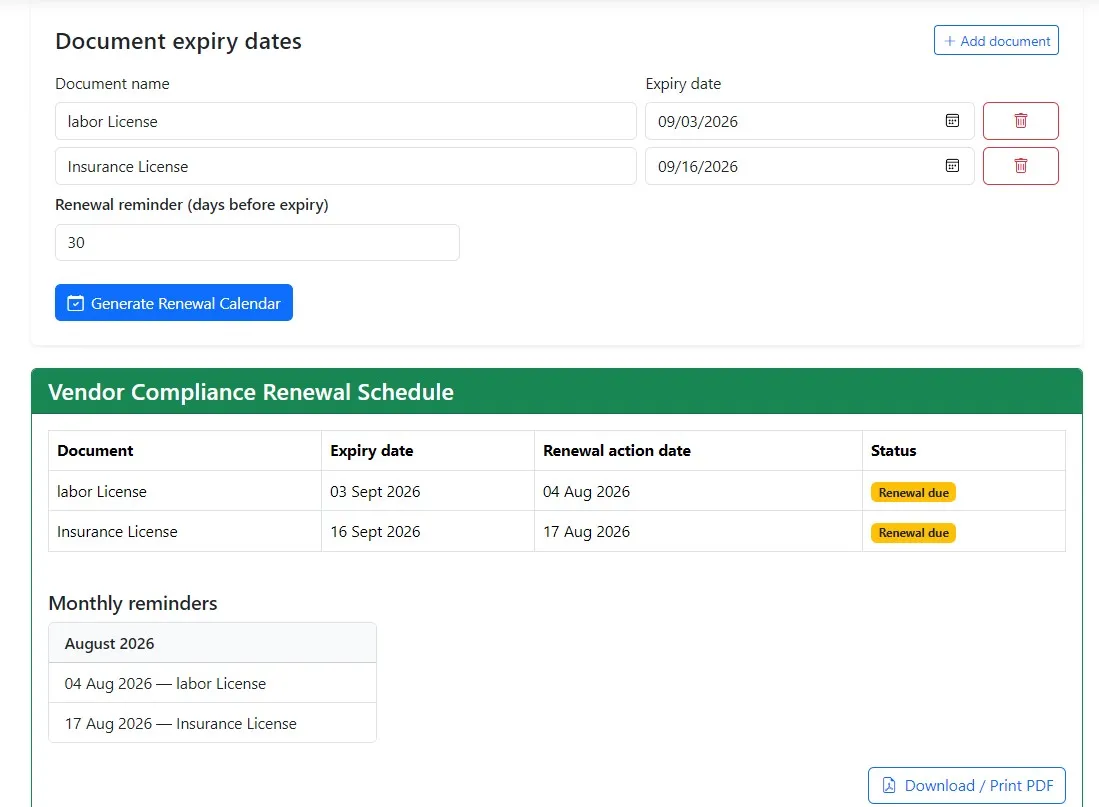
VendorCompliancePro provides a free online Vendor Compliance Calendar to help procurement and compliance teams plan vendor-related compliance activities more effectively.
Use the Free Vendor Compliance Calendar →
What Is a Vendor Compliance Calendar?
A Vendor Compliance Calendar is a planning tool used to organize important vendor compliance dates and activities.
Depending on your organization’s requirements, a compliance calendar can help track:
- Document expiry dates
- Renewal deadlines
- Recurring compliance submissions
- Vendor review dates
- Contract renewal dates
- Insurance renewal dates
- Audit preparation activities
- Periodic compliance reviews
- Follow-up activities
Instead of keeping these dates in different spreadsheets or email threads, a calendar-based approach makes upcoming activities easier to identify.
Why Is a Vendor Compliance Calendar Important?
Vendor compliance is an ongoing process.
A vendor may submit all required documents during onboarding, but some documents and records may require action later.
For example:
- An insurance policy may need renewal.
- A licence may have an expiry date.
- A contractor may need to submit recurring compliance records.
- A vendor may need periodic review.
- A contract may approach its renewal date.
If these activities are not planned properly, teams may discover the issue only after a deadline has passed.
A compliance calendar helps teams move from reactive follow-up to proactive planning.
Common Vendor Compliance Deadlines to Track
The exact requirements depend on the vendor, industry, contract, location, and applicable regulations.
However, organizations may want to track activities such as:
Document Renewals
- Insurance policies
- Labour licences
- Contractor licences
- Factory-related licences where applicable
- Environmental permissions where applicable
- Certifications with expiry dates
Recurring Compliance Submissions
Depending on the vendor and applicable requirements:
- PF-related records
- ESIC-related records
- Attendance records
- Wage records
- Other recurring contractor compliance submissions
Vendor Reviews
- Monthly compliance reviews
- Quarterly vendor reviews
- Annual vendor evaluations
- High-risk vendor reviews
Contract Activities
- Contract expiry
- Contract renewal
- Agreement review
- Insurance requirement review
What Is the Free Vendor Compliance Calendar Tool?
The Vendor Compliance Calendar is a free online utility from VendorCompliancePro designed to help users organize vendor compliance activities and deadlines.
It can be used as a planning aid for teams managing suppliers, contractors, service providers, and other third parties.
The tool is especially useful when you want a simple way to think about upcoming compliance activities rather than maintaining multiple disconnected reminder lists.
Open the Free Vendor Compliance Calendar →
How to Use a Vendor Compliance Calendar
A simple compliance planning process can follow these steps.
Step 1: Identify Vendors
Create a list of suppliers, contractors, service providers, and other vendors that require compliance monitoring.
Step 2: Identify Compliance Activities
Determine which documents, submissions, reviews, and renewals apply to each vendor.
Step 3: Record Important Dates
Capture relevant dates such as:
- Expiry dates
- Renewal dates
- Submission dates
- Review dates
- Contract dates
Step 4: Organize by Time Period
Group activities by:
- Upcoming
- Due soon
- Due this month
- Overdue
- Completed
Step 5: Assign Ownership
Where appropriate, identify who is responsible for following up with the vendor or completing the internal review.
Step 6: Review Regularly
Review upcoming compliance activities regularly so that deadlines do not become last-minute problems.
Vendor Compliance Calendar Example
Imagine a manufacturing company managing 100 contractors and suppliers.
During a particular month, the compliance team may have:
| Activity | Vendor | Timing |
|---|---|---|
| Insurance renewal | Contractor A | Upcoming |
| Compliance review | Supplier B | This month |
| Labour licence renewal | Contractor C | Upcoming |
| Contract review | Service Provider D | Upcoming |
| Recurring compliance submission | Contractor E | Due |
Without a central planning approach, these activities may be spread across emails and spreadsheets.
A compliance calendar provides a clearer view of what needs attention.
Documents and Activities That May Need Calendar Tracking
Not every vendor document needs the same treatment.
A useful approach is to classify requirements into categories.
Expiry-Based Requirements
These have a specific validity or expiry date.
Examples may include:
- Insurance certificates
- Licences
- Certifications
- Contracts
Recurring Requirements
These may need to be submitted or reviewed repeatedly.
Examples may include:
- Monthly compliance records
- Periodic vendor reviews
- Recurring declarations
Event-Based Requirements
These are associated with specific business events.
Examples may include:
- Vendor onboarding
- Contract renewal
- Vendor reassessment
- Audit preparation
This classification helps teams determine what should be placed on the compliance calendar.
Why Excel and Email Reminders Can Become Difficult
Spreadsheets can be useful for basic tracking, especially when the number of vendors is small.
However, as the vendor base grows, teams may encounter:
Too Many Dates
Different vendors have different renewal and submission schedules.
Manual Updates
Someone must continually update dates and statuses.
Missed Reminders
A deadline can be overlooked when reminders depend on individual calendars or email messages.
Poor Visibility
Management may not have a simple view of upcoming compliance activities.
Difficult Follow-Up
Teams may struggle to identify which vendor needs attention first.
A structured compliance calendar can make planning easier.
Benefits of Using a Vendor Compliance Calendar
Better Planning
Teams can see upcoming compliance activities before they become urgent.
Fewer Missed Deadlines
Important renewal and review dates are easier to identify.
Improved Accountability
Compliance activities can be assigned to responsible team members.
Better Audit Preparation
Upcoming reviews and documentation activities can be planned in advance.
Reduced Manual Follow-Up
A structured schedule reduces the need to repeatedly search through emails and spreadsheets.
Improved Visibility
Procurement and compliance teams gain a clearer view of upcoming vendor activities.
Vendor Compliance Calendar Best Practices
Start With Critical Dates
Prioritize dates that could create significant operational or compliance risks if missed.
Use Different Lead Times
Not every activity requires the same amount of preparation.
For example, a contract renewal may require significantly more preparation than a routine document follow-up.
Review the Calendar Regularly
A calendar is useful only when teams actively review and update it.
Assign Ownership
Every important compliance activity should have a clear owner where appropriate.
Keep Requirements Vendor-Specific
Different vendors may have different requirements.
Track Completion
Do not only record due dates. Track whether the activity was completed.
Connect the Calendar to Ongoing Compliance
The calendar should support, not replace, document management and vendor compliance processes.
Vendor Compliance Calendar vs Vendor Document Tracking
These two concepts are related but different.
| Vendor Compliance Calendar | Vendor Document Tracking |
|---|---|
| Focuses on dates and activities | Focuses on documents and status |
| Helps plan upcoming work | Helps manage document records |
| Tracks renewals and reviews | Tracks document validity |
| Provides scheduling visibility | Provides document visibility |
| Helps prioritize follow-ups | Helps identify document gaps |
Organizations may benefit from using both.
Vendor Compliance Calendar and Audit Readiness
A calendar can support audit readiness by helping teams plan compliance activities before an audit occurs.
For example, teams can schedule:
- Vendor compliance reviews
- Document validation
- Expiry reviews
- Contract reviews
- Missing-document follow-ups
- Internal audit preparation
The goal is to avoid preparing all vendor records at the last minute.
A proactive calendar-based process can help organizations maintain better compliance discipline throughout the year.
Industries That Can Benefit
A Vendor Compliance Calendar can be useful for organizations that manage suppliers and contractors across many industries.
Examples include:
- Manufacturing
- Logistics
- Warehousing
- Construction
- Engineering
- Facility management
- Automotive
- Food processing
- Industrial services
The exact compliance activities should always be adapted to the organization’s vendors and applicable requirements.
Common Vendor Compliance Calendar Mistakes
Tracking Only Expiry Dates
Compliance management can involve recurring submissions, reviews, contracts, and other activities as well.
Setting Every Reminder the Same Way
Different activities may require different preparation periods.
Not Assigning Ownership
A deadline without a responsible person can still be missed.
Failing to Update Completed Activities
Old or completed items can make the calendar difficult to use.
Using One Generic Schedule for Every Vendor
Vendor requirements should reflect risk, scope, industry, and contractual obligations.
How a Vendor Compliance Calendar Fits Into Vendor Management
A strong vendor compliance process can follow this sequence:
Vendor Onboarding
↓
Document Collection
↓
Document Verification
↓
Compliance Calendar
↓
Renewal and Submission Tracking
↓
Periodic Vendor Review
↓
Audit Preparation
↓
Ongoing Compliance Monitoring
The calendar becomes the planning layer that helps teams stay ahead of upcoming activities.
How the Free Tool Can Help
The free Vendor Compliance Calendar gives procurement and compliance teams a simple starting point for organizing vendor-related compliance activities.
It can help you think about:
- What is due?
- When is it due?
- Which vendor is involved?
- Which activities require follow-up?
- Which reviews are approaching?
Try the Free Vendor Compliance Calendar →
For organizations with more complex requirements, the generated planning information can be incorporated into a broader vendor compliance management process.
How VendorCompliancePro Helps With Ongoing Compliance
VendorCompliancePro is designed to help organizations manage vendor compliance beyond simple calendar planning.
Capabilities include:
- Vendor self-service portal
- Centralized document repository
- Compliance tracking
- Automated expiry reminders
- Approval workflows
- AI-powered document validation
- Compliance dashboards
- Audit trails
- Reporting and analytics
This helps organizations move from manually remembering compliance dates toward a more structured vendor compliance process.
Frequently Asked Questions
What is a Vendor Compliance Calendar?
A Vendor Compliance Calendar is a planning tool used to organize vendor compliance deadlines, renewals, reviews, submissions, and other important activities.
What should be included in a vendor compliance calendar?
Depending on your requirements, you may include document expiries, insurance renewals, contract renewals, recurring submissions, vendor reviews, and audit preparation activities.
How often should a vendor compliance calendar be reviewed?
It should be reviewed regularly. Many organizations may review upcoming activities weekly or monthly depending on vendor volume and risk.
Is a vendor compliance calendar useful for contractors?
Yes. Contractors may have recurring compliance submissions, licences, insurance requirements, safety records, and periodic reviews that need to be monitored.
Can Excel be used as a vendor compliance calendar?
Yes. Excel can be used for basic date tracking, but larger vendor programs may benefit from centralized compliance software and automated notifications.
Does every vendor need the same compliance calendar?
No. Requirements should be based on vendor type, industry, risk, scope of work, contract, location, and applicable requirements.
Is the Vendor Compliance Calendar free?
Yes. VendorCompliancePro provides the Vendor Compliance Calendar as a free online tool.
Conclusion
Vendor compliance is an ongoing activity, and important deadlines can be difficult to manage when they are spread across spreadsheets, emails, and individual reminders.
A Vendor Compliance Calendar provides a simple way to organize upcoming renewals, recurring submissions, vendor reviews, contract activities, and other compliance tasks.
Use the free tool to create a structured starting point, then customize the schedule according to your vendor requirements, risk levels, contracts, internal policies, and applicable requirements.
Use the Free Vendor Compliance Calendar →