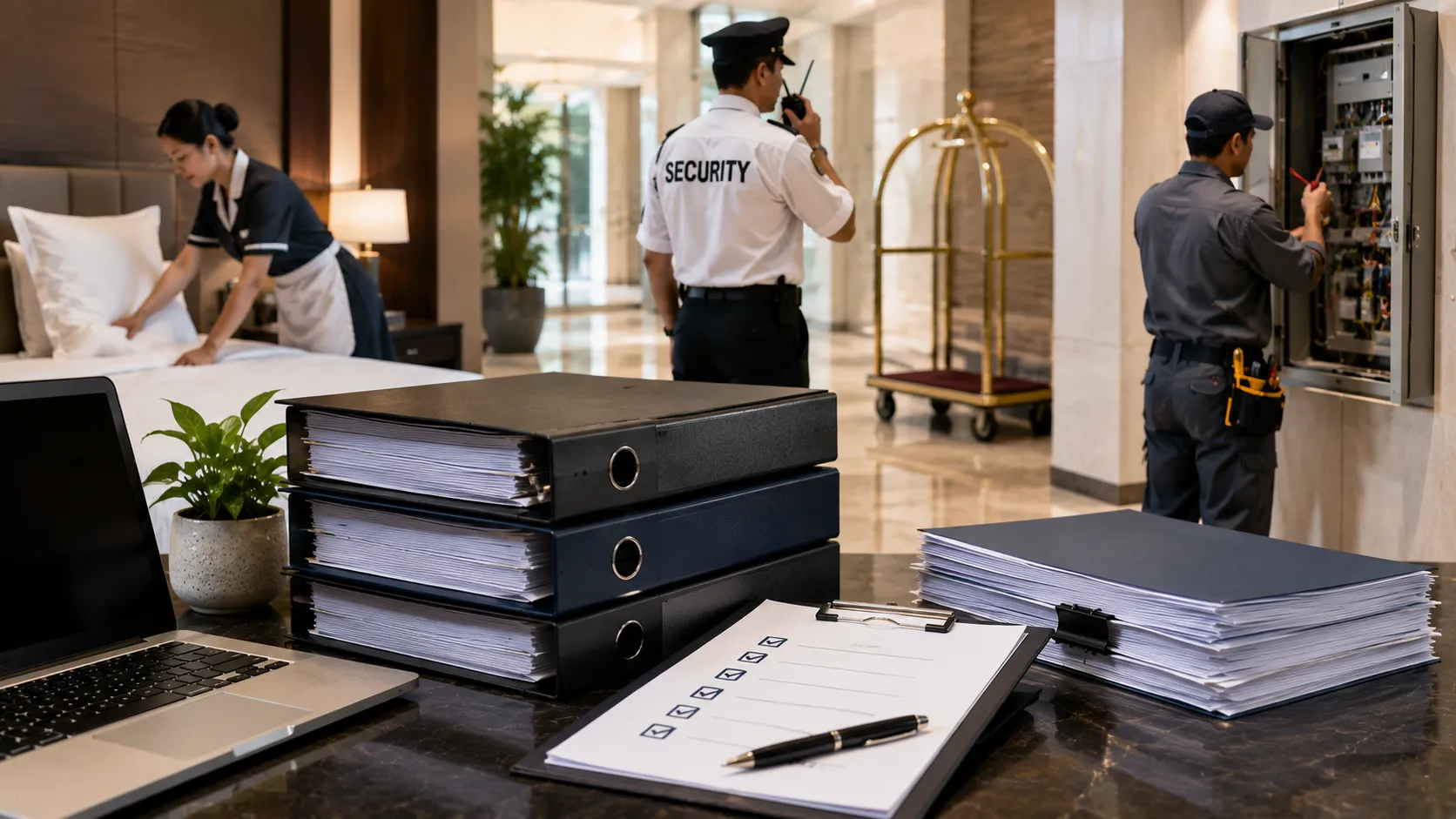
How to Manage Housekeeping, Security and Maintenance Vendor Compliance
Hotels depend on many third-party service providers to keep daily operations running smoothly.
Housekeeping agencies keep rooms and public areas clean. Security agencies protect guests, employees and property. Maintenance contractors keep critical building systems and equipment operational.
These vendors may work on hotel premises every day and can involve significant numbers of outsourced workers.
That means vendor management is not simply about collecting a contract and a few certificates.
Hotels need a structured way to:
- Define vendor requirements
- Collect documents
- Validate submitted documents
- Track worker and contractor records
- Monitor licences and certificates
- Track document expiry dates
- Send renewal reminders
- Review exceptions
- Maintain audit-ready records
This article explains a practical approach to managing compliance for three important hotel vendor categories:
- Housekeeping
- Security
- Maintenance
Important: This article describes a vendor-management approach and is not legal advice. Exact document, licence, worker and contractor requirements depend on the hotel, vendor category, location, contract, workforce and applicable regulations. Hotels should confirm their specific requirements with their legal, compliance, procurement, HR and operations teams.
Why These Three Vendor Categories Need Special Attention
Housekeeping, security and maintenance vendors are different from many ordinary suppliers.
A food supplier may primarily deliver products.
A technology supplier may primarily provide software or support.
But housekeeping, security and maintenance contractors often have workers physically operating inside the hotel.
This can introduce additional operational, safety and contractor-management considerations.
A hotel may therefore need to track:
- Vendor-level documents
- Worker-related records where required
- Licences
- Insurance
- Training records
- Safety documentation
- Contracts
- Periodic service records
- Statutory documents where applicable
- Expiry dates
The key is to avoid using the same checklist for every vendor.
1. Managing Housekeeping Vendor Compliance
Housekeeping is one of the most commonly outsourced hotel services.
A housekeeping agency may provide workers for:
- Guest rooms
- Public areas
- Back-of-house areas
- Laundry
- Deep cleaning
- Event areas
- Other hotel facilities
Because housekeeping workers can be present throughout the hotel, the vendor relationship should have clearly defined documentation and operational requirements.
Housekeeping Vendor Documents
Depending on the hotel’s policy and applicable requirements, a housekeeping vendor may need to provide:
Business Documents
- Business registration information
- PAN
- GSTIN where applicable
- Contact details
- Bank details
- Vendor profile
Contract Documents
- Service agreement
- Scope of work
- Contract start date
- Contract end date
- Service-level requirements
- Renewal information
Insurance Documents
Depending on the contract and risk profile:
- Public liability insurance
- Employee/workmen-related insurance
- Other required insurance coverage
Labour and Statutory Documents
Depending on the arrangement and applicable requirements:
- PF registration
- PF payment records
- ESI registration where applicable
- ESI payment records where applicable
- Labour-related licences
- Wage records
- Attendance records
The exact requirements should be defined by the hotel’s compliance and HR teams.
2. Housekeeping Worker Records
Vendor compliance may also involve worker-level documentation.
Depending on the hotel’s policy and role, this could include:
- Worker identity information
- Training records
- Safety training
- Background verification where required
- Skill records where relevant
- Medical fitness documentation where applicable
- Access authorization
Not every hotel will require every item.
The important thing is to define a clear policy for what the hotel needs from outsourced housekeeping workers.
3. Housekeeping Safety and Training
Housekeeping employees may work with:
- Cleaning chemicals
- Equipment
- Wet floors
- Electrical equipment
- Waste
- Guest-room environments
Hotels may therefore want to track training and safety documentation where required.
Examples include:
- Safety training
- Chemical-handling training
- Equipment training
- Emergency procedures
- PPE-related training
- Incident-related records
These records may not always have traditional expiry dates, but they can still be important for operational compliance.
4. Managing Security Agency Compliance
Security is another critical hotel vendor category.
Security personnel may work at:
- Main entrances
- Guest entrances
- Parking areas
- Back-of-house areas
- Events
- Service entrances
- Other restricted areas
The hotel should define a separate compliance checklist for security agencies.
Security Vendor Documents
Depending on the hotel’s requirements, this can include:
- Business registration information
- PAN/GST
- Applicable security-agency licence/documentation
- Service agreement
- Insurance
- Worker/guard documentation where required
- Training records
- Background verification where required
- Labour/statutory documents
- Other hotel-specific security requirements
The exact licensing and worker requirements should be verified according to the applicable jurisdiction and the hotel’s circumstances.
5. Security Guard Documentation
Hotels may need to maintain information about personnel deployed by the security agency.
Depending on the hotel’s internal policy, this may include:
- Worker name
- Identification information
- Training records
- Background verification
- Security-related training
- Access authorization
- Deployment information
- Other required records
This helps the hotel know who is authorized to work on its premises.
6. Security Training and Operational Records
Security teams may require ongoing training.
Hotels may want to track:
- Emergency response training
- Fire and evacuation awareness
- Access-control procedures
- Incident reporting
- Security procedures
- Other hotel-specific training
The exact training requirements depend on the hotel’s security policy and operational environment.
7. Managing Maintenance Vendor Compliance
Maintenance vendors are another important category because they may work on critical hotel systems.
Examples include contractors responsible for:
- HVAC
- Electrical systems
- Plumbing
- Generators
- Elevators
- Refrigeration
- Kitchen equipment
- Fire-safety systems
- Building systems
A maintenance vendor may require a more technical document checklist than a housekeeping agency.
8. Maintenance Vendor Documents
Depending on the service and applicable requirements, hotels may track:
Vendor Documents
- Business registration
- PAN/GST
- Contact information
- Vendor profile
Contract Documents
- Service agreement
- Scope of work
- SLA
- Contract dates
- Renewal information
Insurance
Depending on the risk:
- Public liability insurance
- Employee/workmen-related insurance
- Equipment insurance
- Other required coverage
Technical Documents
Depending on the service:
- Technician qualifications
- Technical certificates
- Equipment certifications
- Calibration certificates
- Inspection records
- Service records
Safety Documents
Where applicable:
- Safety training
- PPE requirements
- Work permits
- Risk assessments
- Method statements
- Other safety documentation
The hotel’s engineering, facilities and EHS teams should define the exact requirements.
9. Track Maintenance Service Records
Maintenance compliance isn’t always about documents that expire.
Some vendors produce recurring service records.
Examples include:
- HVAC service reports
- Generator maintenance reports
- Equipment inspection reports
- Fire-system service reports
- Elevator maintenance records
- Calibration certificates
- Electrical inspection records
These records should be organized by:
- Vendor
- Equipment
- Location
- Service date
- Next service date
- Report
- Responsible team
This gives the hotel a history of maintenance activities.
10. Separate Expiry Documents From Periodic Records
One common mistake is treating every document as an expiry-based document.
There are at least three useful categories.
Expiry-Based Documents
Examples:
- Insurance policies
- Licences
- Certificates
- Contracts
- Permits
These should have expiry or renewal dates.
Periodic Records
Examples:
- Maintenance reports
- Inspection records
- Service reports
- Training records
These may have a next-review or next-service date rather than an expiry date.
Reference Documents
Examples:
- Vendor profile
- Business registration information
- Historical agreements
These should be retained but may not need automatic expiry reminders.
This distinction makes vendor compliance management much more practical.
11. Contractor Compliance for Hotel Service Vendors
Housekeeping, security and maintenance vendors may provide outsourced workers.
Depending on the arrangement and applicable requirements, hotels may need to monitor contractor-related documentation such as:
- Contractor registration/licence where applicable
- PF records
- ESI records where applicable
- Wage records
- Attendance records
- Worker information
- Insurance
- Labour-related documents
- Safety documentation
EPFO guidance discusses principal-employer responsibilities concerning contractors and verification of statutory PF payments.
Hotels should therefore work with their compliance and HR teams to define the contractor requirements applicable to their specific arrangements.
12. Create Separate Document Checklists
One of the best ways to improve vendor compliance is to create separate checklists.
For example:
Housekeeping Vendor
- Business documents
- GST/PAN
- Service agreement
- Insurance
- Labour-related documents
- PF/ESI documents where applicable
- Worker records where required
- Training records
- Safety documentation
Security Vendor
- Business documents
- GST/PAN
- Applicable security-agency documentation
- Service agreement
- Insurance
- Worker records where required
- Background verification where required
- Training records
- Labour/statutory documents
Maintenance Vendor
- Business documents
- GST/PAN
- Service agreement
- Insurance
- Technical certificates where required
- Technician qualifications where relevant
- Safety documentation
- Service reports
- Inspection records
This is much better than asking all three vendors to submit the same documents.
13. Track Vendor Document Expiry
Once the document requirements are defined, the hotel should track expiry dates.
For example:
| Vendor | Document | Status | Expiry |
|---|---|---|---|
| ABC Housekeeping | Insurance | Valid | 15 Mar 2027 |
| XYZ Security | Licence | Expiring Soon | 02 Sep 2026 |
| Metro Maintenance | Certificate | Expired | 10 Aug 2026 |
| CleanPro Services | PF Document | Missing | — |
This gives the team a clear action list.
14. Automate Vendor Reminders
Manual reminders can become difficult when there are many contractors.
A configurable reminder workflow could look like:
60 Days Before Expiry
        ↓
Reminder

30 Days Before Expiry
        ↓
Follow-Up

15 Days Before Expiry
        ↓
Escalation

Expiry Date
        ↓
Status = Expired
The hotel can decide the appropriate reminder periods for its own process.
Reminders can be sent to:
- Vendor contact
- Procurement owner
- Operations team
- Compliance team
- Facilities team
- Other responsible users
15. Validate Submitted Documents
A vendor may submit a file, but the file may not always be the document that was requested.
For example:
Required:
Insurance Certificate
Uploaded:
Old quotation or unrelated PDF
A document-validation workflow can help identify potential mismatches.
Useful checks include:
- Expected document type
- Vendor name
- Document number
- Licence number
- Issue date
- Expiry date
- Other relevant information
AI-assisted OCR can help extract information from uploaded documents and support these checks.
However, the final decision should remain with the responsible hotel team.
16. Use a Compliance Dashboard
Hotels should be able to see the current status of housekeeping, security and maintenance vendors quickly.
A dashboard might show:
Housekeeping
- Total vendors
- Compliant vendors
- Missing documents
- Expiring documents
- Expired documents
Security
- Total agencies
- Active vendors
- Pending reviews
- Expiring documents
- Expired documents
Maintenance
- Active contractors
- Documents requiring review
- Upcoming expiries
- Expired certificates
- Upcoming service dates
This allows teams to focus on exceptions rather than manually reviewing every vendor.
17. Maintain an Audit Trail
A vendor compliance system should maintain important activity history.
For example:
- Document uploaded
- Document reviewed
- Document approved
- Document rejected
- Expiry date changed
- Reminder sent
- Vendor status changed
- Renewal document uploaded
This can help answer questions such as:
When did the vendor submit the renewed certificate?
Who reviewed the document?
When was the reminder sent?
Which document was rejected?
A Practical Hotel Contractor Compliance Workflow
A simple workflow can look like this:
Vendor Onboarding
       ↓
Vendor Category
       ↓
Required Documents
       ↓
Document Collection
       ↓
AI-Assisted Validation
       ↓
Human Review
       ↓
Approval
       ↓
Expiry / Service Tracking
       ↓
Automated Reminders
       ↓
Renewal
       ↓
Review
This turns vendor compliance into a repeatable process.
Housekeeping, Security and Maintenance: Comparison
| Area | Housekeeping | Security | Maintenance |
|---|---|---|---|
| Vendor Documents | ✓ | ✓ | ✓ |
| GST/PAN | ✓ | ✓ | ✓ |
| Service Agreement | ✓ | ✓ | ✓ |
| Insurance | ✓ | ✓ | ✓ |
| Labour Documents | Often applicable | Often applicable | Depending on arrangement |
| Worker Records | Where required | Where required | Where required |
| Training Records | Important | Important | Important |
| Technical Certificates | Limited | Limited | Often important |
| Service Reports | Sometimes | Sometimes | Very important |
| Expiry Tracking | ✓ | ✓ | ✓ |
| Automated Reminders | ✓ | ✓ | ✓ |
The table is a useful reminder that these vendors share a common compliance workflow but require different document rules.
Best Practices for Managing Hotel Service Vendors
1. Create Vendor Categories
Don’t manage every vendor with the same checklist.
2. Define Mandatory Documents
Clearly identify what must be submitted before approval.
3. Track Worker Requirements Separately
Where workers are deployed on hotel premises, define the worker-level information and documentation required by your policy.
4. Track Expiry Dates
Capture dates for licences, certificates, insurance and contracts where applicable.
5. Track Service Dates
For maintenance and other recurring services, track the next service or inspection date.
6. Automate Reminders
Don’t rely on employees remembering renewal dates.
7. Validate Documents
Check that submitted files appear to match the requested document.
8. Maintain an Audit Trail
Keep a history of submissions, reviews, approvals and reminders.
9. Review Vendor Requirements Regularly
Requirements can change with contracts, operations and applicable regulations.
Quick Compliance Checklist
Housekeeping
- Vendor profile
- GST/PAN
- Service agreement
- Insurance
- Labour-related documents
- PF/ESI where applicable
- Worker records where required
- Training records
- Safety documentation
- Expiry dates
Security
- Vendor profile
- GST/PAN
- Applicable security-agency documentation
- Service agreement
- Insurance
- Worker records where required
- Background verification where required
- Training records
- Labour/statutory documents
- Expiry dates
Maintenance
- Vendor profile
- GST/PAN
- Service agreement
- Insurance
- Technical certificates
- Technician qualifications where relevant
- Safety documentation
- Service reports
- Inspection records
- Next service dates
How VendorCompliancePro Helps Hotels
VendorCompliancePro is designed to help hotels manage vendor and contractor compliance through a centralized workflow:
Collect → Verify → Track → Remind → Report
Hotels can use the platform to:
- Create vendor categories
- Define category-specific document requirements
- Centralize housekeeping, security and maintenance vendor documents
- Validate uploaded documents using AI-assisted validation
- Track document expiry dates
- Track recurring service dates
- Send automated reminders
- Monitor missing and expired documents
- Review submitted documents
- Maintain an audit trail
- Generate vendor compliance reports
Instead of managing separate spreadsheets for housekeeping, security and maintenance vendors, teams can manage the compliance workflow in one place.
Explore VendorCompliancePro for Hotels & Hospitality
Final Thoughts
Housekeeping, security and maintenance vendors play a critical role in hotel operations.
Because these vendors often have workers operating directly on hotel premises, their compliance requirements can be more complex than those of ordinary suppliers.
The best approach is not to create one giant checklist.
Instead:
Categorize the vendor.
Define the required documents.
Track worker and contractor requirements where applicable.
Validate submitted documents.
Track expiry and service dates.
Automate reminders.
Review exceptions.
Maintain an audit trail.
This creates a repeatable process that helps procurement, HR, facilities, operations and compliance teams work from the same information.
As the number of outsourced service providers grows, structured vendor compliance can help hotels reduce manual follow-ups and maintain better visibility into their vendor network.
Frequently Asked Questions
What documents should hotels collect from housekeeping vendors?
Depending on the hotel’s requirements, documents may include business information, GST/PAN, agreements, insurance, labour-related records, PF/ESI records where applicable, worker records, training records and safety documentation.
What documents should hotels collect from security agencies?
Requirements may include business information, applicable security-agency documentation, GST/PAN, agreements, insurance, worker records, training, background verification where required, and labour-related documentation.
What documents should hotels collect from maintenance contractors?
Potential requirements include business documents, GST/PAN, service agreements, insurance, technical certificates, technician qualifications, safety documents, inspection records and service reports.
Should housekeeping, security and maintenance vendors have the same checklist?
No. These vendor categories have different operational and compliance requirements. Hotels should create category-specific document rules.
Should hotels track contractor worker documents?
Where required by the hotel’s policy and applicable arrangements, worker-level records can be important for outsourced service providers operating on hotel premises.
Can AI validate housekeeping, security and maintenance documents?
AI-assisted OCR and document validation can help identify document types, extract important information and highlight potential mismatches. Final compliance decisions should remain with the responsible hotel team.
How can hotels automate vendor compliance reminders?
Hotels can record expiry and renewal dates and configure reminders before documents expire. This reduces the need for manual spreadsheet checks and follow-up.
How should maintenance service records be tracked?
Maintenance records should ideally be associated with the vendor, equipment, location, service date and next service or inspection date. This is different from tracking a document with a traditional expiry date.
Related Articles
Hospitality Vendor Compliance
- Vendor Compliance Checklist for Hotels in India
- How Hotels Can Manage Vendor Documents and Expiry Dates
- Hotel Vendor Compliance: Documents You Should Track
- Vendor Management for Hotels: Excel vs Vendor Compliance Software
Vendor Compliance
- What Is Vendor Compliance?
- Vendor Document Management
- Vendor Audit Readiness Checklist
- Vendor Compliance Software India