Audit Readiness Checker: Free Tool to Check Vendor Compliance and Audit Preparation
Audits become difficult when vendor documents are scattered across emails, spreadsheets, shared folders, and paper files.
Missing documents, expired certificates, incomplete vendor records, and unresolved compliance issues can create unnecessary pressure when an audit is approaching.
An Audit Readiness Checker helps organizations review their current level of preparation and identify areas that may require attention before an audit.
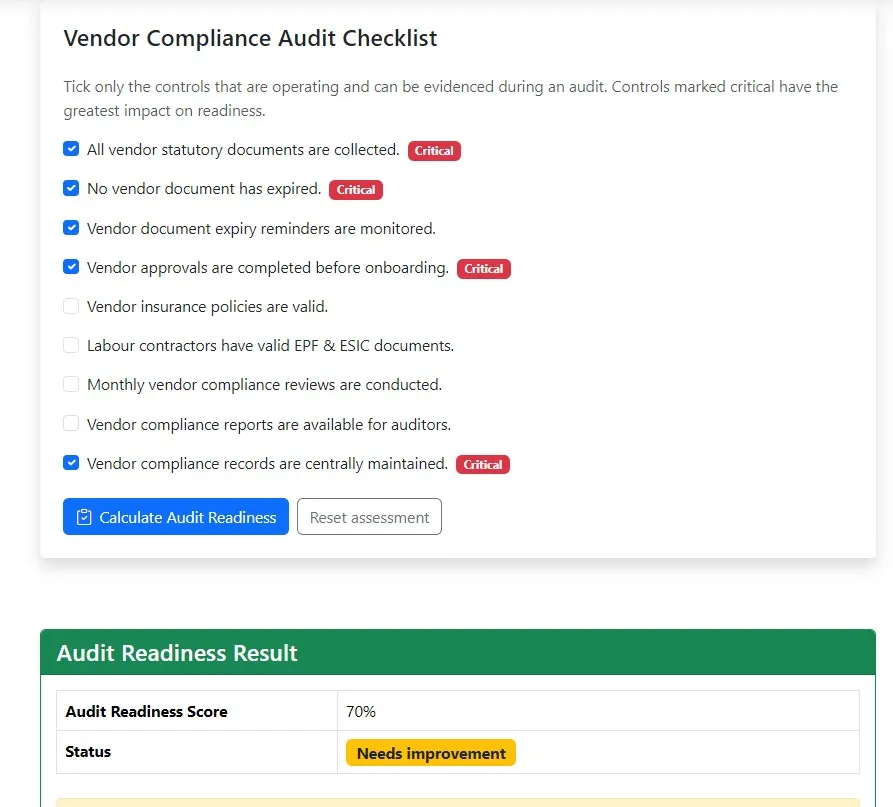
VendorCompliancePro provides a free online Audit Readiness Checker to help procurement, compliance, and vendor management teams perform a practical readiness review.
Use the Free Audit Readiness Checker →
What Is Audit Readiness?
Audit readiness means maintaining the information, documentation, evidence, and processes needed to respond to an audit efficiently.
For vendor and supplier management, audit readiness may involve reviewing:
- Vendor master records
- Required compliance documents
- Document validity
- Approval records
- Audit trails
- Compliance status
- Vendor reviews
- Outstanding issues
The goal is to identify gaps before an auditor requests the evidence.
Why Is Vendor Audit Readiness Important?
Organizations often work with many suppliers, contractors, and service providers.
Each vendor may have different documentation and compliance requirements.
Without regular readiness checks, teams may discover:
- Missing vendor documents
- Expired certificates
- Incomplete records
- Pending approvals
- Unresolved compliance issues
- Difficult-to-find audit evidence
A readiness review helps teams identify these gaps early.
What Is an Audit Readiness Checker?
An Audit Readiness Checker is a checklist-based assessment tool that helps organizations review whether important audit preparation areas have been addressed.
Instead of waiting until an audit date is announced, teams can use a checker periodically to identify areas that need improvement.
The free Audit Readiness Checker from VendorCompliancePro provides a simple starting point for reviewing vendor compliance and audit preparation.
Try the Free Audit Readiness Checker →
What Should You Check Before a Vendor Audit?
A practical vendor audit readiness review can include the following areas.
1. Vendor Master Records
Check whether vendor information is complete and current.
Review:
- Vendor name
- Contact information
- Vendor category
- Business details
- Vendor status
- Relevant registration information
Accurate vendor master data makes audit evidence easier to organize.
2. Required Vendor Documents
Review whether required documents have been collected.
Depending on the vendor, these may include:
- GST Registration Certificate
- PAN Card
- MSME Certificate
- PF registration
- ESIC registration
- Labour licence
- Contractor licence
- Insurance documents
- Quality certifications
- Safety records
Requirements should be customized according to the vendor, industry, contract, and applicable requirements.
3. Document Validity
A document being present does not necessarily mean it is currently valid.
Check:
- Issue dates
- Expiry dates
- Renewal status
- Document scope
- Applicable site or activity
Expired or outdated documents should be identified and addressed before an audit.
4. Missing Documents
Identify vendors with incomplete documentation.
Examples include:
- Missing mandatory documents
- Missing insurance certificates
- Missing statutory records
- Missing quality documentation
- Missing safety records
A clear missing-document list makes follow-up easier.
5. Approval Records
Check whether vendor documents and onboarding activities were properly reviewed and approved.
Where applicable, maintain:
- Submission dates
- Review dates
- Approval dates
- Approved by
- Rejected documents
- Revision history
6. Audit Trails
Audit readiness depends not only on documents but also on evidence of what happened to those documents.
Review whether your system records:
- Upload history
- Approval history
- Document changes
- User activity
- Status changes
A reliable audit trail can make it easier to demonstrate how vendor records were managed.
7. Vendor Compliance Status
Review the current compliance position of each vendor.
Identify:
- Compliant vendors
- Non-compliant vendors
- Vendors with missing documents
- Vendors with expired documents
- Vendors awaiting approval
This gives management a clearer picture of overall vendor readiness.
8. Outstanding Corrective Actions
Check whether previously identified issues have been resolved.
Examples include:
- Missing documents
- Expired certificates
- Failed reviews
- Pending approvals
- Corrective action requests
Open issues should have clear ownership and follow-up.
Vendor Audit Readiness Checklist
A simple readiness checklist can include:
| Area | Check |
|---|---|
| Vendor Master | Vendor information is complete |
| Documents | Required documents are collected |
| Validity | Expiry dates have been reviewed |
| Missing Records | Documentation gaps are identified |
| Approvals | Required approvals are complete |
| Audit Trail | Activities are recorded |
| Compliance | Vendor status is reviewed |
| Corrective Actions | Open issues are tracked |
| Reports | Compliance reports are available |
| Evidence | Audit documents can be retrieved |
This checklist can be adapted to your organization’s audit requirements.
Common Signs That You Are Not Audit Ready
Documents Are Scattered
If vendor records are stored across multiple folders, emails, and spreadsheets, retrieving evidence can take longer.
Expired Documents Are Common
Frequent expired documents may indicate that expiry tracking needs improvement.
Nobody Knows the Current Compliance Status
If teams cannot quickly identify compliant and non-compliant vendors, visibility may be insufficient.
Approvals Are Difficult to Trace
Missing approval history can make it difficult to demonstrate how decisions were made.
Audit Preparation Starts at the Last Minute
If teams begin collecting documents only when an audit is announced, the organization may be reacting rather than maintaining continuous readiness.
Manual Audit Preparation vs Continuous Readiness
| Manual Preparation | Continuous Audit Readiness |
|---|---|
| Start before an audit | Maintain readiness throughout the year |
| Search emails for documents | Centralized records |
| Manually check expiry dates | Ongoing expiry tracking |
| Create reports at the last minute | Regular compliance reporting |
| Follow up manually | Structured workflows |
| Limited visibility | Current compliance status |
The objective is not simply to prepare for one audit. It is to establish a repeatable process that keeps vendor records organized throughout the year.
How to Improve Vendor Audit Readiness
Centralize Vendor Documents
Keep vendor records in a structured repository.
Define Mandatory Requirements
Create vendor-specific document requirements based on industry, service, risk, and contract.
Monitor Expiry Dates
Identify documents approaching expiry before they become compliance gaps.
Conduct Periodic Reviews
Review vendor compliance regularly rather than waiting for an audit.
Maintain Audit Trails
Record uploads, approvals, changes, and user activity.
Track Corrective Actions
Assign ownership to unresolved compliance issues.
Generate Compliance Reports
Use reports to identify gaps and prioritize follow-up.
Audit Readiness for Manufacturing Companies
Manufacturing companies often work with suppliers, contractors, maintenance providers, logistics vendors, and other service providers.
Audit preparation may involve reviewing:
- Supplier documentation
- Contractor compliance
- Safety records
- Insurance
- Quality certifications
- Statutory records
- Vendor approvals
- Document expiry
- Corrective actions
A structured readiness review can help procurement, quality, EHS, and compliance teams identify gaps before an audit.
Audit Readiness for Contractors
Contractors working at company facilities may require additional documentation.
Depending on the work, organizations may review:
- Labour-related documents
- PF and ESIC records where applicable
- Insurance
- Safety training
- EHS induction
- Employee records
- PPE compliance
- Licences
- Site-specific requirements
Requirements should be determined based on the contractor’s actual scope of work and applicable obligations.
How the Free Audit Readiness Checker Helps
The free Audit Readiness Checker provides a practical starting point for reviewing vendor compliance and audit preparation.
You can use it to:
- Review key readiness areas
- Identify potential documentation gaps
- Check whether important records are available
- Think through audit preparation requirements
- Prioritize areas that need attention
Use the Free Audit Readiness Checker →
The checker is a planning and self-assessment tool. It does not replace an audit, legal advice, regulatory interpretation, or your organization’s formal compliance requirements.
Audit Readiness vs Vendor Compliance
These concepts are closely related but different.
| Vendor Compliance | Audit Readiness |
|---|---|
| Focuses on meeting requirements | Focuses on being able to demonstrate readiness |
| Tracks compliance status | Checks evidence and preparation |
| Manages required documents | Ensures records can be retrieved |
| Ongoing compliance activity | Ongoing preparation and evidence management |
| Identifies compliance gaps | Identifies readiness gaps |
Strong vendor compliance processes make audit readiness easier.
How VendorCompliancePro Helps
VendorCompliancePro helps organizations manage vendor compliance and maintain audit-ready records through:
- Vendor self-service portal
- Centralized document repository
- Compliance tracking
- Automated expiry reminders
- Approval workflows
- AI-powered document validation
- Compliance dashboards
- Audit trails
- Reports and analytics
This allows organizations to manage vendor compliance continuously rather than starting from scratch before every audit.
Frequently Asked Questions
What is an Audit Readiness Checker?
An Audit Readiness Checker is a self-assessment tool that helps organizations review important areas of audit preparation and identify potential gaps.
What should be checked before a vendor audit?
Organizations may review vendor master data, required documents, document validity, approvals, audit trails, compliance status, reports, and outstanding corrective actions.
How often should vendor audit readiness be checked?
The frequency depends on vendor volume, risk, industry, and audit requirements. Regular reviews are generally more effective than preparing only when an audit is scheduled.
What documents are commonly reviewed during vendor audits?
Depending on the organization and vendor, records may include GST, PAN, statutory registrations, insurance, licences, quality documents, safety records, contracts, and approval history.
Can Excel be used for audit readiness?
Yes. Excel can support basic tracking, but centralized systems can provide better document visibility, workflows, audit history, and reporting as the vendor base grows.
Does audit readiness mean a company will pass an audit?
No. Audit readiness means the organization has prepared its records and evidence for review. An audit outcome depends on the actual requirements, controls, evidence, and auditor assessment.
Is the Audit Readiness Checker free?
Yes. VendorCompliancePro provides the Audit Readiness Checker as a free online tool.
Conclusion
Audit readiness should not begin a few days before an audit.
Organizations that continuously maintain vendor records, monitor document validity, track compliance gaps, and preserve approval history are better positioned to respond when an audit occurs.
The Audit Readiness Checker provides a simple starting point for reviewing key preparation areas and identifying where additional attention may be needed.
Use the free tool to perform a quick readiness review and then strengthen your vendor compliance process based on your organization’s specific requirements.
Try the Free Audit Readiness Checker →