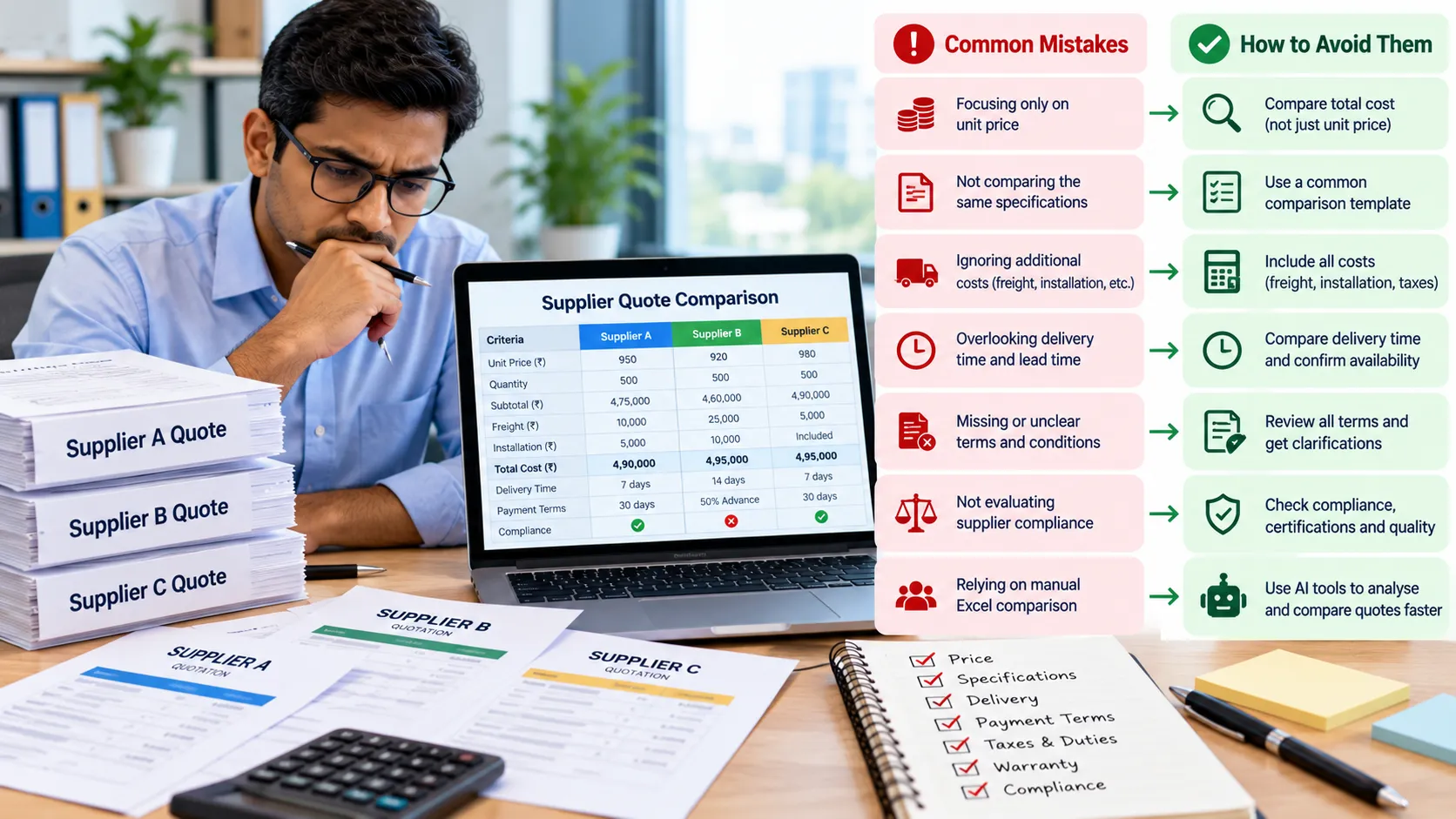
Common Mistakes in Supplier Quote Comparison and How to Avoid Them
Comparing supplier quotations is a routine procurement task, but small oversights can lead to expensive decisions. A quote may look cheaper until freight and installation are added. A supplier may offer an attractive price but fail to meet a required specification. Or a revised quotation may arrive by email while an older figure remains in the comparison sheet.
These problems are not always caused by a complicated process. Often, they happen because the team compares information that is incomplete, inconsistent, or out of date.
A reliable supplier quote comparison process looks beyond the headline price. It checks that suppliers are quoting for the same requirement, calculates comparable costs, records exceptions, and preserves the reasoning behind the decision.
Here are the most common mistakes in supplier quote comparison—and practical ways to avoid them.
1. Comparing unit prices instead of total cost
One of the most common mistakes is choosing the supplier with the lowest unit price without checking the other charges.
A quotation may list transportation, packaging, insurance, installation, testing, or tooling separately. Another supplier may include some of those items in the quoted price. Comparing only the unit price makes the offers look more similar than they really are.
Example
| Cost component | Supplier A | Supplier B |
|---|---|---|
| Goods subtotal | ₹4,75,000 | ₹4,60,000 |
| Transportation | ₹10,000 | ₹25,000 |
| Installation | ₹5,000 | ₹10,000 |
| Total before tax | ₹4,90,000 | ₹4,95,000 |
Illustrative figures only.
Supplier B has the lower goods subtotal, but Supplier A has the lower total before tax in this example.
How to avoid it
- Create a consistent list of relevant cost components.
- Include freight, packaging, installation, and other applicable charges.
- Apply discounts and taxes on a clearly defined, consistent basis.
- Record whether each cost is included, excluded, or still unknown.
- Compare totals using the same quantity, scope, and delivery assumptions.
A blank field should not automatically be treated as a zero-cost item.
2. Comparing quotations with different specifications
Two suppliers can quote different prices because they are offering different products or scopes of work. A cheaper item may use a different material, capacity, grade, size, or performance level.
The same issue appears in service quotations. One supplier may include installation and training, while another quotes only for the core service.
How to avoid it
Prepare a requirement checklist before reviewing prices. Compare the supplier’s offer against the required specifications, quantities, units, scope, and delivery location.
Use clear statuses such as:
- Meets requirement
- Does not meet requirement
- Clarification required
If the offers are not equivalent, resolve the difference before ranking them by price. Do not assume that similar product descriptions mean the same thing.
3. Ignoring freight, installation, and other additional charges
Additional charges are sometimes buried in a separate section of the quotation or included in a note at the end of the document. They can be easy to miss when the buyer is copying only the main price into a spreadsheet.
For equipment and project purchases, installation, commissioning, training, packaging, testing, or travel costs may materially affect the final amount.
How to avoid it
Review the complete quotation, not just the first page or price table. Add separate columns for relevant additional charges and document what each supplier has included.
If a charge is unclear, ask for clarification or mark the comparison as pending. Avoid making assumptions that favour one supplier over another.
4. Treating missing information as zero or as acceptance
A quotation may omit a delivery date, warranty period, tax detail, freight charge, certification, or payment condition. When the comparison sheet contains an empty cell, reviewers may overlook the gap or inadvertently treat it as zero.
Missing information is not the same as a confirmed zero cost or a compliant response.
How to avoid it
- Use a consistent status for missing information.
- Track the clarification question, owner, date, and response.
- Keep unresolved issues visible in the final comparison.
- Apply the procurement rules for clarification and eligibility.
- Do not mark a mandatory requirement as compliant without sufficient evidence.
This simple discipline can prevent an incomplete quote from appearing more attractive than a fully specified offer.
5. Overlooking delivery and lead time
A supplier with a lower price may not be able to deliver when the business needs the goods. A delay can affect production schedules, customer commitments, maintenance work, or project completion.
Delivery terms also need context. “Two weeks” may mean two weeks after the purchase order, after advance payment, or after approval of a drawing.
How to avoid it
Record the stated lead time and the event that starts the clock. Compare the promised delivery date with the actual business requirement. Where delivery is critical, clarify whether the supplier can commit to the required date and what conditions apply.
Do not treat delivery time as a minor note if a delay could create significant operational consequences.
6. Comparing payment terms inconsistently
Two quotations with similar totals can create different cash-flow and commercial risks. One supplier may offer 30-day credit, while another requires a 50% advance payment. Payment milestones, credit periods, and late-payment conditions can affect the attractiveness of an offer.
How to avoid it
Include payment terms in the comparison sheet. Record advance requirements, credit periods, milestone payments, and any relevant conditions. If payment terms are important to the decision, involve the appropriate finance or commercial reviewer rather than relying on price alone.
7. Using outdated or revised quotations
Suppliers sometimes revise prices, delivery dates, quantities, or commercial conditions during the RFQ process. If an earlier value remains in the comparison workbook, the team may make a decision using a quotation that is no longer valid.
How to avoid it
- Record the quotation date and version.
- Keep the original and revised files.
- Mark which version is used for the final comparison.
- Update the comparison sheet when a revision is accepted.
- Check quote validity before final approval.
A simple revision log can prevent confusion when several people are reviewing supplier responses.
8. Copying values manually without checking the source
Manual data entry is vulnerable to mistakes. A decimal point may be misplaced, a quantity may be copied incorrectly, or a line item may be missed. These errors are particularly important in long quotations with many rows.
How to avoid it
Use a consistent data-entry template and verify important values against the original quote. Check quantities, units, currencies, discounts, totals, and additional charges. For high-value purchases, consider an independent review of the calculation.
If your team uses document extraction or AI-assisted tools, verify the extracted values too. Automation can reduce repetitive work, but it does not guarantee that every field has been read correctly.
9. Letting spreadsheet formulas create false confidence
Excel can calculate totals and identify the lowest numeric value, but formulas depend on correct inputs and references. A formula may be overwritten, point to the wrong cells, or compare totals calculated on different assumptions.
A result can look precise and still be wrong.
How to avoid it
- Separate input cells from calculated cells.
- Label assumptions and calculation methods.
- Protect important formulas where appropriate.
- Test formulas with a small sample before using them for a real RFQ.
- Review unusual results and investigate unexpected differences.
- Keep a record of any manual adjustments.
For example, MIN() can identify the lowest number in a range. It cannot determine whether the supplier meets the technical requirement or whether the numbers are genuinely comparable.
10. Selecting the lowest bidder before checking mandatory requirements
The lowest-priced supplier is not necessarily eligible for selection. The offer may fail a mandatory specification, lack required evidence, exclude an essential service, or have unresolved commercial conditions.
The correct evaluation sequence depends on the organization’s procurement policy and the specific RFQ or tender rules.
How to avoid it
Define mandatory requirements and evaluation criteria before bids are reviewed. Apply them consistently and document the result. Where the process requires technical qualification before commercial ranking, complete that stage before comparing eligible commercial offers.
Do not allow an attractive price to silently override a mandatory safety, technical, legal, or compliance requirement.
11. Ignoring the reason behind the final decision
A comparison table may show the prices but not explain why a supplier was selected. If the decision is later reviewed, the team may struggle to reconstruct which exceptions were accepted, which clarifications were received, or how the totals were calculated.
How to avoid it
Keep a decision record that includes:
- The quotations and versions reviewed
- The evaluation criteria used
- The cost calculation basis
- Technical and commercial exceptions
- Clarifications and their resolutions
- The recommendation and required approvals
The amount of documentation should suit the purchase’s value, complexity, and risk, while following your organization’s record-retention requirements.
12. Using the same process for every RFQ
A simple purchase with two consistent quotations does not need the same level of review as a complex RFQ with many suppliers, dozens of line items, technical requirements, and contractual exceptions.
Using an overly complicated process for every purchase can waste time. Using a minimal spreadsheet for a complex purchase can leave important risks unchecked.
How to avoid it
Match the process to the purchase. Consider value, complexity, business criticality, technical risk, number of suppliers, and the quality of the quotations. Use a proportionate checklist for simple purchases and a more structured review for complex or high-risk sourcing.
A practical supplier quote comparison checklist
Before recommending a supplier, review the following checklist.
- All suppliers have quoted for the same requirement and quantity.
- Units, specifications, scope, and delivery location are comparable.
- Unit prices and extended amounts have been checked.
- Freight, installation, packaging, and other relevant charges are included.
- Discounts, taxes, and currency assumptions are consistent.
- Delivery lead time and the conditions attached to it are recorded.
- Payment, warranty, and quote-validity terms are reviewed.
- Missing information and exceptions are clearly marked.
- Revised quotations are tracked and the correct version is used.
- Calculations and extracted values have been verified.
- Mandatory requirements and the applicable evaluation rules have been followed.
- The recommendation and approval trail are documented.
This checklist can be adapted to your organization’s purchasing policy and the type of goods or services being sourced.
Can AI help prevent supplier quote comparison mistakes?
AI-assisted tools may help reduce some repetitive tasks involved in reviewing quotations. Depending on the tool and supported file formats, they may extract fields from supplier documents, organize data into a comparison view, and highlight missing or different values for review.
That can be useful when quotations arrive as a mix of spreadsheets and PDFs, or when buyers repeatedly copy the same types of information into a comparison sheet.
However, AI should not be treated as a guarantee of accuracy. It may misread a scanned document, miss a note, or fail to understand whether two technical descriptions are equivalent. Buyers should verify important values against the source quotations and review technical and commercial exceptions before making a decision.
Explore RFQ Quote Compare AI
If your team spends considerable time preparing supplier quote comparisons, explore RFQ Quote Compare AI.
The page introduces our RFQ quote comparison MVP. Review its current capabilities and check whether it supports your documents and process. Before using any tool with sensitive or high-value procurement information, confirm file support, output accuracy, data-handling arrangements, and the review steps your team will retain.
The aim is to reduce repetitive comparison work while keeping the procurement team in control of verification and supplier selection.
Frequently asked questions
What is the most common mistake in supplier quote comparison?
Comparing unit prices without checking total relevant costs is a common mistake. Freight, installation, packaging, taxes, discounts, and other conditions can change which offer is most economical.
How do I compare supplier quotations fairly?
Start with the same requirement, quantity, specifications, and delivery assumptions. Calculate comparable costs consistently, check commercial terms, record missing information, and apply the stated evaluation criteria.
Should I always choose the lowest supplier quote?
No. The lowest price may come with technical non-compliance, extra charges, unsuitable delivery terms, or unresolved conditions. Follow the procurement rules and evaluate the complete offer.
What should a supplier quote comparison spreadsheet include?
Useful fields include supplier name, item description, quantity, unit, unit price, discounts, additional charges, comparable total cost, delivery, payment terms, warranty, specification status, quotation date, and notes about exceptions.
Can AI compare supplier quotations accurately?
AI may help extract and organize information from supported documents, but accuracy depends on document quality and the tool’s capabilities. Verify extracted values, cost calculations, and exceptions against the original quotations.
How often should a supplier comparison sheet be updated?
Update it whenever a quotation is revised, a clarification changes an offer, or an assumption used in the calculation changes. Keep track of the quotation version used for the final recommendation.
Final thoughts
Supplier quote comparison is more than finding the lowest price. A dependable process checks that the offers are comparable, includes relevant costs, verifies requirements, records exceptions, and uses the correct quotation versions.
Most mistakes can be reduced with a clear template, consistent evaluation rules, and a final review checklist. When manual extraction and comparison work becomes a recurring bottleneck, an AI-assisted workflow may be worth testing—but source verification and accountable human judgment remain essential.
To explore an AI-assisted approach, visit RFQ Quote Compare AI.